
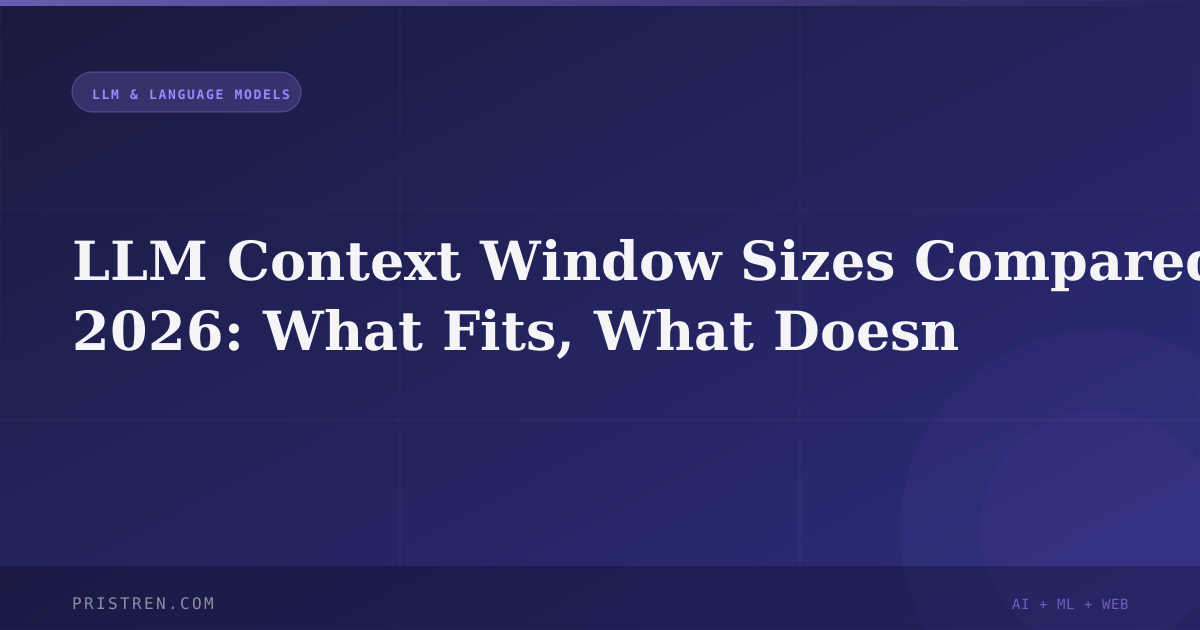
Context window size determines how much text a model can process in a single request. Gemini 1.5 Pro leads with 1 million tokens. Claude 3.5 Sonnet supports 200k tokens. GPT-4o, Llama 3.3, and Mistral Large support 128k tokens. Bigger is not always better - models perform less accurately on information buried in the middle of very long contexts. The right choice depends on your actual context requirements and quality needs.
What Context Window Size Means Practically
A context window is the total amount of text (measured in tokens, roughly 0.75 words per token) that a model can process simultaneously in a single request. This includes your system prompt, conversation history, any documents you have loaded into the prompt, and the model's response.
When your input exceeds the context window, you cannot send it in a single request. You must either:
- Truncate the content (lose some information)
- Chunk the content and process it in multiple requests (lose cross-chunk coherence)
- Summarize earlier content to compress it
Larger context windows eliminate these trade-offs for most real-world document sizes.
Current Context Window Sizes (May 2026)
| Model | Provider | Context Window | Approximate Word Count |
|---|---|---|---|
| Gemini 1.5 Pro | 1,000,000 tokens | ~750,000 words | |
| Gemini 1.0 Ultra | 1,000,000 tokens | ~750,000 words | |
| Claude 3.5 Sonnet | Anthropic | 200,000 tokens | ~150,000 words |
| Claude 3 Opus | Anthropic | 200,000 tokens | ~150,000 words |
| GPT-4o | OpenAI | 128,000 tokens | ~90,000 words |
| o1 | OpenAI | 128,000 tokens | ~90,000 words |
| Llama 3.3 70B | Meta | 128,000 tokens | ~90,000 words |
| Mistral Large | Mistral | 128,000 tokens | ~90,000 words |
| GPT-4o-mini | OpenAI | 128,000 tokens | ~90,000 words |
| Claude 3 Haiku | Anthropic | 200,000 tokens | ~150,000 words |
What Fits in Each Context Size
Understanding what these numbers mean in terms of real content helps with model selection.
128,000 Tokens (~90,000 words)
- An entire novel (average novel is 70,000-100,000 words, fits partially or fully depending on length)
- 300-400 pages of a textbook
- 90,000 lines of code (for reference: a large web application might be 50,000-200,000 lines)
- Several hours of meeting transcripts
- A complete legal contract with appendices
- All customer support tickets from a medium-size company for one month
128k is large enough for most document analysis tasks. The limitation shows up when processing large codebases, comparing multiple long documents simultaneously, or maintaining very long research sessions.
200,000 Tokens (~150,000 words)
- A full trilogy of novels in a single context
- A large textbook in its entirety
- Multiple complete research papers simultaneously
- A company's complete documentation for a product
- A large codebase (small to medium projects fit entirely)
- 500+ page annual reports with all footnotes
Claude's 200k window is meaningfully larger than GPT-4o's 128k. For tasks that are right at the edge of 128k, Claude often processes without chunking while GPT-4o requires splitting.
1,000,000 Tokens (~750,000 words)
- An entire large codebase (even substantial open-source projects)
- Years of email archives
- Complete works of an author
- A company's entire document repository for a product line
- Multiple books on a subject simultaneously
Gemini 1.5 Pro's 1M token context is a qualitative difference from the 128k-200k range. It enables use cases that are not possible at smaller context sizes: loading an entire codebase for refactoring, processing years of data at once, or analyzing a complete document corpus for a research question.
The Lost-in-the-Middle Problem
Larger context windows are not a simple upgrade. Research has consistently found that LLMs perform worse at retrieving and reasoning about information in the middle of long contexts compared to information at the beginning and end.
This "lost in the middle" effect was documented in a 2023 paper and has been reproduced across multiple models. The effect is significant: accuracy on questions requiring information from the middle of a long context can drop by 20-40% compared to questions about information at the beginning or end.
The implication: a model with a 200k context window does not reliably use all 200k tokens equally. If the critical information for your task is buried in the middle of a long document, the model may miss it or weight it less than information at the edges of the context.
This problem is more pronounced in models that are not specifically trained for long-context tasks. Models with explicit long-context training (some Gemini models, some Claude versions) show smaller lost-in-the-middle effects.
Practical Implications for Different Use Cases
Document Q&A
If you are asking questions about a single document, putting the document in the context and asking questions at the end (after the document) takes advantage of the "recency" effect - the model weights recent context more heavily. For critical information that is in the middle of a long document, consider restating or quoting it in your question.
Code Analysis
For codebase analysis, the lost-in-the-middle effect means that code in the middle of a long file or in the middle of a large context dump may receive less accurate analysis than code at the boundaries. For precise analysis of a specific function, include that function directly in the prompt near the end rather than hoping the model finds it in a large context.
Multi-Document Analysis
When comparing multiple documents, the arrangement matters. The most recently included document will be weighted most. Critical comparison points should be close to the end of the context or explicitly restated in the question.
Long Conversation Maintenance
In long conversations, earlier turns may be underweighted as the conversation grows. For important constraints or context established early in a conversation, restating them periodically helps maintain them throughout a long session.
RAG as an Alternative to Large Contexts
Retrieval augmented generation (RAG) is an alternative to loading everything into a large context. Instead of putting 100,000 tokens of documentation into the context, you index the documentation in a vector database and retrieve only the most relevant sections for each query.
RAG avoids the lost-in-the-middle problem because you are always putting the most relevant content directly in front of the model, typically near the end of the context. It also reduces token costs significantly (fewer input tokens per query) and can scale to corpora larger than any context window.
The limitation of RAG: it requires the information to be retrievable. If your task requires reasoning across many sections simultaneously - "what are all the ways this codebase handles authentication?" - RAG may miss connections between disparate sections. Large context windows handle this case better.
The practical recommendation: use RAG when the relevant information is localizable (a specific question has a specific answer in a known section). Use large context windows when the task requires holistic reasoning across the entire corpus.
Pricing and Context Window Trade-offs
Larger context windows cost more per request because you are sending more input tokens. If you routinely use 150,000 tokens of context, GPT-4o (128k limit) forces chunking, but Gemini 1.5 Pro handles it in one call.
However, Gemini 1.5 Pro charges for all million tokens of context window space you use. A query using 500,000 tokens will be priced accordingly. At GPT-4o prices, you would not pay for tokens you do not use.
Choose context window size based on your actual typical context size, not the maximum possible. If your typical prompt is 30,000 tokens, the difference between 128k and 1M context window models is irrelevant to your cost and quality - both handle your use case equally.
Keep Reading
- LLM Knowledge Cutoff Guide - using current information alongside large contexts
- LLM Comparison Guide 2026 - full feature and performance comparison
- Cutting LLM API Costs - managing token costs when using large contexts
Pristren builds AI-powered software for teams. Zlyqor is our all-in-one workspace - chat, projects, time tracking, AI meeting summaries, and invoicing - in one tool. Try it free.


Comments
Have a question or something to add? Sign in to join the discussion.