Machine Learning: Complete Guide for Software Developers
Learn machine learning as a software developer with this complete guide covering Python, algorithms, mathematics, projects, deep learning, and a practical roadmap.
You already know how to build software. You can design an API, set up database schemas, debug an asynchronous race condition, configure CI/CD pipelines, and ship features that real users pay for.
Then you decide to look into Machine Learning.
Within twenty minutes, you find yourself drowning in multivariate calculus, eigenvalues, stochastic gradient proofs, and academic papers from 2017. The tutorials tell you to start by calculating loss functions by hand in Python. You end up closing the tab, wondering if you need a four-year applied mathematics degree just to classify support tickets.
You don't.
Machine learning is not an alternate reality reserved for PhD researchers. For a software engineer, machine learning is simply software written by optimization algorithms rather than human fingers.
This guide is written from the perspective of an engineer who builds and ships systems. It covers how to shift your mental model from deterministic code to probabilistic systems, what math you actually need (and what you can ignore), the exact stack to master, and how to put a model behind a reliable production API.
The Mental Shift: Deterministic Code vs. Probabilistic Systems
One AI engineering post, weekly
LLM benchmarks, prompt techniques, and token-cost breakdowns — not another AI news roundup.
As developers, we are conditioned to think deterministically:
Traditional Software:
Input (JSON payload) + Handcrafted Logic (if/else, switch, business rules) ➔ Deterministic Output
If you pass the same input through your function ten million times, you expect the exact same output ten million times. If it returns something else, you open your debugger and look for a bug.
Machine learning flips the paradigm:
Machine Learning System:
Historical Data + Expected Outcomes + Training Loop ➔ Model Artifact (Weights/Parameters)
New Input ➔ Model Artifact ➔ Probabilistic Estimate (Confidence Score)
In an ML-driven service:
You write the harness, not the logic. The weights inside your model represent business logic extracted automatically from patterns in historical data.
There is no 100% correct answer. Your model will never say "this user will unconditionally churn tomorrow." It will say "given their activity drop and past cohort behavior, there is an 84.2% probability of churn."
Failures are silent. In traditional software, a syntax error or a null pointer throws an exception. In ML, a model fed with garbled, unnormalized input will silently return an inference. It won't crash your server; it will just make confident, incorrect decisions in production.
Once you realize that an ML model is essentially an auto-generated function that returns a probability distribution, the intimidation factor disappears.
What Math Do You Actually Need? (The Honest Truth)
Academia insists on teaching machine learning bottom-up: Linear Algebra ➔ Vector Calculus ➔ Probability Theory ➔ Convex Optimization ➔ Toy Algorithms.
Engineers learn top-down: Build a working pipeline ➔ Observe failures ➔ Learn the underlying mechanics to fix them.
Here is the exact level of mathematics required to build, evaluate, and debug production systems:
Writing matrix inversion or manual SVD proofs by hand.
Statistics
Mean, median, standard deviation, percentiles, skew, normal distribution, and p-values.
Calculating complex statistical distributions from raw formulas.
Calculus
The intuition of derivatives: a gradient simply indicates the direction and magnitude to tweak parameters to reduce error.
Hand-deriving backpropagation through multi-head cross-attention.
Probability
Conditional probability, Bayes' intuition, precision, recall, and ROC-AUC curves.
Theoretical measure theory and deep stochastic calculus.
The Pragmatic Rule: Learn enough theory so you aren't treating the model as magical black magic. You need to know why changing a learning rate causes divergence, or why scaling features prevents a single feature with large numbers from dominating gradient steps. Everything else can be learned just-in-time.
Team workspace
Ship faster with chat, meetings, and projects in one place — Zlyqor.
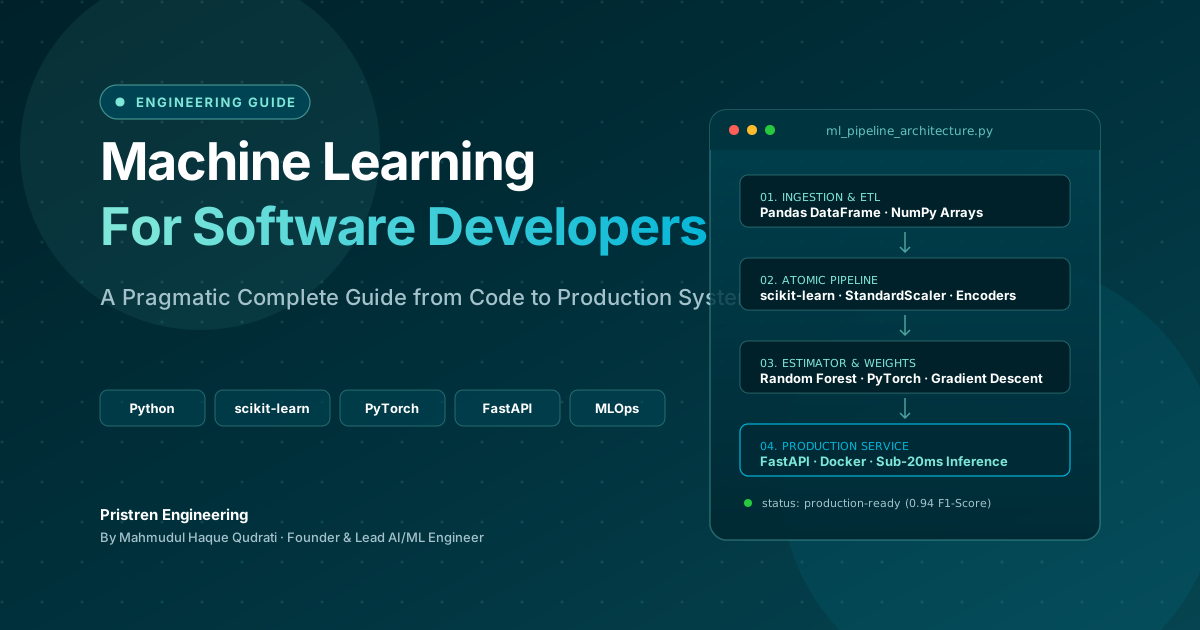
Python 3.11+: The universal runtime of modern machine learning.
NumPy: Vectorized mathematics. When executing operations across NumPy arrays, underlying C/BLAS routines execute SIMD instructions across contiguous memory buffers without Python interpreter overhead.
Pandas / Polars: Relational data manipulation. If you know SQL SELECT, JOIN, GROUP BY, and WHERE, Pandas is just in-memory tabular manipulation with a DataFrame syntax.
scikit-learn: The premier library for tabular data, linear models, random forests, feature scaling, and evaluation metrics.
PyTorch: The industry standard for neural networks, embeddings, and deep learning architectures.
FastAPI & Docker: How you turn a trained model into a hardened, high-throughput microservice.
The 6-Stage Machine Learning Workflow
Treat machine learning as an iterative engineering pipeline, not a one-time notebook script.
1. Problem Formulation & Baseline Validation
Before writing a single line of training code, answer this: Can this problem be solved with deterministic logic or a database query?(For a full validation framework, check our five-question ML project scoping guide).
If an if/else rule solves 90% of the problem with zero maintenance overhead, write the if/else.
If the relationship between inputs and outputs is fuzzy, noisy, or human-subjective (e.g., text sentiment, fraudulent transaction patterns, customer churn likelihood), use machine learning.
2. Feature Extraction & Data Hygiene
Your model is only as good as the features it learns from. Garbage in, garbage out:
Handling Nulls: Don't drop missing rows blindly. An empty billing zip code might be the strongest signal of a fraudulent account.
Categorical Encoding: Convert text categories into vectors using One-Hot Encoding (for low cardinality like US states) or Target/Frequency Encoding (for high cardinality like zip codes).
Feature Scaling: Algorithms like Logistic Regression and Support Vector Machines rely on distance calculations. Normalize your numbers so an income of $150,000 doesn't dwarf an age of 32.
3. Preventing Data Leakage (The #1 Beginner Trap)
Data leakage occurs when information from the future or from the test set leaks into the training pipeline.
The Classic Mistake: Normalizing your entire dataset before splitting it into train and test. The mean and standard deviation of the test set are now baked into your training weights!
The Engineering Fix: Fit preprocessors only on training data, then apply .transform() to testing and production payloads. Always use scikit-learn's Pipeline object to enforce this separation cleanly.
4. Training a Fast Baseline
Always start with the simplest possible model:
For regression: Linear Regression or a Decision Tree.
For classification: Logistic Regression or a small Random Forest.
A baseline gives you an anchor. If your complex 12-layer deep neural network achieves 88% accuracy, but a basic Logistic Regression achieves 87.5% with 2ms latency, the neural network should not go to production.
5. Metric Selection: When Accuracy Lies
Never measure a classification model on accuracy alone.
Suppose you process 10,000 credit card payments a day, and 50 are fraudulent (0.5% fraud rate). A dumb function that simply returns return "NOT_FRAUD" for every single request will achieve 99.5% accuracy. It is also a catastrophic business failure.
Instead, monitor:
Precision: When the model flags fraud, how often is it actually fraud? (Minimizes false alarms and angry legitimate customers).
Recall: Out of all real fraud cases, what percentage did the model catch? (Minimizes financial loss).
F1-Score / PR-AUC: The harmonic balance between precision and recall.
6. Packaging & Deployment
Your team doesn't need a Jupyter Notebook (.ipynb). They need a versioned artifact running in a container with health checks, latency monitoring, and structured logging.
From Python Script to Production Service
Here is a concrete, end-to-end example showing how an engineer moves from raw data to a production-ready inference endpoint using Python and FastAPI.
Phase 1: Train, Evaluate & Serialize (train.py)
import joblib
import pandas as pd
from sklearn.model_selection import train_test_split
from sklearn.pipeline import Pipeline
from sklearn.preprocessing import StandardScaler
from sklearn.ensemble import RandomForestClassifier
from sklearn.metrics import classification_report

# 1. Load data
data = pd.DataFrame({
    'account_age_days': [12, 450, 32, 900, 5, 600, 15, 1200],
    'failed_logins_last_hour': [4, 0, 3, 0, 5, 0, 2, 0],
    'payment_amount': [1200.50, 15.00, 890.00, 42.50, 2500.00, 19.99, 450.00, 120.00],
    'is_fraud': [1, 0, 1, 0, 1, 0, 1, 0]
})

X = data.drop('is_fraud', axis=1)
y = data['is_fraud']

# 2. Train/Test Split (Never evaluate on training data)
X_train, X_test, y_train, y_test = train_test_split(
    X, y, test_size=0.25, random_state=42, stratify=y
)

# 3. Encapsulate Preprocessing and Estimator in an Atomic Pipeline
pipeline = Pipeline([
    ('scaler', StandardScaler()),
    ('classifier', RandomForestClassifier(n_estimators=50, max_depth=4, random_state=42))
])

# 4. Fit on Train Only
pipeline.fit(X_train, y_train)

# 5. Evaluate
predictions = pipeline.predict(X_test)
print(classification_report(y_test, predictions, zero_division=0))

# 6. Serialize as an immutable artifact with metadata
artifact = {
    "version": "1.0.0",
    "features": list(X.columns),
    "model": pipeline
}
joblib.dump(artifact, "fraud_detector_v1.joblib")
print("Model artifact successfully serialized.")
Phase 2: High-Performance Serving API (app.py)
import joblib
import pandas as pd
from fastapi import FastAPI, HTTPException
from pydantic import BaseModel, Field

app = FastAPI(
    title="Fraud Detection Inference Service",
    description="Production-grade inference API using scikit-learn artifact",
    version="1.0.0"
)

# Load artifact into memory on server startup (not per request!)
artifact = joblib.load("fraud_detector_v1.joblib")
model = artifact["model"]
EXPECTED_FEATURES = artifact["features"]

class TransactionPayload(BaseModel):
    account_age_days: int = Field(..., ge=0, description="Age of account in days")
    failed_logins_last_hour: int = Field(..., ge=0, description="Failed login attempts in past 60 min")
    payment_amount: float = Field(..., gt=0, description="Total amount in USD")

class InferenceResponse(BaseModel):
    is_fraud: bool
    risk_score: float
    model_version: str

@app.post("/v1/predict", response_model=InferenceResponse)
async def predict_fraud(transaction: TransactionPayload):
    try:
        # Convert Pydantic payload directly to DataFrame matching trained feature names
        input_data = pd.DataFrame([transaction.model_dump()])[EXPECTED_FEATURES]

        # Get raw probability output [P(clean), P(fraud)]
        probabilities = model.predict_proba(input_data)[0]
        fraud_probability = float(probabilities[1])

        # Business decision rule: flag if probability exceeds 65%
        is_flagged = fraud_probability >= 0.65

        return InferenceResponse(
            is_fraud=is_flagged,
            risk_score=round(fraud_probability, 4),
            model_version=artifact["version"]
        )
    except Exception as e:
        raise HTTPException(status_code=500, detail=f"Inference execution failed: {str(e)}")

@app.get("/healthz")
def health_check():
    return {"status": "healthy", "model_version": artifact["version"]}
Production Gotchas That Tutorials Never Mention
When taking an ML model from a local environment into production, watch out for these real-world pitfalls:
Feature Drift & Model Staleness: Code doesn't rot, but data does. If your user base shifts or macro-economic conditions change, the relationships your model learned three months ago may no longer apply. Set up automated jobs to measure prediction distribution shifts over time.
Cold Start & Latency Budgets: Heavy models like transformer networks can take hundreds of milliseconds to compute inference on a CPU. If your web app needs sub-50ms responses, run inferences asynchronously via background workers (e.g., Celery, Redis Streams, or RabbitMQ) or export your model to ONNX Runtime for optimized C++ execution.
Memory Footprint (OOM Crashes): Python data frames duplicate memory during complex merges. When deploying inside Kubernetes or a container with memory limits, monitor RSS memory usage. If memory spikes, your container will be killed by an OOM (Out Of Memory) event without logging an informative Python traceback.
Fallback Mechanisms: Always build a fallback circuit breaker. If the ML inference engine throws an exception or times out, your API should gracefully degrade to a sensible default or heuristic rather than failing customer requests with a 500 error.
Machine Learning Roadmap for Developers
Here is a realistic, phased timeline for full-stack and backend engineers:
Phase 1: Core Data Fundamentals (Weeks 1 - 2)
└── Master NumPy array vectorization, Pandas grouping, filtering, and data cleaning.

Phase 2: Applied Classical Machine Learning (Weeks 3 - 4)
└── Train Regression & Classification models using scikit-learn. Master cross-validation, precision/recall trade-offs, and Pipelines.

Phase 3: Inference Engineering & Deployment (Weeks 5 - 6)
└── Wrap models in FastAPI endpoints. Package inside minimal Docker containers. Handle serialization with joblib or ONNX.

Phase 4: Deep Learning & Neural Architectures (Weeks 7 - 8)
└── PyTorch fundamentals: Tensors, autograd, layers, and transfer learning with pre-trained models from Hugging Face.

Phase 5: Production MLOps & Monitoring (Weeks 9+)
└── Implement model monitoring, automated evaluation pipelines, drift detection, and experiment tracking with MLflow or Weights & Biases.
Machine Learning Projects for Software Developers
Don't build generic toy examples. Build projects that demonstrate end-to-end systems architecture:
Deliverable: A developer search tool that allows natural language queries across Git commit messages or documentation.
Frequently Asked Questions
Do I need a GPU to learn machine learning?
No. For classical machine learning (tabular data, linear models, random forests, gradient boosting), a modern multi-core CPU is more than sufficient. You only need GPUs when training medium-to-large deep learning models, fine-tuning LLMs, or running heavy computer vision pipelines. Even then, cloud options like Google Colab or modal GPU instances provide on-demand access for a few cents an hour.
What is the difference between scikit-learn and PyTorch?
scikit-learn is designed for classical, statistical machine learning algorithms (linear regression, decision trees, random forests, clustering, dimensionality reduction) on structured tabular data. PyTorch is an extensible deep learning framework optimized for neural networks, backpropagation, and tensor math executing on GPUs, ideal for computer vision, audio, natural language processing, and LLMs.
Should I fine-tune a model or just call an LLM API?
If your task involves general text analysis, summarization, or interactive chat, calling a modern LLM API (like Claude or GPT) via structured outputs or tool use is almost always faster, cheaper to set up, and easier to maintain. You should only train or fine-tune your own model when you have proprietary tabular data, strict data residency requirements, microsecond latency constraints, or need to run inference offline at the edge.
How do I prevent machine learning models from crashing my production backend?
Isolate the machine learning inference into a dedicated microservice running behind an internal load balancer. Never run heavy CPU/GPU model computation inside your primary web application process. Always enforce strict request timeouts, serialize inputs through validation schemas (like Pydantic), and implement a deterministic fallback rule if the inference service is unreachable.
Summary: Start Building Today
The greatest advantage you have over someone coming into machine learning from pure math or statistics is that you already know how to build real products.
You know how to write tests, structure codebases, manage environments, handle network errors, and build UI interfaces that make technology usable. Machine learning is simply a powerful new component in your architecture.
Pick a real problem in your application today. Gather a clean CSV. Train a simple scikit-learn model. Put it behind an endpoint. Ship it.
That is how you become a true machine learning engineer.
Frequently Asked Questions
Do software developers need a mathematics degree to learn machine learning?
No. You need foundational intuition in linear algebra (vectors and matrix dimensions), basic statistics (mean, variance, percentiles), and basic calculus (gradients as directional tweaks). You do not need to derive backpropagation proofs by hand to build and deploy high-performing models.
What is the recommended machine learning roadmap for developers?
Start with Python and tabular data manipulation (NumPy and Pandas), master classical ML baselines with scikit-learn pipelines, learn model deployment and serving with FastAPI and Docker, and then advance to deep learning with PyTorch and production MLOps.
Should developers use scikit-learn or PyTorch first?
Start with scikit-learn. It provides the cleanest environment to understand data preprocessing, train/test splitting, cross-validation, and metrics on tabular datasets. Move to PyTorch when you need neural architectures for computer vision, NLP, or custom embeddings.
What is the best machine learning project for software developers to build first?
Build an end-to-end classification or regression service: for example, an automated fraud detection API or customer churn predictor wrapped in a FastAPI endpoint with Pydantic payload validation and Docker containerization.
Visionary technologist, software engineer, and machine learning specialist. Founder and CEO of Pristren, directing engineering teams that ship production-grade AI/ML pipelines, mission-critical full-stack applications, and developer tooling. Creator of Zlyqor, the unified team workspace platform. Author of 540+ technical guides and benchmark research reports on large language models, agentic workflows, Model Context Protocol (MCP), and modern web stacks.





// discussion
Comments