BGE-M3 is a single model that outputs dense vectors, sparse term weights, and ColBERT token vectors simultaneously. It supports 100+ languages and 8192 tokens, enabling hybrid search without separate models.
BGE-M3: The Embedding Model That Does Dense, Sparse, and Multi-Vector Retrieval
BGE-M3 from BAAI unifies three retrieval paradigms in one model - dense vectors, sparse keyword matching, and ColBERT multi-vector scoring - across 100+ languages with 8192 token support.

Mahmudul Haque Qudrati
CEO & ML Engineer
March 13, 2026
4 min read
One AI engineering post, weekly
LLM benchmarks, prompt techniques, and token-cost breakdowns — not another AI news roundup.
Most embedding models produce a single dense vector per text. BGE-M3 produces three types of representations simultaneously, each useful for different retrieval scenarios:
- Dense retrieval: Single 1024-dimension vector, standard cosine similarity, fast ANN search
- Sparse retrieval: Weighted term importance scores (like BM25 but learned), exact keyword matching advantage
- Multi-vector (ColBERT): Token-level embeddings for late interaction scoring, highest accuracy but more compute
The BGE-M3 paper shows that combining all three (hybrid search) outperforms any single mode on BEIR benchmark by 2-5 points on nDCG@10.
MTEB Benchmark Performance
On the Massive Text Embedding Benchmark (MTEB), BGE-M3 dense retrieval scores competitively with OpenAI's text-embedding-3-large on English tasks, while significantly outperforming it on multilingual tasks. The 100+ language support includes Chinese, Japanese, Korean, Arabic, and European languages with strong performance.
The HuggingFace model page includes detailed benchmark tables per language and task type.
Team workspace
Ship faster with chat, meetings, and projects in one place — Zlyqor.
FlagEmbedding Python Library
The FlagEmbedding GitHub repository provides optimized inference:
python
from FlagEmbedding import BGEM3FlagModel

model = BGEM3FlagModel(
    "BAAI/bge-m3",
    use_fp16=True  # Half precision for faster inference
)

sentences = [
    "What is machine learning?",
    "ML is a subset of AI that learns from data.",
    "How do neural networks work?",
]

# Dense embeddings
dense_embeddings = model.encode(
    sentences,
    batch_size=12,
    max_length=8192,
)["dense_vecs"]

# All three modes simultaneously
all_embeddings = model.encode(
    sentences,
    return_dense=True,
    return_sparse=True,
    return_colbert_vecs=True,
)

print(f"Dense shape: {all_embeddings['dense_vecs'].shape}")
print(f"Sparse keys example: {list(all_embeddings['lexical_weights'][0].keys())[:5]}")
Hybrid Search Combination Strategy
For production RAG, combine dense and sparse scores with a weighted sum:
python
def hybrid_score(dense_score: float, sparse_score: float, alpha: float = 0.5) -> float:
    """
    alpha=1.0: pure dense (semantic)
    alpha=0.0: pure sparse (keyword)
    alpha=0.5: balanced hybrid
    """
    return alpha * dense_score + (1 - alpha) * sparse_score
Set alpha higher (0.7-0.8) for semantic queries, lower (0.2-0.3) for keyword-heavy queries like product searches or code lookups.
8192 Token Input Window
The 8192 token limit is a significant practical advantage over models capped at 512 or 2048 tokens. You can embed entire documents without chunking - a research paper abstract plus full introduction, a complete API documentation page, a lengthy product description.
Comparison to OpenAI text-embedding-3-large
| Metric | BGE-M3 (dense) | text-embedding-3-large |
|---|---|---|
| Dimensions | 1024 | 3072 (reducible) |
| Max tokens | 8192 | 8191 |
| Languages | 100+ | ~50 effective |
| Cost | Free (self-hosted) | $0.13/1M tokens |
| Hybrid search | Built-in | External BM25 needed |
For teams running >100M tokens/month, self-hosting BGE-M3 on a single GPU instance pays back infrastructure cost within weeks.
What is BGE-M3?
BGE-M3 is a multilingual embedding model developed by BAAI (Beijing Academy of Artificial Intelligence) that supports three retrieval modes: dense, sparse, and multi-vector (ColBERT). It handles 100+ languages and up to 8192 tokens per input. The model is open-source and free to self-host.
How Does BGE-M3 Work?
BGE-M3 uses a unified encoder that outputs three representations simultaneously:
- A dense vector (1024 dimensions) for semantic similarity
- Lexical weights for sparse retrieval (like BM25 but learned)
- Token-level vectors for ColBERT-style late interaction
During training, it uses a hybrid loss combining contrastive learning for dense, knowledge distillation for sparse, and a multi-vector loss for ColBERT. This allows a single model to excel at all three paradigms.
Best Practices for BGE-M3
- Use hybrid search with alpha tuning (0.5 default, adjust based on query type)
- For multilingual documents, BGE-M3 outperforms separate monolingual models
- Leverage 8192 token window to embed full documents without chunking
- Use FP16 inference for 2x speedup with minimal accuracy loss
- For production, batch encode queries and documents separately
Cost of BGE-M3
BGE-M3 is free and open-source (MIT license). You can download it from HuggingFace and run it on your own infrastructure. A single GPU (e.g., NVIDIA T4 or better) can handle production workloads. Estimated cost: $0.00 per 1M tokens (self-hosted) vs $0.13 for OpenAI's text-embedding-3-large.
Is BGE-M3 Worth It in 2026?
Yes. BGE-M3 remains competitive in 2025-2026 due to its unique multi-mode capability, extensive language support, and long context window. While newer models may offer marginal improvements, BGE-M3's hybrid search and open-source nature make it a cost-effective choice for production RAG systems. It's especially valuable for multilingual applications and scenarios requiring both semantic and keyword matching.
Keep Reading
- How to Choose the Right Embedding Model for RAG
- Multilingual RAG: Challenges and Solutions
- Hybrid Search: Combining Dense and Sparse Retrieval
Try BGE-M3 with Zlyqor's managed infrastructure. Sign up at app.zlyqor.com for a free trial.
Frequently Asked Questions
What is BGE-M3 embeddings?
BGE-M3 is a multilingual embedding model from BAAI that outputs dense vectors, sparse term weights, and ColBERT token vectors simultaneously. It supports 100+ languages and up to 8192 tokens per input, enabling hybrid search without separate models.
How does BGE-M3 embeddings work?
BGE-M3 uses a unified encoder that produces three representations: a 1024-dim dense vector for semantic similarity, lexical weights for sparse keyword matching, and token-level vectors for ColBERT late interaction. Training uses a hybrid loss combining contrastive learning, knowledge distillation, and multi-vector loss.
What are the best practices for BGE-M3 embeddings?
Use hybrid search with alpha tuning (0.5 default, adjust based on query type). For multilingual documents, BGE-M3 outperforms separate monolingual models. Leverage the 8192 token window to embed full documents without chunking. Use FP16 inference for 2x speedup. Batch encode queries and documents separately in production.
How much does BGE-M3 embeddings cost?
BGE-M3 is free and open-source (MIT license). Self-hosted cost is $0.00 per 1M tokens (hardware cost only). Compare to OpenAI text-embedding-3-large at $0.13 per 1M tokens. A single GPU like NVIDIA T4 can handle production workloads.
Is BGE-M3 embeddings worth it in 2026?
Yes. BGE-M3 remains competitive in 2026 due to its unique multi-mode capability, 100+ language support, and 8192 token context. It is cost-effective for production RAG, especially for multilingual applications and hybrid search requiring both semantic and keyword matching.
What languages does BGE-M3 support?
BGE-M3 supports 100+ languages including Chinese, Japanese, Korean, Arabic, and European languages. It significantly outperforms OpenAI's text-embedding-3-large on multilingual tasks while being competitive on English.
How does BGE-M3 compare to OpenAI embeddings?
BGE-M3 dense (1024 dim) is competitive with text-embedding-3-large (3072 dim) on English, better on multilingual. BGE-M3 has built-in hybrid search, 8192 tokens, and is free to self-host. OpenAI costs $0.13/1M tokens and requires external BM25 for hybrid search.
#bge-m3#embeddings#multilingual#rag#baai
Mahmudul Haque Qudrati
CEO & ML Engineer
Visionary technologist, software engineer, and machine learning specialist. Founder and CEO of Pristren, directing engineering teams that ship production-grade AI/ML pipelines, mission-critical full-stack applications, and developer tooling. Creator of Zlyqor, the unified team workspace platform. Author of 540+ technical guides and benchmark research reports on large language models, agentic workflows, Model Context Protocol (MCP), and modern web stacks.


More from Mahmudul
Related Articles
 11 min read
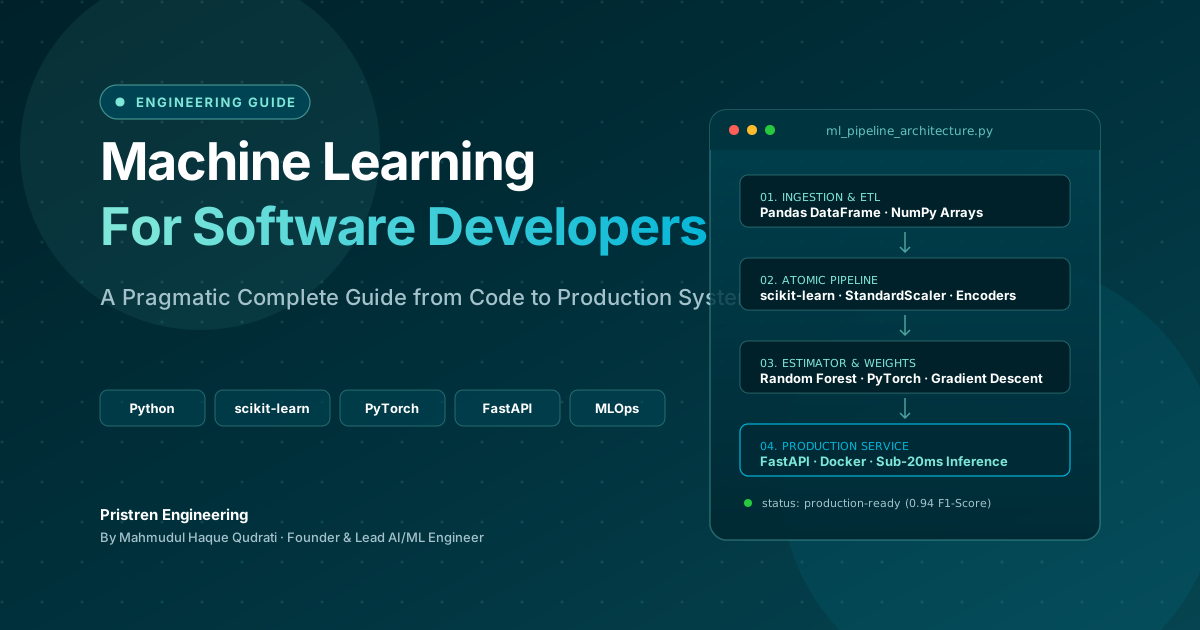
Machine Learning: Complete Guide for Software Developers
Learn machine learning as a software developer with this complete guide covering Python, algorithms, mathematics, projects, deep learning, and a practical roadmap.
 9 min read
When to Fine-Tune an LLM (And When to Rely on RAG Instead)
Fine-tuning updates model weights, while RAG inserts context. Learn how to combine these strategies or choose the right one for your data.
 7 min read
ONNX: Export Any ML Model and Run It Anywhere
ONNX (Open Neural Network Exchange) is the universal model format - export from PyTorch, scikit-learn, or HuggingFace and run 3x faster inference with ONNX Runtime on CPU or GPU.
// discussion
Comments