CLIP: Using OpenAI's Contrastive Model for Zero-Shot Image Classification
CLIP learns joint image-text embeddings from 400 million pairs, enabling zero-shot classification on any category you can describe in words - no labeled training data required.

Mahmudul Haque Qudrati
CEO & ML Engineer
May 9, 2026
7 min read
One AI engineering post, weekly
LLM benchmarks, prompt techniques, and token-cost breakdowns — not another AI news roundup.
CLIP (Contrastive Language-Image Pre-training) was trained on 400 million image-text pairs from the internet. Rather than predicting explicit labels, it learns to match images to their correct text descriptions using a contrastive loss: correct pairs are pulled together in embedding space, while incorrect pairs are pushed apart.
The resulting representations are universal: any image concept you can describe in English can be used as a classification target, even if CLIP never saw a labeled example during training.
Zero-Shot Classification
python
from PIL import Image
import torch
import open_clip

model, _, preprocess = open_clip.create_model_and_transforms("ViT-L-14", pretrained="openai")
tokenizer = open_clip.get_tokenizer("ViT-L-14")
model.eval()

image = preprocess(Image.open("product.jpg")).unsqueeze(0)
candidate_labels = [
    "a photo of a running shoe",
    "a photo of a dress shirt",
    "a photo of a laptop bag",
    "a photo of a wristwatch",
]

text_tokens = tokenizer(candidate_labels)

with torch.no_grad():
    image_features = model.encode_image(image)
    text_features = model.encode_text(text_tokens)

    image_features /= image_features.norm(dim=-1, keepdim=True)
    text_features /= text_features.norm(dim=-1, keepdim=True)

    similarity = (100.0 * image_features @ text_features.T).softmax(dim=-1)

for label, score in zip(candidate_labels, similarity[0]):
    print(f"{label}: {score.item():.2%}")
Team workspace
Ship faster with chat, meetings, and projects in one place — Zlyqor.
ImageNet Zero-Shot Results
CLIP ViT-L/14 achieves 76.2% top-1 accuracy on ImageNet zero-shot - meaning it was never shown ImageNet labels during training. This matched ResNet-101 trained specifically on ImageNet, demonstrating that natural language supervision at scale can match specialist supervised training.
Semantic Image Search
CLIP embeddings enable semantic image search without manual tagging:
python
import numpy as np

# Precompute and store image embeddings for your catalog
def embed_images(image_paths, model, preprocess):
    embeddings = []
    for path in image_paths:
        img = preprocess(Image.open(path)).unsqueeze(0)
        with torch.no_grad():
            emb = model.encode_image(img)
            emb /= emb.norm(dim=-1, keepdim=True)
        embeddings.append(emb.numpy())
    return np.vstack(embeddings)

# Query with natural language
def search(query_text, image_embeddings, model, tokenizer, top_k=5):
    tokens = tokenizer([query_text])
    with torch.no_grad():
        text_emb = model.encode_text(tokens)
        text_emb /= text_emb.norm(dim=-1, keepdim=True)
    scores = image_embeddings @ text_emb.numpy().T
    return np.argsort(scores.squeeze())[::-1][:top_k]
CLIP vs ALIGN vs SigLIP
CLIP (OpenAI): softmax-normalized contrastive loss, 400M pairs, ViT backbones up to ViT-L/14. ALIGN (Google): similar approach but trained on 1.8B noisier pairs - scales better to noisy data. SigLIP (Google): sigmoid loss instead of softmax - does not require the full batch normalization that CLIP needs, enabling larger effective batch sizes and better few-shot performance.
For new projects, SigLIP typically outperforms CLIP at equivalent model sizes. For existing integrations, CLIP's mature ecosystem (OpenCLIP, FAISS indexes, Pinecone native support) provides practical advantages.
Use Cases
Content moderation (embed images, flag semantic similarity to known violating content), product catalog tagging (classify thousands of images into taxonomy nodes without labeled data), e-commerce recommendation (find visually and semantically similar products), and accessibility (generate searchable alt text from image embeddings).
Links
#clip#openai#zero-shot#image-classification#contrastive-learning
Mahmudul Haque Qudrati
CEO & ML Engineer
Visionary technologist, software engineer, and machine learning specialist. Founder and CEO of Pristren, directing engineering teams that ship production-grade AI/ML pipelines, mission-critical full-stack applications, and developer tooling. Creator of Zlyqor, the unified team workspace platform. Author of 540+ technical guides and benchmark research reports on large language models, agentic workflows, Model Context Protocol (MCP), and modern web stacks.

More from Mahmudul
Related Articles
 11 min read
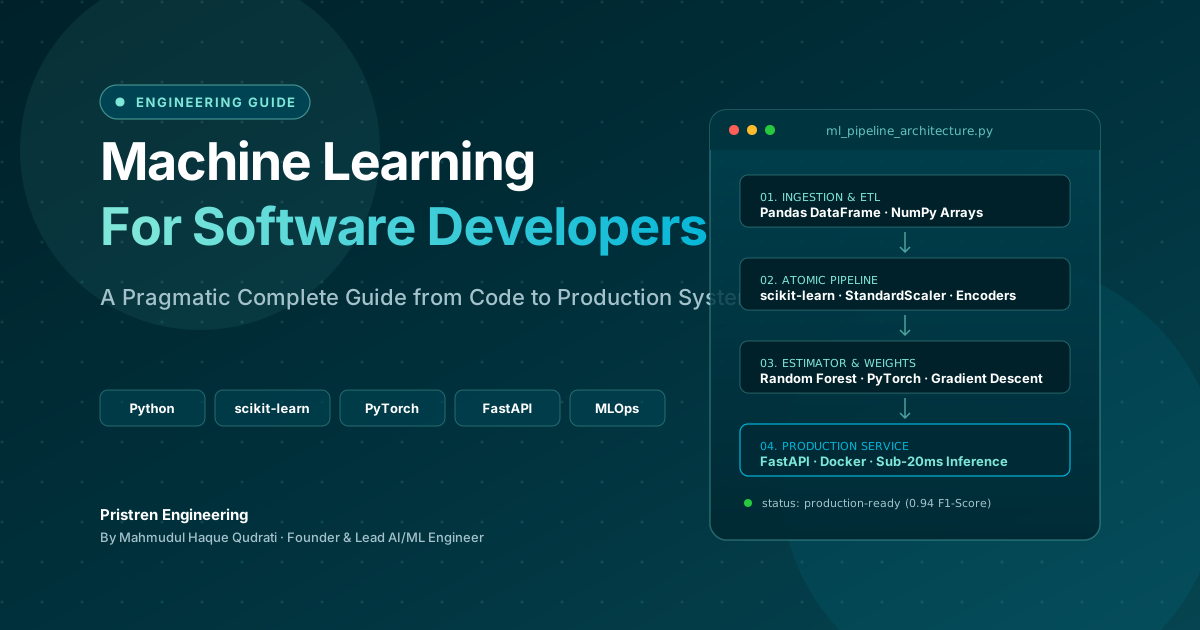
Machine Learning: Complete Guide for Software Developers
Learn machine learning as a software developer with this complete guide covering Python, algorithms, mathematics, projects, deep learning, and a practical roadmap.
 8 min read
GPT-6 Astra AGI: How to Actually Use It and Get Its Best Performance
GPT-6 Astra is OpenAI's most capable model, but 'AGI' is a marketing claim. This guide shows you how to access, use, and get the best from it with practical endpoints, pricing, and agent patterns.
 5 min read
GPT-6 Astra Benchmarks, Pricing, and Safety: What Developers Need to Know
OpenAI's GPT-6 Astra delivers state-of-the-art coding and agentic performance, but costs 50% more than GPT-4o. This guide covers benchmarks, pricing, safety, and practical advice for developers deciding whether to upgrade.
// discussion
Comments