Cross-validation is the standard technique for estimating how well a trained model will perform on new, unseen data. It addresses a fundamental problem: a single train/test split can give you a very misleading estimate of true model performance, depending on which examples happen to land in your test set. Cross-validation reduces this variance by averaging performance across multiple different splits.
Cross-Validation: Reliably Estimating Model Performance on Unseen Data
A single train/test split gives you a noisy estimate of real performance. Cross-validation gives you a reliable one. Here is every variant, when to use each, and the mistakes to avoid.

Mahmudul Haque Qudrati
CEO & ML Engineer
May 18, 2026
6 min read
Contents
- Why a Single Train/Test Split Is Unreliable
- K-Fold Cross-Validation: The Standard Approach
- Stratified K-Fold: Maintaining Class Balance
- Leave-One-Out Cross-Validation
- Time Series Cross-Validation: The Most Misunderstood Case
- Nested Cross-Validation: Unbiased Hyperparameter Tuning
- Common Mistakes
- Keep Reading
One AI engineering post, weekly
LLM benchmarks, prompt techniques, and token-cost breakdowns — not another AI news roundup.
Suppose you have 1,000 labeled examples. You split them 80/20: 800 training, 200 test. Your model achieves 87% accuracy on the test set.
Is 87% a reliable estimate? Not necessarily. If you had split the data differently -- say, the first 800 examples for training and the last 200 for test -- you might get 83% or 91%, depending on which examples ended up in the test set. With only 200 test examples, accuracy estimates have high variance.
The 95% confidence interval for a proportion estimate of 87% on 200 examples is roughly 82% to 92%. That is a 10-percentage-point range around a single number that feels precise. Cross-validation collapses this uncertainty by averaging across multiple test sets.
K-Fold Cross-Validation: The Standard Approach
K-fold CV divides your data into K equally-sized folds. The process:
- Split data into K folds (K = 5 or K = 10 are the most common choices)
- For each fold i from 1 to K:
- Train on all folds except fold i
- Evaluate on fold i
- Average the K evaluation scores
The result: every example has been used exactly once as a test example, and K times as a training example. The final performance estimate uses all your data for evaluation.
from sklearn.model_selection import cross_val_score
from sklearn.ensemble import RandomForestClassifier

model = RandomForestClassifier(n_estimators=100)
scores = cross_val_score(model, X, y, cv=5, scoring="accuracy")

print(f"Accuracy: {scores.mean():.3f} +/- {scores.std():.3f}")
# Accuracy: 0.871 +/- 0.023
The standard deviation across folds is as informative as the mean. A high standard deviation (+/- 0.10) suggests high variance across splits, which might indicate insufficient data or a model that is sensitive to which examples it sees.
Choosing K:
- K = 5: Lower computational cost, slightly higher variance in the estimate. Good default for large datasets or slow models.
- K = 10: Slightly lower bias, slightly higher variance, more computation. Common in academic evaluation.
- K = 5 is usually the right default. K = 10 adds computation without a meaningful improvement in most real cases.
Team workspace
Ship faster with chat, meetings, and projects in one place — Zlyqor.
Stratified K-Fold: Maintaining Class Balance
Standard K-fold splits data randomly without regard for class distribution. On an imbalanced dataset (say, 95% class A, 5% class B), you might get a fold where class B is severely underrepresented or absent entirely.
Stratified K-fold maintains the class distribution in each fold proportional to the overall distribution. This ensures each fold is a representative sample of the full dataset.
from sklearn.model_selection import StratifiedKFold

skf = StratifiedKFold(n_splits=5, shuffle=True, random_state=42)
for train_idx, val_idx in skf.split(X, y):
    X_train, X_val = X[train_idx], X[val_idx]
    y_train, y_val = y[train_idx], y[val_idx]
    # train and evaluate...
Always use stratified K-fold for classification tasks. For regression, standard K-fold is fine (there are no discrete classes to balance).
Leave-One-Out Cross-Validation
LOOCV is K-fold where K = N (the number of examples). You train N models, each leaving out exactly one example and testing on that example.
Advantages:
- Maximum use of training data (N-1 examples per fold)
- Minimal bias in the estimate (each model sees almost all the data)
- No randomness (deterministic, unlike K-fold with shuffling)
Disadvantages:
- Extremely expensive: you train N models instead of K models
- High variance across "folds": each test set is one example, so each evaluation is maximally noisy
- The N test scores are highly correlated (the N models are nearly identical)
LOOCV is most appropriate for very small datasets (fewer than 50-100 examples) where you cannot afford to hold out 20% of your data as a test set. For anything larger, K-fold is preferred.
from sklearn.model_selection import LeaveOneOut

loo = LeaveOneOut()
scores = cross_val_score(model, X, y, cv=loo)
print(f"LOOCV Accuracy: {scores.mean():.3f}")
Time Series Cross-Validation: The Most Misunderstood Case
For time series data, standard K-fold is wrong. It will test the model on data from before the training period, which simulates a scenario that cannot exist in production (predicting the past using the future).
The correct approach: always train on past data and evaluate on future data.
Expanding window CV: The training set grows with each fold. Fold 1: train on months 1-6, test on month 7. Fold 2: train on months 1-7, test on month 8. And so on. This is the most realistic simulation of how you would retrain over time.
Sliding window CV: Keep the training window fixed. Fold 1: train on months 1-6, test on month 7. Fold 2: train on months 2-7, test on month 8. This is appropriate when you expect data distribution to shift over time (older data becomes less relevant).
from sklearn.model_selection import TimeSeriesSplit

tscv = TimeSeriesSplit(n_splits=5)
for train_idx, val_idx in tscv.split(X):
    X_train, X_val = X[train_idx], X[val_idx]
    # train and evaluate in temporal order...
Gap: In some forecasting scenarios, you should add a gap between training and validation to account for the fact that very recent data might not be available in production (due to data pipeline delays). TimeSeriesSplit supports a gap parameter.
Nested Cross-Validation: Unbiased Hyperparameter Tuning
This is the most important technique most practitioners do not use.
If you use cross-validation to select hyperparameters AND to report model performance, you get an optimistically biased performance estimate. The reason: you searched over many hyperparameter configurations and picked the best one -- so the reported performance reflects the best outcome of your search, which will not generalize to new data.
Nested CV uses two loops:
- Outer loop: K-fold splits for unbiased performance estimation
- Inner loop: K-fold splits within each training fold for hyperparameter tuning
from sklearn.model_selection import GridSearchCV, cross_val_score

inner_cv = StratifiedKFold(n_splits=3)
outer_cv = StratifiedKFold(n_splits=5)

param_grid = {"max_depth": [3, 5, 7], "n_estimators": [50, 100, 200]}
clf = GridSearchCV(RandomForestClassifier(), param_grid, cv=inner_cv)

nested_scores = cross_val_score(clf, X, y, cv=outer_cv)
print(f"Nested CV accuracy: {nested_scores.mean():.3f}")
Nested CV gives you a nearly unbiased estimate of what your model selection procedure will achieve on new data. It is expensive (K_outer x K_inner x number_of_configs models trained), but it is the statistically correct approach.
Common Mistakes
Leaking preprocessing into CV: Fit your scaler, imputer, or feature selector INSIDE each fold (on training data only), then apply to validation data. Never fit on the full dataset before splitting. Scikit-learn Pipelines handle this correctly when used with cross_val_score.
from sklearn.pipeline import Pipeline
from sklearn.preprocessing import StandardScaler

pipeline = Pipeline([("scaler", StandardScaler()), ("clf", RandomForestClassifier())])
# Scaler is fit inside each fold automatically
scores = cross_val_score(pipeline, X, y, cv=5)
Reporting test set performance after multiple rounds of tuning: Each time you look at the test set and adjust your model, you are using it for training. Hold out a final test set and evaluate on it exactly once.
Using CV for very large datasets unnecessarily: For 1M+ examples, a single train/validation/test split gives reliable estimates. Five-fold CV on 1M examples is 5x the compute with diminishing statistical returns. Use CV when N is small (under ~10,000).
Keep Reading
- Hyperparameter Tuning Guide -- nested CV is the right way to tune and evaluate simultaneously
- ML Model Evaluation Metrics Guide -- what to measure during each CV fold
- Ensemble Methods Guide -- stacking uses held-out fold predictions as training data for the meta-model
Pristren builds AI-powered software for teams. Zlyqor is our all-in-one workspace -- chat, projects, time tracking, AI meeting summaries, and invoicing -- in one tool. Try it free.
Frequently Asked Questions
What is cross-validation and why is it important for model performance estimation?
Cross-validation is a resampling method that splits your data into multiple training and test sets to evaluate model performance more reliably than a single train/test split. It reduces variance in performance estimates by averaging results across different splits, giving you a more accurate picture of how your model will perform on unseen data.
How does k-fold cross-validation work?
K-fold cross-validation divides your data into K equal-sized folds. For each fold, you train the model on the remaining K-1 folds and evaluate on the held-out fold. After repeating this K times, you average the K evaluation scores. Common choices for K are 5 or 10.
What are the best practices for cross-validation?
Always use stratified k-fold for classification to maintain class balance. Fit preprocessing steps (scaling, imputation) inside each fold to avoid data leakage. Use nested cross-validation when tuning hyperparameters to get unbiased performance estimates. For time series, use temporal cross-validation (expanding or sliding window).
How much does cross-validation cost in terms of computation?
Cross-validation is computationally expensive because it requires training K models instead of one. For example, 5-fold CV trains 5 models, which is roughly 5x the cost of a single train/test split. For very large datasets (over 1 million examples), a single split may be sufficient. For small datasets, LOOCV trains N models, which can be prohibitive.
Is cross-validation worth it in 2025?
Yes, cross-validation remains essential for reliable model evaluation, especially for small to medium datasets (under 10,000 examples). It helps avoid over-optimistic performance estimates and is critical for hyperparameter tuning. For large datasets, a single split may suffice, but cross-validation still provides more robust estimates when computational resources allow.
What is the difference between k-fold and stratified k-fold?
Standard k-fold splits data randomly, which can lead to folds with imbalanced class distributions. Stratified k-fold ensures each fold has the same proportion of classes as the full dataset. Always use stratified k-fold for classification, especially with imbalanced data.
How do I implement time series cross-validation?
Use scikit-learn's TimeSeriesSplit, which creates train/test splits that respect temporal order: training data always comes before test data. Choose expanding window (training set grows) or sliding window (fixed-size training set) based on whether older data remains relevant.
#cross-validation#model-evaluation#k-fold#time-series#overfitting
Mahmudul Haque Qudrati
CEO & ML Engineer
Visionary technologist, software engineer, and machine learning specialist. Founder and CEO of Pristren, directing engineering teams that ship production-grade AI/ML pipelines, mission-critical full-stack applications, and developer tooling. Creator of Zlyqor, the unified team workspace platform. Author of 540+ technical guides and benchmark research reports on large language models, agentic workflows, Model Context Protocol (MCP), and modern web stacks.

More from Mahmudul
Related Articles
 11 min read
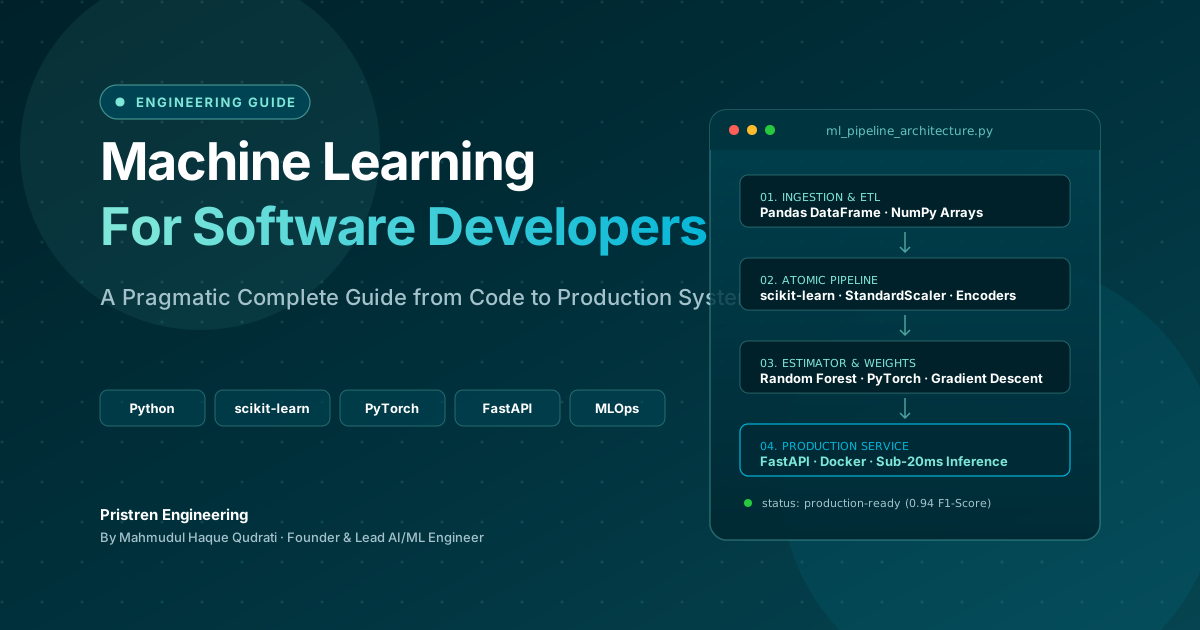
Machine Learning: Complete Guide for Software Developers
Learn machine learning as a software developer with this complete guide covering Python, algorithms, mathematics, projects, deep learning, and a practical roadmap.
 7 min read
ONNX: Export Any ML Model and Run It Anywhere
ONNX (Open Neural Network Exchange) is the universal model format - export from PyTorch, scikit-learn, or HuggingFace and run 3x faster inference with ONNX Runtime on CPU or GPU.
 9 min read
Gradient Descent Explained: How Machine Learning Models Actually Learn
Gradient descent is the engine behind every modern ML model. Here is how it works, why learning rate matters, and when to use Adam over SGD.
// discussion
Comments