Machine learning moves fast, and keeping up with research papers is a challenge even for full-time practitioners. This guide covers the papers that have most shaped the field — from the foundational works everyone references to the recent technical reports that define the current state of the art. It also covers how to read papers efficiently so you can extract value without spending hours on each one.
ML Research Papers Every Practitioner Should Know in 2026
From Attention Is All You Need to DeepSeek V3 — these are the papers that shaped modern ML. How to read them efficiently and what each one actually contributed.

Mahmudul Haque Qudrati
CEO & ML Engineer
May 18, 2026
7 min read
One AI engineering post, weekly
LLM benchmarks, prompt techniques, and token-cost breakdowns — not another AI news roundup.
Before the list, the method. Most developers spend too much time on papers and extract too little value. The efficient approach:
- Abstract + introduction (2 minutes): What problem does this paper solve? What is the core claim? Is this relevant to you?
- Conclusion (1 minute): What did they find? What are the limitations they acknowledge?
- Figures and tables (5 minutes): The results tables and architecture diagrams are often the most information-dense part. Read the figure captions carefully.
- Methods (10-20 minutes, if you need implementation details): How does it work? This is where the technical depth lives. Skip if you only need the what, not the how.
- Related work (skip or skim): Useful for finding adjacent papers. Not essential for understanding the contribution.
With this approach, you can get the essential value from most papers in 15-30 minutes.
Foundational Papers: The Essential Reading List
Attention Is All You Need (Vaswani et al., 2017)
The paper that introduced the transformer architecture. Before transformers, sequence models were RNNs and LSTMs, which processed sequences sequentially and had difficulty with long-range dependencies.
The transformer replaced recurrence with self-attention: every position in the sequence attends to every other position simultaneously. This enabled full parallelization during training and substantially improved performance on translation benchmarks.
What makes this paper essential: every significant NLP model since 2018 — BERT, GPT, T5, LLaMA, Claude — is built on the transformer architecture introduced here. Understanding self-attention, multi-head attention, positional encoding, and the encoder-decoder structure gives you the conceptual foundation for everything that follows.
Key figure: Figure 1, the encoder-decoder architecture diagram. Spend time understanding exactly what flows where.
BERT: Pre-training of Deep Bidirectional Transformers for Language Understanding (Devlin et al., 2018)
Introduced bidirectional pretraining for language models (masked language modeling) and demonstrated that fine-tuning a pretrained model on downstream tasks dramatically outperforms training task-specific models from scratch.
The paradigm shift: instead of training a model for each NLP task, pretrain one large model on general text, then fine-tune on task-specific data. This "pretrain then fine-tune" paradigm now dominates NLP.
BERT set new state-of-the-art results on 11 NLP benchmarks at the time of publication. Its impact on the field was immediate and lasting.
Language Models are Few-Shot Learners (Brown et al., 2020) — the GPT-3 paper
Demonstrated that a large enough language model can perform tasks from just a few examples in the prompt (few-shot learning), without any gradient updates. This was the paper that made the AI community realize that scaling language models produced qualitatively new capabilities.
GPT-3 (175B parameters) could translate languages, write code, answer questions, and perform arithmetic — none of which it was explicitly trained to do. These abilities emerged from scale and the diversity of the pretraining data.
Key concept: in-context learning. The model does not update its weights when shown few-shot examples — it uses the examples as context within a single forward pass.
LoRA: Low-Rank Adaptation of Large Language Models (Hu et al., 2021)
Introduced a parameter-efficient fine-tuning method that dramatically reduces the computational cost of fine-tuning large models.
The insight: weight updates during fine-tuning have low intrinsic rank. Instead of updating all model weights (billions of parameters), you add small low-rank matrices to the attention layers and train only those (millions of parameters). Performance approaches full fine-tuning at a small fraction of the cost.
LoRA made fine-tuning accessible: you can fine-tune a 7B-parameter model on a single consumer GPU in hours. This paper is responsible for the explosion of domain-specific fine-tuned models since 2022.
Team workspace
Ship faster with chat, meetings, and projects in one place — Zlyqor.
Recent Influential Papers
Chain-of-Thought Prompting Elicits Reasoning in Large Language Models (Wei et al., 2022)
Showed that including reasoning steps in few-shot examples dramatically improves LLM performance on arithmetic, commonsense, and symbolic reasoning tasks. Simply adding "Let's think step by step" before the model's response substantially improves accuracy.
The mechanism: chain-of-thought prompting gives the model computational budget to work through multi-step problems before committing to an answer. This is analogous to showing your work in a math exam.
Practical impact: virtually every production LLM application now uses some form of chain-of-thought or structured reasoning prompting.
Training Language Models to Follow Instructions with Human Feedback (Ouyang et al., 2022) — the InstructGPT paper
Introduced Reinforcement Learning from Human Feedback (RLHF) for aligning language models with human intent. The key steps: (1) collect human preference data comparing model outputs, (2) train a reward model on these preferences, (3) fine-tune the language model using PPO to maximize the reward.
InstructGPT is the technical foundation of ChatGPT and the alignment techniques used in Claude, Gemini, and most production assistants. It showed that RLHF could make a smaller model more useful than a larger model that was only pretrained.
LLaMA: Open and Efficient Foundation Language Models (Touvron et al., 2023)
Meta's open-source LLaMA models demonstrated that training on more data for longer produces more efficient models than simply scaling parameters. LLaMA-13B outperformed GPT-3 (175B) on most benchmarks.
The practical impact: LLaMA made high-quality open source LLM weights available to researchers and developers for the first time. LLaMA 2 and LLaMA 3 followed, and the open-source ecosystem of fine-tuned models (Mistral, Mixtral, Llama variants) is built on these weights.
2024-2026: Current State of the Art
Llama 3 Technical Report (Meta, 2024)
Describes the training and evaluation of Llama 3, Meta's current flagship open-source model family (8B, 70B, and 405B parameter models). Notable contributions: instruction tuning pipeline, extensive safety work, multilingual capabilities, and the decision to release model weights publicly.
Llama 3-70B is competitive with GPT-3.5 on most benchmarks. Llama 3-405B is competitive with GPT-4 on many tasks. These are the foundation for most serious open-source LLM applications in 2025-2026.
Deepseek V3 Technical Report (DeepSeek AI, 2024)
Documents DeepSeek V3, a 671B parameter Mixture of Experts model that achieves performance competitive with GPT-4o and Claude 3.5 Sonnet at substantially lower training cost. Key innovations: multi-head latent attention (MLA) for KV cache compression, auxiliary-loss-free load balancing for MoE training, FP8 mixed precision training.
Most significant for practitioners: the cost-efficiency story. DeepSeek V3 was trained for approximately $5.5M — dramatically less than comparable frontier models. This suggests that the efficiency frontier is moving rapidly and that open-source models will continue to close the gap with proprietary ones.
Claude 3 Model Card (Anthropic, 2024)
Not a traditional research paper but the most detailed public documentation of Anthropic's Claude 3 family. Covers Constitutional AI (the technique Anthropic uses instead of standard RLHF), capability evaluations across domains, safety evaluations, and the gaps between Haiku, Sonnet, and Opus.
Practical value: the evaluation methodology is rigorous and the benchmark results are well-documented. The Constitutional AI section describes a viable alternative to RLHF for value alignment.
How to Stay Current
The field moves faster than any reading list can capture. The practical system for staying current as a practitioner:
ArXiv Sanity Preserver (arxiv-sanity.com): Filters the daily ArXiv ML papers by community upvotes. Check the top-5 weekly.
Papers With Code: Tracks state-of-the-art results on benchmarks and links papers to their code. Search by task to find the current best approach.
Hugging Face blog: Covers practically significant papers with working code examples. Closer to engineering than to research.
AI News (Simon Willison's blog, The Gradient): Curated synthesis rather than raw paper links. Good for understanding impact and context.
The goal is not to read every paper — it is to know what has been established, what is actively changing, and which papers to read in depth when they are directly relevant to your work.
Keep Reading
- How Large Language Models Work: A Complete Guide — the practical synthesis of everything these papers describe
- GPT Architecture Explained — deep dive into the GPT-3 paper's architecture
- Transfer Learning Explained — the BERT paper introduced the pretrain-then-fine-tune paradigm this post describes
Pristren builds AI-powered software for teams. Zlyqor is our all-in-one workspace — chat, projects, time tracking, AI meeting summaries, and invoicing — in one tool. Try it free.
Frequently Asked Questions
What is ML Research Papers Every Practitioner Should Know in 2026?
This is a curated list of the most influential machine learning research papers that every practitioner should be familiar with in 2026. It includes foundational works like the Transformer and BERT, as well as recent state-of-the-art papers such as DeepSeek V3 and Llama 3. The guide also provides a method for reading papers efficiently.
How does ML Research Papers Every Practitioner Should Know in 2026 work?
The guide works by categorizing papers into foundational, recent influential, and current state-of-the-art sections. For each paper, it explains the core contribution, key concepts, and practical impact. It also includes a step-by-step approach to reading papers efficiently, saving you time while extracting maximum value.
What are the best practices for ML Research Papers Every Practitioner Should Know in 2026?
Best practices include: (1) Use the efficient reading method: start with abstract, conclusion, and figures before diving into methods. (2) Focus on understanding the core contribution and how it applies to your work. (3) Stay current by using tools like ArXiv Sanity Preserver, Papers With Code, and Hugging Face blog. (4) Don't try to read every paper — prioritize those directly relevant to your projects.
How much does ML Research Papers Every Practitioner Should Know in 2026 cost?
The guide itself is free. The papers it references are freely available on arXiv or through open-access repositories. However, some papers may be behind paywalls, but most are accessible via preprint servers. The tools recommended for staying current, like ArXiv Sanity Preserver and Papers With Code, are also free.
Is ML Research Papers Every Practitioner Should Know in 2026 worth it in 2026?
Yes, absolutely. The field evolves rapidly, and this guide focuses on papers that have had lasting impact or represent the current frontier. By reading these papers, you gain a strong foundation in modern ML and understand the key innovations driving today's models. The efficient reading method also helps you keep up without overwhelming your schedule.
#ml-research#papers#transformers#llms#deep-learning
Mahmudul Haque Qudrati
CEO & ML Engineer
Visionary technologist, software engineer, and machine learning specialist. Founder and CEO of Pristren, directing engineering teams that ship production-grade AI/ML pipelines, mission-critical full-stack applications, and developer tooling. Creator of Zlyqor, the unified team workspace platform. Author of 540+ technical guides and benchmark research reports on large language models, agentic workflows, Model Context Protocol (MCP), and modern web stacks.

More from Mahmudul
Machine Learning: Complete Guide for Software Developers
11 min read
GPT-6 Astra AGI: How to Actually Use It and Get Its Best Performance
8 min read
DeepSeek vs MiniMax vs Kimi in Coding Benchmarks: Real Scores, Real Prices, Real Tradeoffs
8 min read
GPT-6 Astra Benchmarks, Pricing, and Safety: What Developers Need to Know
5 min read
Related Articles
 11 min read
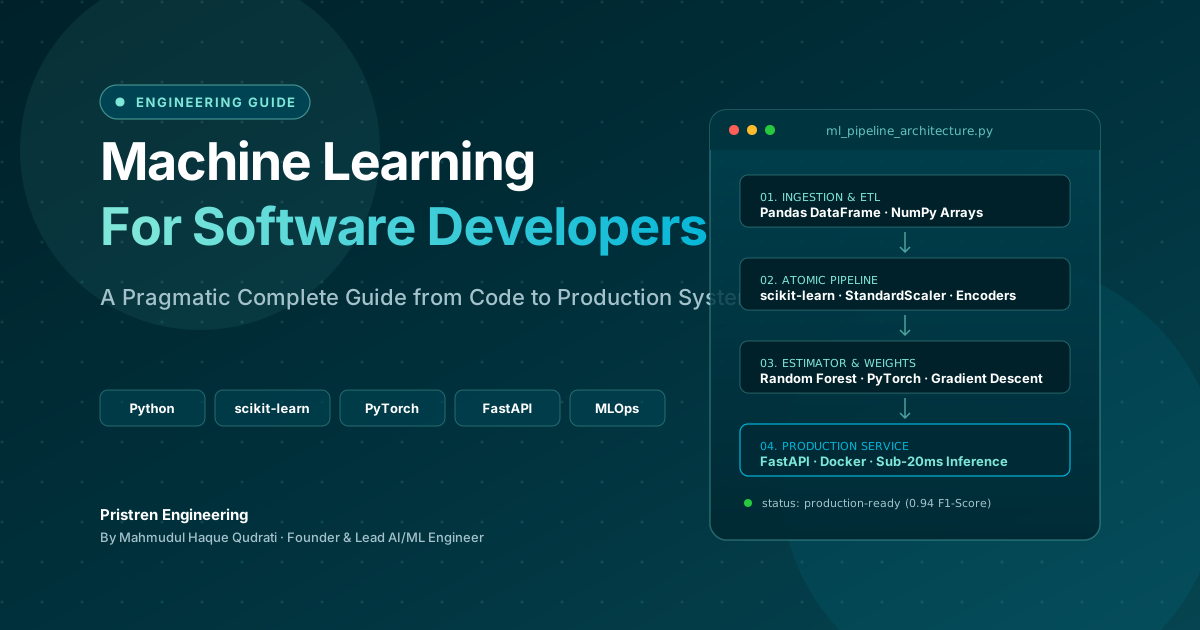
Machine Learning: Complete Guide for Software Developers
Learn machine learning as a software developer with this complete guide covering Python, algorithms, mathematics, projects, deep learning, and a practical roadmap.
 4 min read
How to Get Started with Computer Vision as a Developer?
A hands-on guide for developers entering computer vision: pick the right library, write your first pipeline, and avoid common pitfalls.
 12 min read
DeepSeek-R1: Architectures, Training Methods, and Why Reasoning Models Matter
An in-depth look at reinforcement learning, Chain-of-Thought reasoning, and why DeepSeek-R1 represents a shift in LLM capabilities and cost.
// discussion
Comments