Supervised learning requires two things: input data (features) and correct answers (labels). Your job is to train a model that maps inputs to outputs accurately.
The training loop has three steps that repeat thousands or millions of times:
1. Make a prediction. Feed an input example through the current model. The model produces a prediction -- a number, a category, a probability distribution.
2. Measure the error. Compare the prediction to the true label. Compute a loss value that quantifies how wrong the prediction was.
3. Adjust the model. Use the gradient of the loss (how each model parameter contributed to the error) to update the parameters in a direction that would have made the prediction less wrong. This is gradient descent.
After enough iterations over your training data, the model's parameters converge to values that produce accurate predictions across the full dataset. Ideally, they also generalize to new examples the model has never seen.
What Labels Actually Are
Labels are the "correct answers" in supervised learning. They are whatever output you want the model to predict.
For a spam classifier, labels are "spam" or "not spam" applied to each email. For a house price predictor, labels are the actual sale prices. For a medical image classifier, labels are diagnoses provided by expert radiologists. For a sentiment analyzer, labels are "positive," "negative," or "neutral" applied to customer reviews.
The critical insight: labels define what the model learns. If your labels are wrong, biased, or inconsistently applied, your model will faithfully learn to reproduce those errors. Garbage labels produce garbage models, regardless of how sophisticated your architecture is.
Where Labels Come From
Label acquisition is often the most expensive, time-consuming, and frustrating part of building an ML system. There are several sources:
Human annotation. Hire people (internal or via platforms like Amazon Mechanical Turk, Scale AI, or Labelbox) to label examples manually. This is the most flexible approach but expensive and slow. Expert annotation -- radiologists labeling X-rays, lawyers labeling contracts -- is very expensive.
Existing records. If you are building a fraud detector for a credit card company, historical fraud reports are already labeled. If you are building a churn predictor, whether customers actually churned is in your database. These "naturally occurring" labels from past outcomes are often the most practical source.
Implicit feedback. User behavior often serves as implicit labels. Clicks, purchases, and ratings are labels for recommendation systems. Click-through rate is a label for ad ranking. These labels are free and abundant but imperfect -- a click does not mean the user liked the content, just that they clicked.
Programmatic labeling. Write rules that apply labels automatically. Snorkel and similar tools formalize this. Fast and scalable, but the labels reflect the quality of your rules. Works best when combined with a small set of human-labeled examples to calibrate.
Synthetic data. Generate labeled examples algorithmically. Works well in structured domains like robotics (simulated environments), computer vision (rendered images), and code (programs with known correct outputs). Quality depends heavily on how realistic the synthetic distribution is.
Practical Examples at Different Scales
Small scale (hundreds to thousands of examples). A startup wants to classify support tickets by urgency. A team member labels 500 tickets over a few days. They fine-tune a pretrained text classifier (BERT or similar). With careful feature engineering and a simple model, even 200 examples can produce useful classifiers for narrow, well-defined tasks.
Medium scale (tens of thousands of examples). A SaaS company wants to predict churn. They have 50,000 historical customer records with a "churned" label derived from subscription cancellations. They train a gradient boosting model (XGBoost or LightGBM) on engineered features (usage patterns, support ticket frequency, billing history). This scale is comfortable for tree models and small neural networks.
Large scale (millions of examples). An e-commerce company trains a product recommendation model. Millions of user interactions serve as implicit labels. They use deep learning, often with embedding layers for users and items. At this scale, the bottleneck is infrastructure, not labels.
The Train/Validation/Test Split
You cannot evaluate your model on the same data you trained it on -- the model will appear to perform well simply because it memorized the training examples.
The standard approach: split your labeled data into three sets.
Training set (typically 70-80% of data). The model learns from this. Weights are updated based on training examples only.
Validation set (typically 10-15%). Used during training to monitor performance and tune hyperparameters. You check validation loss/accuracy to catch overfitting and decide when to stop training. The model never trains on validation examples, but your choices (architecture, learning rate, regularization) are informed by validation performance, which means the validation set is "used up" indirectly.
Test set (typically 10-15%). Held out completely until you are done training and tuning. You evaluate your final model on the test set exactly once to get an honest estimate of real-world performance. If you evaluate on the test set multiple times and adjust your model based on those results, you are leaking information and your test accuracy is optimistic.
When Supervised Learning Fails
Supervised learning is not universally applicable. It breaks down in several common situations:
Expensive or impossible labels. If labeling requires a world-class expert (a neurosurgeon, a structural engineer, a securities lawyer), you may only be able to afford hundreds of examples. Some tasks have no clear labeling protocol at all. When labels are scarce, consider self-supervised pretraining, transfer learning from related tasks, or active learning (letting the model ask a human to label the most informative examples).
Distribution shift. Your model performs well on held-out test data but fails in production. This happens when the distribution of production data is different from your training data. A fraud detection model trained on 2022 data may fail to detect 2025 fraud patterns. A medical classifier trained on data from one hospital may generalize poorly to a different hospital's patient population. Monitoring for distribution shift and periodically retraining on fresh data is a production ML necessity, not an optional nicety.
Noisy labels. Human annotators disagree. Label quality varies across annotators, time periods, and data sources. Noisy labels hurt model performance in proportion to the noise rate. Mitigation: multiple annotators per example with majority voting, label quality audits, learning-with-noisy-labels techniques (like noise-robust loss functions).
Feedback loops. Your model's predictions change the data you collect, which changes future training data. A content recommendation model trained on engagement data will recommend more engaging content, which generates more engagement data, which pushes the model further toward engagement optimization regardless of other values. Feedback loops are subtle and dangerous.
Tasks that change. If the underlying task evolves -- fraud patterns shift, customer preferences change, regulations update -- a static trained model becomes stale. You need retraining pipelines, not just training pipelines.
Supervised Learning vs. Other Paradigms
Supervised learning is not the only approach. Unsupervised learning finds patterns without labels -- clustering, dimensionality reduction, anomaly detection. Reinforcement learning learns from rewards rather than labeled examples. Self-supervised learning (the paradigm behind large language models) creates supervisory signals from the structure of unlabeled data itself.
Choose supervised learning when: you have labeled examples, the task is well-defined, and the label distribution in your training data matches what you will see in production.
Supervised learning remains the most practically useful ML paradigm because most business problems can be framed as "given these inputs, predict this output" and because labels -- while expensive -- are usually obtainable.
Keep Reading
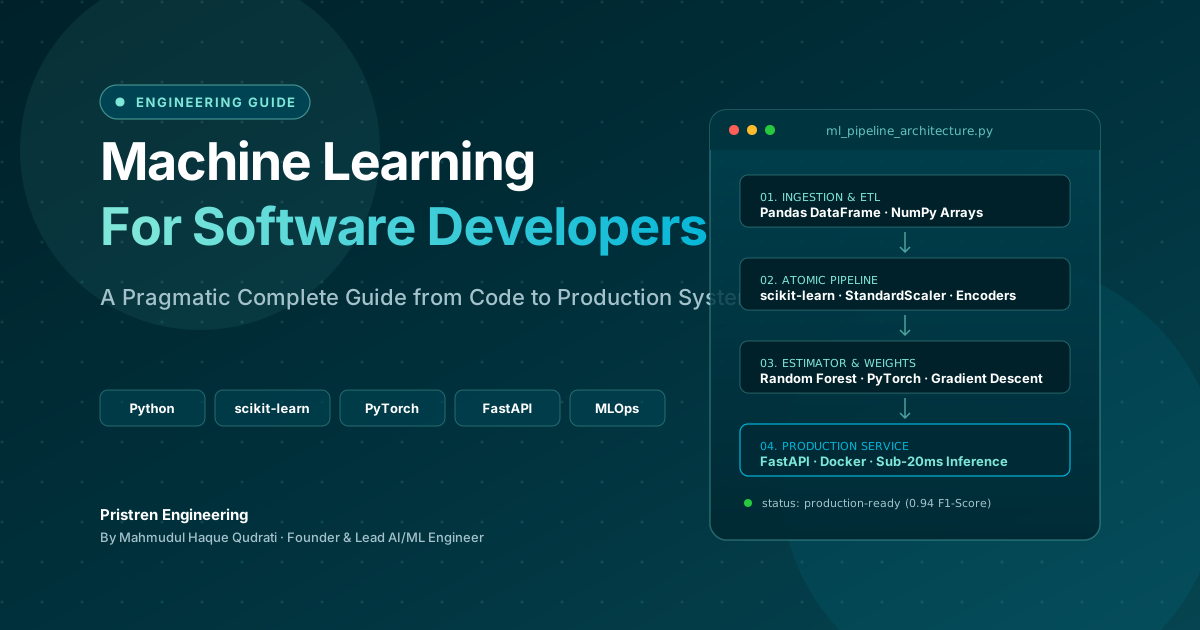
- Machine Learning Complete Guide for Software Developers - the full picture of where supervised learning fits in the broader ML landscape
- Overfitting and Underfitting: How to Fix Them - the most common failure mode in supervised learning and how to diagnose it
- ML Model Evaluation Metrics Guide - how to actually measure whether your supervised model is working
Pristren builds AI-powered software for teams. Zlyqor is our all-in-one workspace -- chat, projects, time tracking, AI meeting summaries, and invoicing -- in one tool. Try it free.



// discussion
Comments