DeepSeek-VL2: Efficient Vision-Language Model With Mixture of Experts
DeepSeek-VL2 applies Mixture of Experts to vision-language modeling, activating only 4.5B of 27B parameters per forward pass while matching models twice its active size.

Mahmudul Haque Qudrati
CEO & ML Engineer
May 6, 2026
7 min read
One AI engineering post, weekly
LLM benchmarks, prompt techniques, and token-cost breakdowns — not another AI news roundup.
Mixture of Experts (MoE) architectures have reshaped the LLM landscape by allowing massive total parameter counts with modest active parameter budgets. DeepSeek-VL2 brings this approach to vision-language modeling: 27B total parameters, but only 4.5B are active per token, making inference memory and compute closer to a 5B dense model.
Architecture Overview
DeepSeek-VL2 uses:
- Vision encoder: SigLIP-400M, processing images via dynamic tiling
- MoE language backbone: DeepSeek-V2 MoE architecture - 27B total parameters, 4.5B active via top-K expert routing
- Modality bridge: MLP projector connecting vision encoder outputs to language model inputs
The dynamic tiling for vision handles arbitrary image resolutions by splitting images into tiles matched to the vision encoder's native input size, then encoding each tile independently before concatenating token sequences.
python
import torch
from transformers import AutoModelForCausalLM
from deepseek_vl2.models import DeepseekVLV2Processor, DeepseekVLV2ForCausalLM
from deepseek_vl2.utils.io import load_pil_images

model_path = "deepseek-ai/deepseek-vl2"
processor = DeepseekVLV2Processor.from_pretrained(model_path)
model = DeepseekVLV2ForCausalLM.from_pretrained(
    model_path, trust_remote_code=True, torch_dtype=torch.bfloat16
).cuda().eval()

conversation = [
    {
        "role": "User",
        "content": "<image>
Extract all text visible in this document and format it as markdown.",
        "images": ["document.jpg"],
    },
    {"role": "Assistant", "content": ""},
]

pil_images = load_pil_images(conversation)
prepare_inputs = processor(conversations=conversation, images=pil_images, force_batchify=True).to(model.device)

with torch.no_grad():
    outputs = model.generate(**prepare_inputs, max_new_tokens=512)

answer = processor.tokenizer.decode(outputs[0][prepare_inputs["input_ids"].shape[1]:], skip_special_tokens=True)
print(answer)
Team workspace
Ship faster with chat, meetings, and projects in one place — Zlyqor.
DeepSeek-VL2 Sizes
Three variants cover different deployment scenarios:
- DeepSeek-VL2-Tiny: 3B total, ~1B active - for edge/constrained deployment
- DeepSeek-VL2-Small: 16B total, 2.8B active - balanced quality/efficiency
- DeepSeek-VL2: 27B total, 4.5B active - highest quality, single A100 80GB
Task Performance
DeepSeek-VL2 excels at OCR-heavy tasks: DocVQA, ChartQA, InfoVQA, and TextVQA. The dynamic tiling preserves fine text in documents better than fixed-resolution models. On MMMU it is competitive with InternVL2-26B despite lower active parameter count.
Comparison to InternVL2
Both models handle high-resolution documents well. InternVL2-26B has a larger active parameter count (26B dense vs 4.5B active for DeepSeek-VL2) which shows on complex reasoning tasks. DeepSeek-VL2 wins on inference throughput at equivalent GPU memory budgets due to MoE sparsity.
DeepSeek Platform API Access
For teams not running their own inference infrastructure, DeepSeek provides API access to VL2 at competitive pricing - making it practical to test before committing to self-hosted deployment.
Links
#deepseek-vl2#vision#moe#deepseek#multimodal
Mahmudul Haque Qudrati
CEO & ML Engineer
Visionary technologist, software engineer, and machine learning specialist. Founder and CEO of Pristren, directing engineering teams that ship production-grade AI/ML pipelines, mission-critical full-stack applications, and developer tooling. Creator of Zlyqor, the unified team workspace platform. Author of 540+ technical guides and benchmark research reports on large language models, agentic workflows, Model Context Protocol (MCP), and modern web stacks.

More from Mahmudul
Related Articles
 11 min read
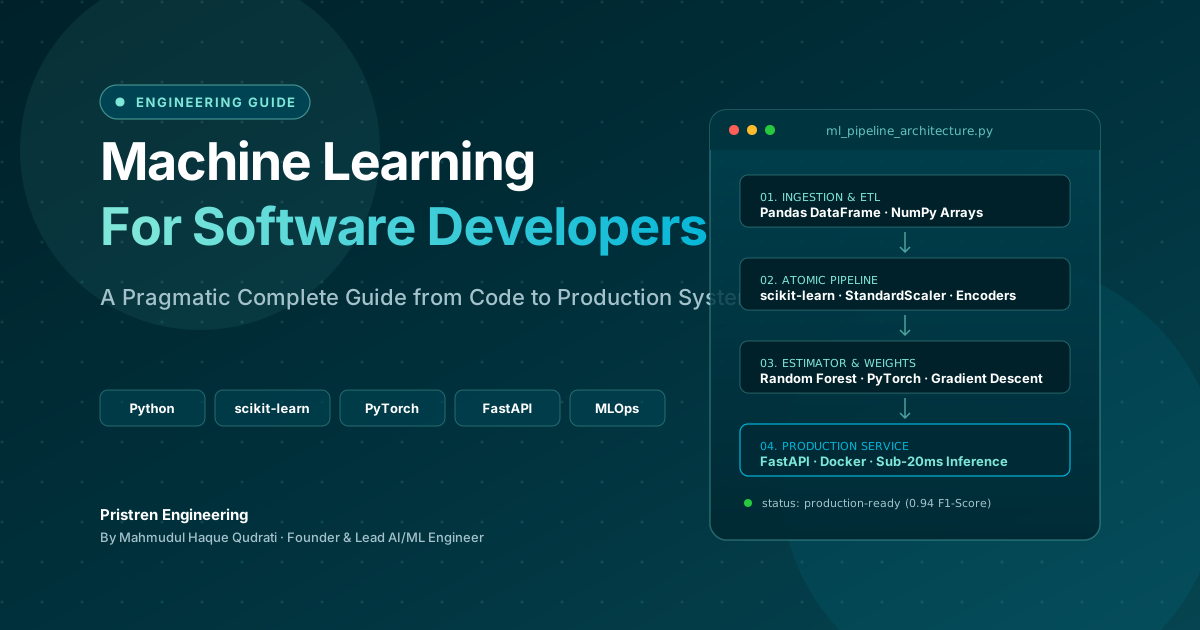
Machine Learning: Complete Guide for Software Developers
Learn machine learning as a software developer with this complete guide covering Python, algorithms, mathematics, projects, deep learning, and a practical roadmap.
 12 min read
DeepSeek-R1: Architectures, Training Methods, and Why Reasoning Models Matter
An in-depth look at reinforcement learning, Chain-of-Thought reasoning, and why DeepSeek-R1 represents a shift in LLM capabilities and cost.
 10 min read
Local LLMs in 2026: Comparing Llama 3.3, Mistral Large, and DeepSeek-R1
Running LLMs locally is no longer just for developers. We benchmark the latency, memory usage, and reasoning quality of 2026's top open models.
// discussion
Comments