DeepSpeed: Train Models With Billions of Parameters on Limited GPUs
Microsoft's DeepSpeed enables training of 100B+ parameter models across distributed GPU clusters through ZeRO optimization stages, CPU offloading, and RLHF support.

Mahmudul Haque Qudrati
CEO & ML Engineer
May 16, 2026
8 min read
One AI engineering post, weekly
LLM benchmarks, prompt techniques, and token-cost breakdowns — not another AI news roundup.
DeepSpeed is Microsoft's open-source library for distributed deep learning training. Its core contribution is ZeRO (Zero Redundancy Optimizer), a set of techniques that eliminate the memory redundancies in standard distributed training and allow models much larger than any single GPU's memory to be trained efficiently.
DeepSpeed integrates with PyTorch and HuggingFace Trainer, so adding it to an existing training script is often a configuration change rather than a code rewrite.
The ZeRO Stages
Standard data parallelism copies the full model to every GPU. ZeRO eliminates this redundancy progressively:
ZeRO Stage 1 - shards optimizer states across GPUs. Each GPU stores optimizer state only for the parameters it's responsible for. Memory reduction: ~4x.
ZeRO Stage 2 - additionally shards gradients. Memory reduction: ~8x.
ZeRO Stage 3 - additionally shards model parameters. Each GPU stores only a fraction of the model weights. Memory reduction: scales linearly with the number of GPUs. With 8 GPUs, each stores 1/8 of the parameters.
json
{
  "zero_optimization": {
    "stage": 3,
    "offload_optimizer": {
      "device": "cpu",
      "pin_memory": true
    },
    "offload_param": {
      "device": "cpu",
      "pin_memory": true
    },
    "overlap_comm": true,
    "contiguous_gradients": true,
    "sub_group_size": 1e9,
    "reduce_bucket_size": "auto",
    "stage3_prefetch_bucket_size": "auto",
    "stage3_param_persistence_threshold": "auto",
    "stage3_max_live_parameters": 1e9,
    "stage3_max_reuse_distance": 1e9
  },
  "bf16": {
    "enabled": true
  },
  "train_micro_batch_size_per_gpu": 1,
  "gradient_accumulation_steps": 16
}
Team workspace
Ship faster with chat, meetings, and projects in one place — Zlyqor.
HuggingFace Trainer Integration
Adding DeepSpeed to a HuggingFace Trainer run requires passing the config path:
python
from transformers import TrainingArguments, Trainer

training_args = TrainingArguments(
    output_dir="./outputs",
    deepspeed="ds_config_zero3.json",    # just add this
    per_device_train_batch_size=1,
    gradient_accumulation_steps=16,
    num_train_epochs=3,
    bf16=True,
)

trainer = Trainer(
    model=model,
    args=training_args,
    train_dataset=dataset,
)
trainer.train()
Run with: deepspeed --num_gpus 8 train.py
ZeRO-Offload
ZeRO-Offload extends Stage 2 to offload optimizer states and gradients to CPU RAM or NVMe storage. This allows training larger models on fewer GPUs at the cost of slower training (PCIe bandwidth is the bottleneck):
json
{
  "zero_optimization": {
    "stage": 2,
    "offload_optimizer": {
      "device": "cpu"
    }
  }
}
With ZeRO-Offload, a single A100 (80GB) with 256GB of CPU RAM can train a 65B parameter model.
DeepSpeed-Chat for RLHF
DeepSpeed-Chat provides an end-to-end RLHF pipeline (supervised fine-tuning → reward model training → PPO reinforcement learning) optimized for training at scale. It's the reference implementation for training ChatGPT-style models on your own data.
DeepSpeed vs FSDP
PyTorch's FSDP (Fully Sharded Data Parallel) is the built-in alternative. FSDP is simpler to configure for standard cases and integrates more natively with PyTorch. DeepSpeed has better performance for very large models (100B+), more optimization options, and the CPU/NVMe offload capabilities that FSDP lacks. For training up to 13B parameters, FSDP is often sufficient and easier. For larger models or when CPU offload is needed, DeepSpeed is the stronger choice.
Resources
#deepspeed#microsoft#distributed-training#zero#fsdp
Mahmudul Haque Qudrati
CEO & ML Engineer
Visionary technologist, software engineer, and machine learning specialist. Founder and CEO of Pristren, directing engineering teams that ship production-grade AI/ML pipelines, mission-critical full-stack applications, and developer tooling. Creator of Zlyqor, the unified team workspace platform. Author of 540+ technical guides and benchmark research reports on large language models, agentic workflows, Model Context Protocol (MCP), and modern web stacks.


More from Mahmudul
Related Articles
 11 min read
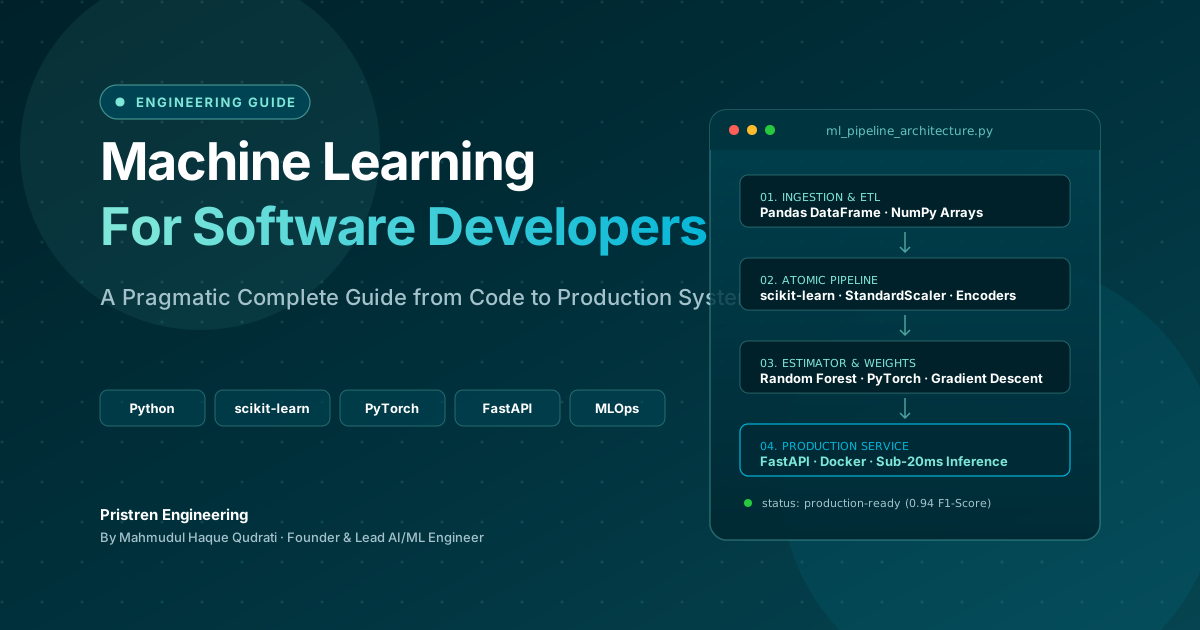
Machine Learning: Complete Guide for Software Developers
Learn machine learning as a software developer with this complete guide covering Python, algorithms, mathematics, projects, deep learning, and a practical roadmap.
 3 min read
Microsoft Starts Canceling Claude Code Licenses: What Developers Need to Know
Microsoft has started canceling Claude Code licenses for its employees, signaling a shift in AI tooling strategy. This post explains the context, implications, and what developers should consider.
 7 min read
ONNX: Export Any ML Model and Run It Anywhere
ONNX (Open Neural Network Exchange) is the universal model format - export from PyTorch, scikit-learn, or HuggingFace and run 3x faster inference with ONNX Runtime on CPU or GPU.
// discussion
Comments