DINOv2: Meta's Self-Supervised Vision Features That Beat Supervised Models
DINOv2 learns visual features from 142 million curated images without labels, producing representations that outperform supervised ImageNet models as frozen feature extractors across classification, segmentation, and depth tasks.

Mahmudul Haque Qudrati
CEO & ML Engineer
May 2, 2026
7 min read
One AI engineering post, weekly
LLM benchmarks, prompt techniques, and token-cost breakdowns — not another AI news roundup.
Standard vision model training requires millions of labeled images. DINOv2 from Meta demonstrates that self-supervised learning — using the model's own predictions as supervision — can produce features that surpass supervised training on downstream tasks.
DINOv2 uses self-distillation: a student network learns to match the outputs of a teacher network (exponential moving average of student weights). Both networks see different augmented views of the same image; the student must predict what the teacher sees for the global view. No labels needed.
LVD-142M Dataset
The quality of self-supervised learning depends heavily on training data diversity. DINOv2's LVD-142M (Large-scale Visual Deduplicated) dataset was curated through:
- Starting with a large uncurated web image collection
- Self-supervised retrieval to find images similar to curated reference datasets
- Deduplication to remove near-duplicate images
This produces 142 million diverse, high-quality images without manual annotation — far more than ImageNet's 1.2 million.
Team workspace
Ship faster with chat, meetings, and projects in one place — Zlyqor.
Using DINOv2 as a Frozen Feature Extractor
python
import torch
from transformers import AutoImageProcessor, AutoModel
from PIL import Image

processor = AutoImageProcessor.from_pretrained("facebook/dinov2-large")
model = AutoModel.from_pretrained("facebook/dinov2-large")
model.eval()

image = Image.open("photo.jpg")
inputs = processor(images=image, return_tensors="pt")

with torch.no_grad():
    outputs = model(**inputs)

# CLS token: global image representation
cls_features = outputs.last_hidden_state[:, 0, :]  # [1, 1024]

# Patch tokens: spatial features for dense tasks
patch_features = outputs.last_hidden_state[:, 1:, :]  # [1, num_patches, 1024]

print(f"Global feature shape: {cls_features.shape}")
print(f"Patch feature shape: {patch_features.shape}")
ViT Backbone Variants
| Variant | Parameters | Dim | Speed |
|---|---|---|---|
| ViT-S/14 | 21M | 384 | Fastest |
| ViT-B/14 | 86M | 768 | Fast |
| ViT-L/14 | 307M | 1024 | Moderate |
| ViT-g/14 | 1.1B | 1536 | Slow |
The HuggingFace DINOv2-large page is the standard balance point. ViT-g provides marginal improvements for most use cases.
Fine-Tuning for Custom Vision Tasks
DINOv2 frozen features with a linear head achieve 86.5% top-1 on ImageNet — competitive with many fully supervised models. For custom classification:
python
import torch.nn as nn
from transformers import AutoModel

class DINOv2Classifier(nn.Module):
    def __init__(self, num_classes: int):
        super().__init__()
        self.backbone = AutoModel.from_pretrained("facebook/dinov2-base")
        self.classifier = nn.Linear(768, num_classes)
        # Freeze backbone for fast training
        for param in self.backbone.parameters():
            param.requires_grad = False

    def forward(self, pixel_values):
        outputs = self.backbone(pixel_values=pixel_values)
        cls = outputs.last_hidden_state[:, 0]
        return self.classifier(cls)
Training only the linear head converges in minutes and works well with as few as 50 labeled examples per class — DINOv2's features generalize to new visual domains without extensive fine-tuning.
The GitHub repository includes depth estimation and semantic segmentation examples using DINOv2 patch features directly.
#dinov2#meta#self-supervised#vision#features
Mahmudul Haque Qudrati
CEO & ML Engineer
Visionary technologist, software engineer, and machine learning specialist. Founder and CEO of Pristren, directing engineering teams that ship production-grade AI/ML pipelines, mission-critical full-stack applications, and developer tooling. Creator of Zlyqor, the unified team workspace platform. Author of 540+ technical guides and benchmark research reports on large language models, agentic workflows, Model Context Protocol (MCP), and modern web stacks.


More from Mahmudul
Related Articles
 11 min read
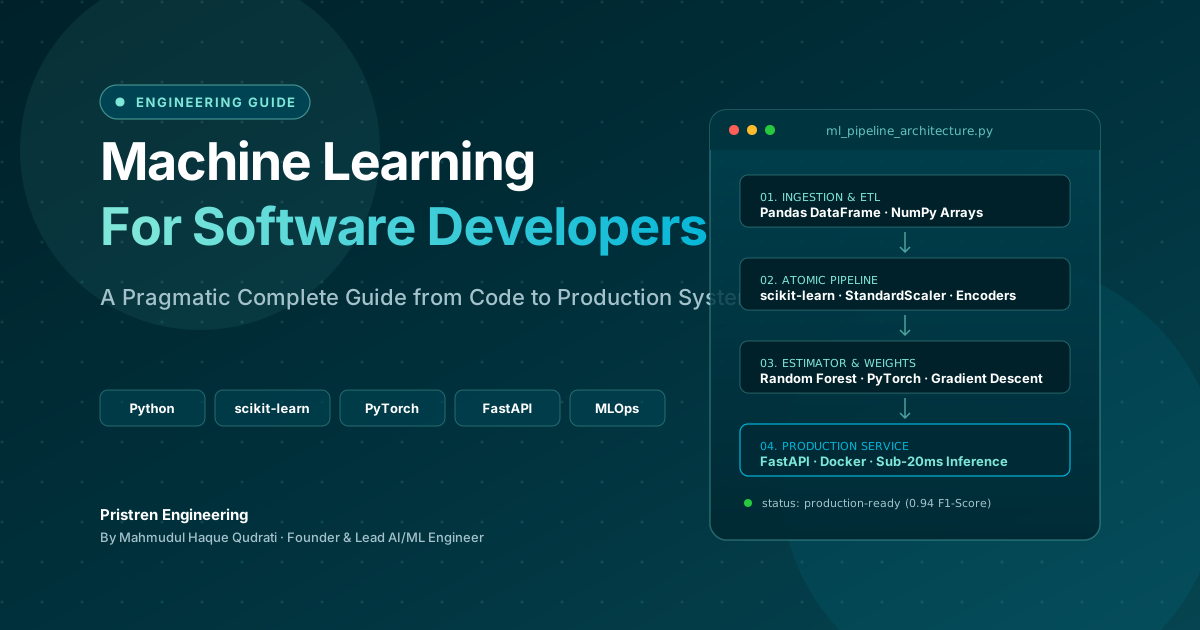
Machine Learning: Complete Guide for Software Developers
Learn machine learning as a software developer with this complete guide covering Python, algorithms, mathematics, projects, deep learning, and a practical roadmap.
 7 min read
ONNX: Export Any ML Model and Run It Anywhere
ONNX (Open Neural Network Exchange) is the universal model format - export from PyTorch, scikit-learn, or HuggingFace and run 3x faster inference with ONNX Runtime on CPU or GPU.
 9 min read
Gradient Descent Explained: How Machine Learning Models Actually Learn
Gradient descent is the engine behind every modern ML model. Here is how it works, why learning rate matters, and when to use Adam over SGD.
// discussion
Comments