DistilBERT in Production: Fast NLP Classification Without the GPU Bill
DistilBERT delivers 97% of BERT's performance at 40% smaller size and 60% faster inference, making it the practical default for production text classification that needs low latency on CPU.

Mahmudul Haque Qudrati
CEO & ML Engineer
March 29, 2026
7 min read
One AI engineering post, weekly
LLM benchmarks, prompt techniques, and token-cost breakdowns — not another AI news roundup.
The DistilBERT paper introduced knowledge distillation for transformer compression. A large BERT teacher trains a 6-layer DistilBERT student to mimic its output distributions, not just match labels. The result: 66M parameters (vs BERT-base's 110M), 60% faster inference, 40% smaller, with 97% of BERT's GLUE performance.
For production classification (sentiment, intent, topic), that 3% gap rarely matters. DistilBERT's latency advantage often matters more than marginal accuracy when serving thousands of requests per second.
The HuggingFace DistilBERT page provides cased and uncased variants.
Fine-Tuning for Classification With Trainer API
python
from transformers import (
    DistilBertForSequenceClassification,
    DistilBertTokenizerFast,
    Trainer,
    TrainingArguments,
)
from datasets import load_dataset
import numpy as np

tokenizer = DistilBertTokenizerFast.from_pretrained("distilbert-base-uncased")
model = DistilBertForSequenceClassification.from_pretrained(
    "distilbert-base-uncased",
    num_labels=2
)

dataset = load_dataset("imdb")

def tokenize(batch):
    return tokenizer(batch["text"], truncation=True, padding=True, max_length=512)

dataset = dataset.map(tokenize, batched=True, batch_size=1000)

training_args = TrainingArguments(
    output_dir="./distilbert-sentiment",
    num_train_epochs=3,
    per_device_train_batch_size=32,
    per_device_eval_batch_size=64,
    evaluation_strategy="epoch",
    learning_rate=2e-5,
)

trainer = Trainer(
    model=model,
    args=training_args,
    train_dataset=dataset["train"],
    eval_dataset=dataset["test"],
)
trainer.train()
Team workspace
Ship faster with chat, meetings, and projects in one place — Zlyqor.
ONNX Export for CPU Inference (5-10ms Latency)
Export to ONNX for deployment without PyTorch dependency:
python
from transformers import DistilBertForSequenceClassification, DistilBertTokenizerFast
import torch

model = DistilBertForSequenceClassification.from_pretrained("./distilbert-sentiment")
tokenizer = DistilBertTokenizerFast.from_pretrained("distilbert-base-uncased")
model.eval()

dummy_input = tokenizer("Sample text", return_tensors="pt")
torch.onnx.export(
    model,
    (dummy_input["input_ids"], dummy_input["attention_mask"]),
    "distilbert_classifier.onnx",
    opset_version=14,
    input_names=["input_ids", "attention_mask"],
    output_names=["logits"],
    dynamic_axes={"input_ids": {0: "batch", 1: "seq"}, "attention_mask": {0: "batch", 1: "seq"}},
)
ONNX Runtime inference averages 5-10ms per request on a 4-core CPU, compared to 50-80ms for PyTorch on the same hardware.
FastAPI Deployment
Wrap the ONNX session in FastAPI for a production-ready classification endpoint. Load the session once at startup, process batches of up to 32 texts per request. With 4 Gunicorn workers on a 4-vCPU machine, throughput exceeds 200 classifications/second.
Cost Comparison vs GPT-4o API
Classifying 10 million texts/month:
| Approach | Monthly Cost |
|---|---|
| GPT-4o API | ~$30,000 |
| GPT-4o-mini API | ~$600 |
| DistilBERT (1x c5.xlarge) | ~$120 |
| DistilBERT (self-hosted, bare metal) | ~$15 |
For high-volume classification tasks - content moderation, intent routing, topic labeling - fine-tuned DistilBERT is the economically rational choice. Fine-tune once on your labeled data; the model then classifies at near-zero marginal cost.
#distilbert#text-classification#nlp#onnx#inference
Mahmudul Haque Qudrati
CEO & ML Engineer
Visionary technologist, software engineer, and machine learning specialist. Founder and CEO of Pristren, directing engineering teams that ship production-grade AI/ML pipelines, mission-critical full-stack applications, and developer tooling. Creator of Zlyqor, the unified team workspace platform. Author of 540+ technical guides and benchmark research reports on large language models, agentic workflows, Model Context Protocol (MCP), and modern web stacks.


More from Mahmudul
Related Articles
 11 min read
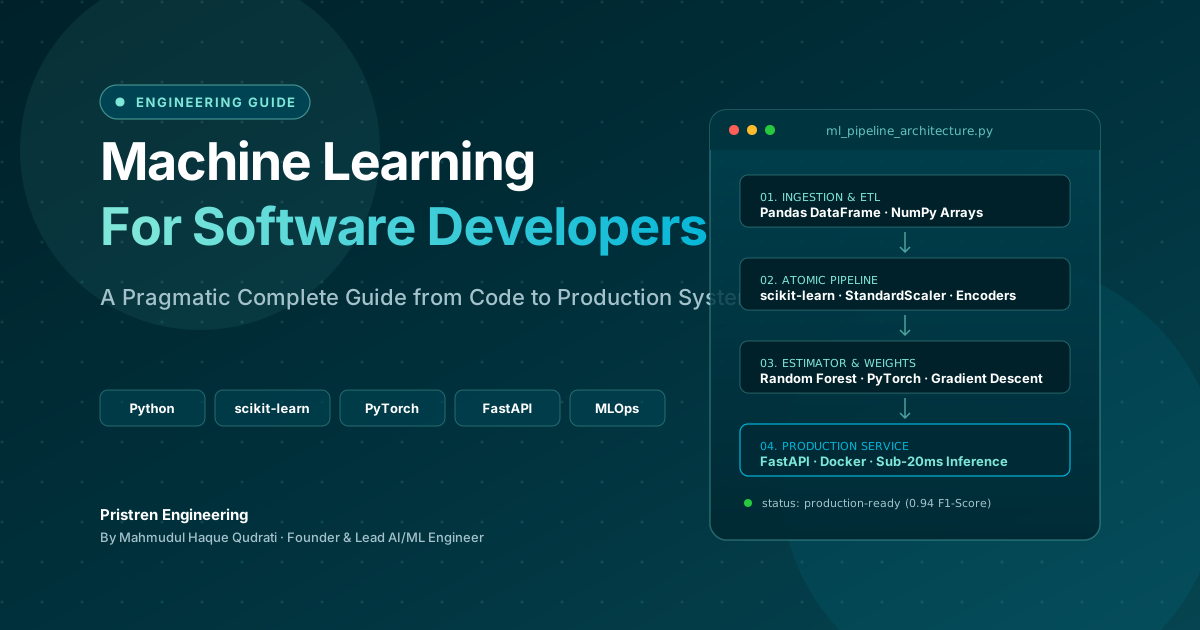
Machine Learning: Complete Guide for Software Developers
Learn machine learning as a software developer with this complete guide covering Python, algorithms, mathematics, projects, deep learning, and a practical roadmap.
 11 min read
Understanding Transformer Attention Mechanisms: Self-Attention vs Cross-Attention
A mathematical and visual walkthrough of multi-head attention, self-attention, and encoder-decoder cross-attention inside language models.
 7 min read
ONNX: Export Any ML Model and Run It Anywhere
ONNX (Open Neural Network Exchange) is the universal model format - export from PyTorch, scikit-learn, or HuggingFace and run 3x faster inference with ONNX Runtime on CPU or GPU.
// discussion
Comments