Feast: The Open-Source Feature Store for Real-Time ML
Feast solves training-serving skew and enables feature reuse across models - define features once and serve them consistently from both batch and real-time data sources.

Mahmudul Haque Qudrati
CEO & ML Engineer
May 5, 2026
7 min read
One AI engineering post, weekly
LLM benchmarks, prompt techniques, and token-cost breakdowns — not another AI news roundup.
Three problems plague ML feature pipelines without a feature store:
Training-serving skew. Features are computed differently at training time (batch job) and serving time (real-time API). The model was never trained on what it sees in production.
Duplicate feature computation. Ten models compute the same "user purchase count last 7 days" in ten different pipelines.
Point-in-time correctness. When generating training data, you need the feature values as they were at prediction time - not today's values retroactively applied to historical labels.
Feast solves all three.
Core Concepts
Feature View: defines a set of features from a data source.
Offline Store: historical feature data for training (Parquet files, BigQuery, Snowflake, Redshift).
Online Store: low-latency feature data for serving (Redis, DynamoDB, SQLite for dev).
Feature Service: a named set of features consumed by a model.
Team workspace
Ship faster with chat, meetings, and projects in one place — Zlyqor.
Defining Feature Views
python
from datetime import timedelta
from feast import Entity, FeatureView, Field, FileSource
from feast.types import Float64, Int64, String

# Define the entity (what your features describe)
user = Entity(name="user", join_keys=["user_id"])

# Define a data source
user_stats_source = FileSource(
    path="data/user_stats.parquet",
    timestamp_field="event_timestamp",
)

# Define the feature view
user_stats_fv = FeatureView(
    name="user_stats",
    entities=[user],
    ttl=timedelta(days=7),
    schema=[
        Field(name="purchase_count_7d", dtype=Int64),
        Field(name="avg_order_value_30d", dtype=Float64),
        Field(name="days_since_last_login", dtype=Int64),
        Field(name="country", dtype=String),
    ],
    online=True,
    source=user_stats_source,
)
Getting Historical Features for Training
python
from feast import FeatureStore
import pandas as pd

store = FeatureStore(repo_path=".")

# Entity DataFrame: who you want features for and at what time
entity_df = pd.DataFrame({
    "user_id": [1001, 1002, 1003],
    "event_timestamp": pd.to_datetime(["2025-03-01", "2025-03-15", "2025-04-01"]),
    "label": [1, 0, 1],  # the target variable
})

# Point-in-time correct feature retrieval
training_df = store.get_historical_features(
    entity_df=entity_df,
    features=[
        "user_stats:purchase_count_7d",
        "user_stats:avg_order_value_30d",
        "user_stats:country",
    ],
).to_df()

print(training_df.head())
get_historical_features() returns the feature values as they were at each event_timestamp - eliminating data leakage.
Materializing to Online Store and Serving
bash
# Push features to online store (Redis/DynamoDB)
feast materialize-incremental $(date +%Y-%m-%dT%H:%M:%S)
python
# In your serving API
from feast import FeatureStore

store = FeatureStore(repo_path=".")

def predict(user_id: int) -> float:
    features = store.get_online_features(
        features=["user_stats:purchase_count_7d", "user_stats:avg_order_value_30d"],
        entity_rows=[{"user_id": user_id}],
    ).to_dict()

    X = [[features["purchase_count_7d"][0], features["avg_order_value_30d"][0]]]
    return model.predict_proba(X)[0][1]
Latency for online retrieval from Redis: typically 1-5ms.
Feast vs Tecton
Feast is fully open source, self-managed, and free. Tecton is a managed feature platform with a SaaS model, better UI, and enterprise support. For teams starting out, Feast covers all the fundamentals. For organizations with 50+ ML engineers and SLA requirements, Tecton's managed infrastructure is worth evaluating.
Resources: Feast GitHub, docs.
#feast#feature-store#mlops#real-time#feature-engineering
Mahmudul Haque Qudrati
CEO & ML Engineer
Visionary technologist, software engineer, and machine learning specialist. Founder and CEO of Pristren, directing engineering teams that ship production-grade AI/ML pipelines, mission-critical full-stack applications, and developer tooling. Creator of Zlyqor, the unified team workspace platform. Author of 540+ technical guides and benchmark research reports on large language models, agentic workflows, Model Context Protocol (MCP), and modern web stacks.


More from Mahmudul
Related Articles
 11 min read
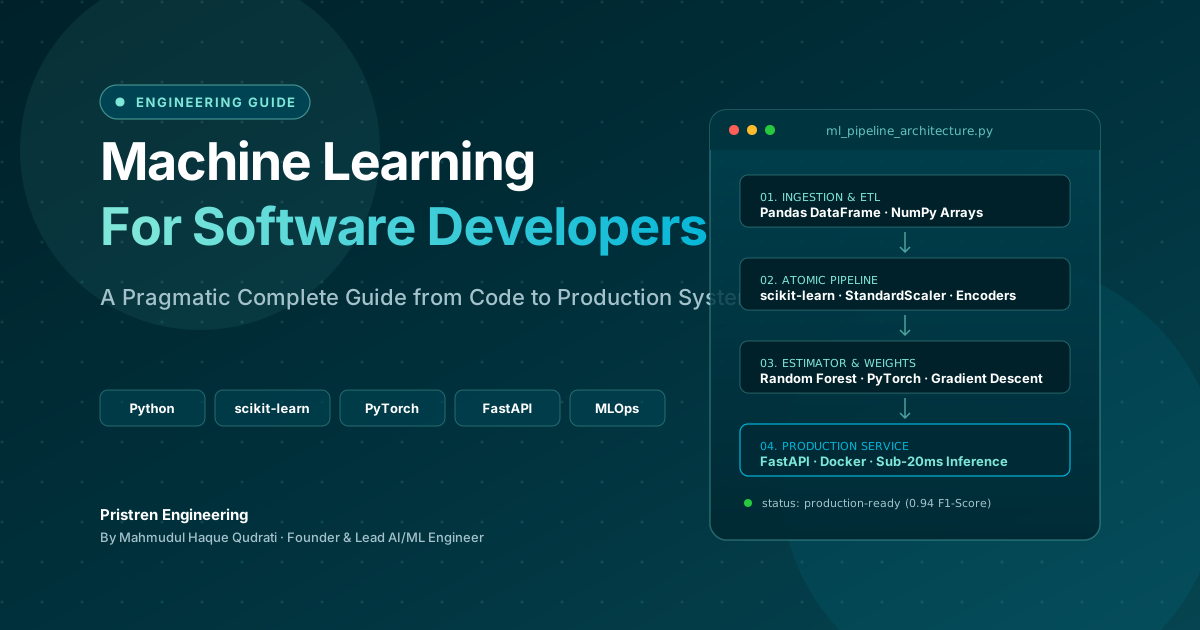
Machine Learning: Complete Guide for Software Developers
Learn machine learning as a software developer with this complete guide covering Python, algorithms, mathematics, projects, deep learning, and a practical roadmap.
 7 min read
ONNX: Export Any ML Model and Run It Anywhere
ONNX (Open Neural Network Exchange) is the universal model format - export from PyTorch, scikit-learn, or HuggingFace and run 3x faster inference with ONNX Runtime on CPU or GPU.
 9 min read
Redis Guide for Developers: Not Just a Cache
Redis is an in-memory data structure store used for caching, sessions, rate limiting, queues, pub/sub, and distributed locks. Here is how to use it well.
// discussion
Comments