LayoutLMv3: Understanding PDFs, Forms, and Documents With Layout Awareness
Microsoft's LayoutLMv3 pretrains on text, bounding boxes, and image patches together, enabling form understanding, receipt parsing, and document VQA without separate OCR fine-tuning.

Mahmudul Haque Qudrati
CEO & ML Engineer
May 17, 2026
7 min read
One AI engineering post, weekly
LLM benchmarks, prompt techniques, and token-cost breakdowns — not another AI news roundup.
A PDF invoice has amounts in the top-right, addresses in the top-left, and line items in a table. A standard language model that strips formatting sees "Invoice #1234 Acme Corp 123 Main St Total $5,000" with no spatial context. LayoutLMv3 understands that "Total" in the bottom-right with "$5,000" immediately to its right - within the same bounding box row - means something very different from "Total" appearing in a header.
Architecture: Text + Layout + Image Together
LayoutLMv3 uses a unified multimodal transformer that processes three input streams jointly:
- Text tokens - from an OCR engine (Tesseract, Azure Form Recognizer, or any OCR output)
- Layout tokens - 2D bounding box coordinates (x1, y1, x2, y2, width, height) for each text token, normalized to [0, 1000]
- Image patches - the document image divided into 16×16 patches, processed like ViT
The model is pretrained with three objectives: Masked Language Modeling (MLM) on text, Masked Image Modeling (MIM) on image patches, and Word-Patch Alignment (WPA) - predicting whether a text token and an image patch are aligned.
python
from transformers import LayoutLMv3Processor, LayoutLMv3ForTokenClassification
from PIL import Image
import torch

processor = LayoutLMv3Processor.from_pretrained("microsoft/layoutlmv3-base", apply_ocr=True)
model = LayoutLMv3ForTokenClassification.from_pretrained("microsoft/layoutlmv3-base")

# apply_ocr=True runs Tesseract internally
image = Image.open("receipt.png").convert("RGB")
encoding = processor(image, return_tensors="pt")

with torch.no_grad():
    outputs = model(**encoding)

predictions = outputs.logits.argmax(-1).squeeze().tolist()
token_boxes = encoding.bbox.squeeze().tolist()

for token_id, box, pred in zip(encoding.input_ids.squeeze().tolist(), token_boxes, predictions):
    token = processor.tokenizer.decode([token_id])
    print(f"Token: {token:15} Box: {box} Label: {pred}")
Team workspace
Ship faster with chat, meetings, and projects in one place — Zlyqor.
Fine-Tuning on Custom Documents
For domain-specific forms, fine-tuning LayoutLMv3 on labeled examples consistently outperforms prompting a general VLM:
python
from transformers import LayoutLMv3ForTokenClassification, TrainingArguments, Trainer

label2id = {"O": 0, "B-DATE": 1, "B-TOTAL": 2, "B-VENDOR": 3, "B-ADDRESS": 4}
id2label = {v: k for k, v in label2id.items()}

model = LayoutLMv3ForTokenClassification.from_pretrained(
    "microsoft/layoutlmv3-base",
    num_labels=len(label2id),
    id2label=id2label,
    label2id=label2id,
)

training_args = TrainingArguments(
    output_dir="layoutlmv3-receipts",
    per_device_train_batch_size=4,
    num_train_epochs=10,
    learning_rate=5e-5,
    fp16=True,
    evaluation_strategy="epoch",
)

trainer = Trainer(
    model=model,
    args=training_args,
    train_dataset=train_dataset,
    eval_dataset=eval_dataset,
    tokenizer=processor,
)
trainer.train()
Benchmark Datasets for Document AI
- FUNSD (Form Understanding in Noisy Scanned Documents) - 199 forms with semantic entity labels and entity linking; F1 benchmark for form NER
- CORD (Consolidated Receipt Dataset) - 11,000 receipt images with 30 semantic label categories; used for receipt parsing
- DocVQA - 50,000 QA pairs over scanned documents; requires reading comprehension from layout-aware context
LayoutLMv3 achieves F1 > 90% on FUNSD and CORD with standard fine-tuning recipes.
Integration With Azure Form Recognizer
Azure Form Recognizer uses LayoutLM variants as its underlying model for structured extraction. If you need managed infrastructure with SLA guarantees and pre-built models for invoices, receipts, ID cards, and W-2s, Azure Form Recognizer is the production-ready path that avoids managing model serving yourself.
Links
#layoutlmv3#document-ai#microsoft#ocr#form-understanding
Mahmudul Haque Qudrati
CEO & ML Engineer
Visionary technologist, software engineer, and machine learning specialist. Founder and CEO of Pristren, directing engineering teams that ship production-grade AI/ML pipelines, mission-critical full-stack applications, and developer tooling. Creator of Zlyqor, the unified team workspace platform. Author of 540+ technical guides and benchmark research reports on large language models, agentic workflows, Model Context Protocol (MCP), and modern web stacks.

More from Mahmudul
Related Articles
 11 min read
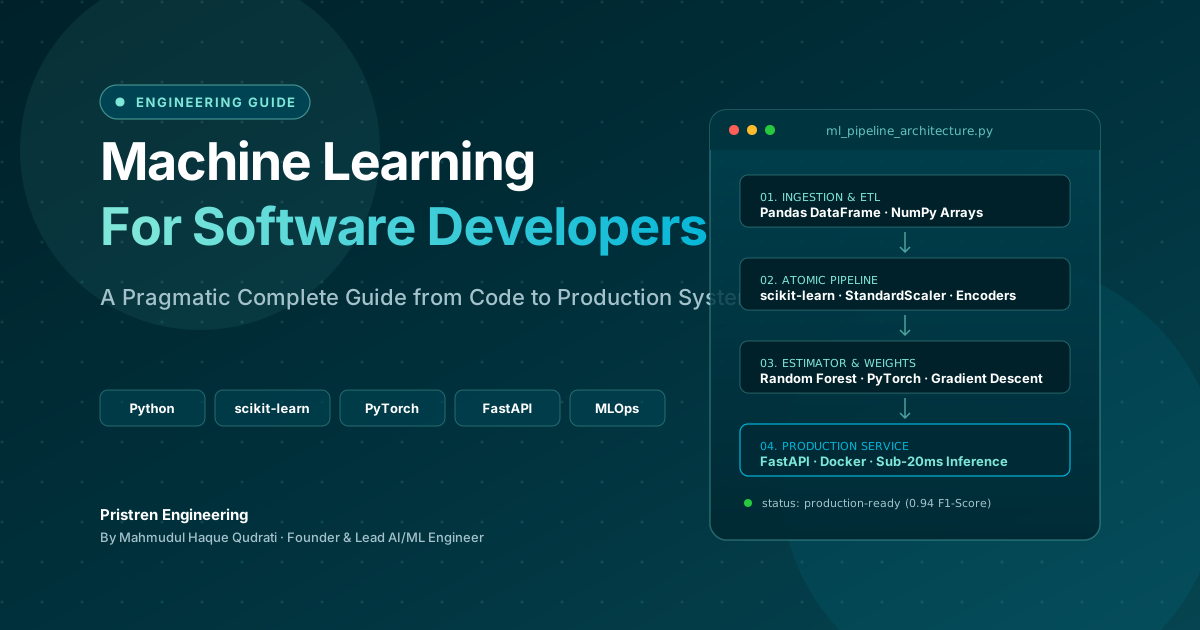
Machine Learning: Complete Guide for Software Developers
Learn machine learning as a software developer with this complete guide covering Python, algorithms, mathematics, projects, deep learning, and a practical roadmap.
 3 min read
Microsoft Starts Canceling Claude Code Licenses: What Developers Need to Know
Microsoft has started canceling Claude Code licenses for its employees, signaling a shift in AI tooling strategy. This post explains the context, implications, and what developers should consider.
 7 min read
ONNX: Export Any ML Model and Run It Anywhere
ONNX (Open Neural Network Exchange) is the universal model format - export from PyTorch, scikit-learn, or HuggingFace and run 3x faster inference with ONNX Runtime on CPU or GPU.
// discussion
Comments