LLM Compression: Pruning, Distillation, and Quantization Compared
Three techniques for making large language models smaller and faster - quantization, pruning, and knowledge distillation - each with different tradeoffs in quality, speed, and implementation complexity.

Mahmudul Haque Qudrati
CEO & ML Engineer
May 15, 2026
8 min read
One AI engineering post, weekly
LLM benchmarks, prompt techniques, and token-cost breakdowns — not another AI news roundup.
A Llama 3 70B model requires 140GB of VRAM in FP16 - four A100 GPUs just to load. Inference costs scale linearly with model size. Compression techniques reduce these requirements while preserving most of the capability, making large models deployable on smaller hardware.
The three main approaches have different tradeoffs: quantization is the easiest to apply, pruning requires more expertise, and distillation is the most expensive upfront but produces the best small-model quality.
1. Quantization
Quantization reduces the numerical precision of model weights. A standard FP16 model uses 2 bytes per parameter; INT8 uses 1 byte; INT4 uses 0.5 bytes.
LLM.int8() - the bitsandbytes approach. Uses INT8 for most weights but keeps a small set of "outlier" weights in FP16. Near-lossless quality, ~2x memory reduction.
python
from transformers import AutoModelForCausalLM
import bitsandbytes

model = AutoModelForCausalLM.from_pretrained(
    "meta-llama/Meta-Llama-3-8B",
    load_in_8bit=True,          # LLM.int8()
    device_map="auto",
)
GPTQ - post-training quantization to 4-bit using gradient-based weight rounding. Requires a calibration dataset, produces better quality than naive INT4. Standard for community-quantized models on HuggingFace.
AWQ (Activation-aware Weight Quantization) - identifies the most important weights using activation statistics and preserves their precision. Often matches or beats GPTQ quality with faster inference.
| Method | Bit Width | Memory vs FP16 | Quality Loss |
|---|---|---|---|
| LLM.int8() | 8-bit | ~50% | Minimal |
| GPTQ | 4-bit | ~25% | Low |
| AWQ | 4-bit | ~25% | Very low |
| bitsandbytes 4-bit | 4-bit | ~25% | Low-Medium |
Team workspace
Ship faster with chat, meetings, and projects in one place — Zlyqor.
2. Pruning
Pruning removes weights or entire structural components (attention heads, FFN neurons) from a model. Unlike quantization, pruning permanently removes computation - yielding real speedups, not just memory savings.
SparseGPT enables one-shot pruning of Llama-scale models to 50% sparsity with minimal accuracy loss, without any retraining:
python
# SparseGPT is applied post-training
from sparseml.transformers import SparseAutoModelForCausalLM

model = SparseAutoModelForCausalLM.from_pretrained(
    "meta-llama/Meta-Llama-3-8B",
    recipe="zoo:nlp/text_generation/llama-3-8b/pytorch/huggingface/llama3_8b/pruned50-none"
)
Structured pruning (removing entire attention heads or FFN channels) achieves real speedups on standard hardware. Unstructured pruning (zeroing individual weights) requires sparse matrix hardware support to realize the theoretical speedup.
10-50% speedup is realistic with structured pruning at 20-40% sparsity, with 1-3% quality degradation on standard benchmarks.
3. Knowledge Distillation
Distillation trains a small "student" model to mimic a large "teacher" model. The student learns from the teacher's output probabilities (soft targets), not just the ground-truth labels.
python
import torch.nn.functional as F

def distillation_loss(student_logits, teacher_logits, labels, temperature=4.0, alpha=0.7):
    soft_loss = F.kl_div(
        F.log_softmax(student_logits / temperature, dim=-1),
        F.softmax(teacher_logits / temperature, dim=-1),
        reduction="batchmean"
    ) * (temperature ** 2)
    hard_loss = F.cross_entropy(student_logits, labels)
    return alpha * soft_loss + (1 - alpha) * hard_loss
Real examples: DistilBERT is 40% smaller than BERT-base with 97% of its performance. Phi-3 Mini (3.8B parameters) achieves GPT-3.5-level performance on many benchmarks through careful data curation and distillation from larger models.
Distillation is the most expensive technique (requires training the student model) but produces the best small-model quality because the student learns from richer supervision than ground truth alone.
Combining Techniques
In practice, the three techniques are complementary. A common production pipeline: distill a 70B model to 13B → prune 20% of heads → quantize to 4-bit AWQ. The result is a model that runs on a single A10G with performance competitive with the original 70B at full precision.
Resources
#compression#pruning#distillation#quantization#efficiency
Mahmudul Haque Qudrati
CEO & ML Engineer
Visionary technologist, software engineer, and machine learning specialist. Founder and CEO of Pristren, directing engineering teams that ship production-grade AI/ML pipelines, mission-critical full-stack applications, and developer tooling. Creator of Zlyqor, the unified team workspace platform. Author of 540+ technical guides and benchmark research reports on large language models, agentic workflows, Model Context Protocol (MCP), and modern web stacks.


More from Mahmudul
Related Articles
 11 min read
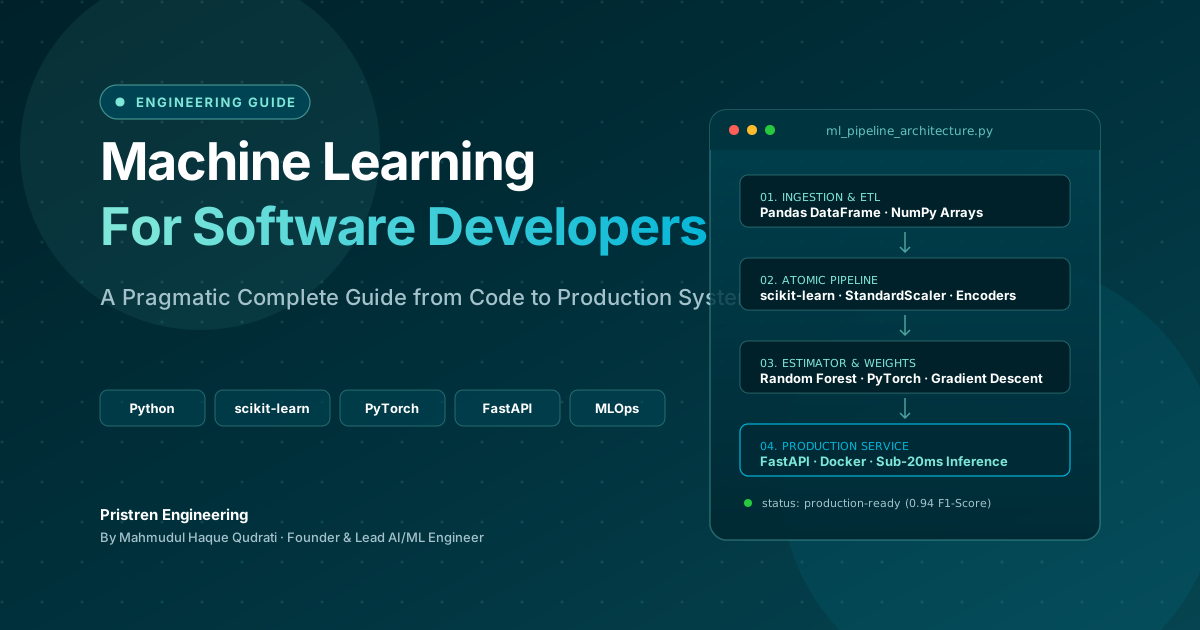
Machine Learning: Complete Guide for Software Developers
Learn machine learning as a software developer with this complete guide covering Python, algorithms, mathematics, projects, deep learning, and a practical roadmap.
 7 min read
ONNX: Export Any ML Model and Run It Anywhere
ONNX (Open Neural Network Exchange) is the universal model format - export from PyTorch, scikit-learn, or HuggingFace and run 3x faster inference with ONNX Runtime on CPU or GPU.
 9 min read
Gradient Descent Explained: How Machine Learning Models Actually Learn
Gradient descent is the engine behind every modern ML model. Here is how it works, why learning rate matters, and when to use Adam over SGD.
// discussion
Comments