Phi-4: Microsoft's 14B Model That Beats Larger Models on Reasoning
Phi-4 at 14B parameters scores 80.4% on MATH (vs GPT-4o at 76.6%) using a synthetic data pipeline focused on textbook-quality STEM content.

Mahmudul Haque Qudrati
CEO & ML Engineer
May 5, 2026
7 min read
One AI engineering post, weekly
LLM benchmarks, prompt techniques, and token-cost breakdowns — not another AI news roundup.
Microsoft Phi-4 continues the Phi series' thesis: model quality is determined more by training data quality than by raw parameter count. Phi-4's 14 billion parameters achieve remarkable STEM reasoning by training primarily on synthetically generated "textbook-quality" problem-solution pairs rather than raw web scrapes.
MATH benchmark: 80.4% vs GPT-4o at 76.6%. A 14B model beating a frontier model on mathematical reasoning is a meaningful signal about what's possible with careful data engineering.
Architecture and Training
- 14 billion parameters - fits on a single RTX 4090 (24GB) in FP16, or a single 3090 in INT4
- 16k token context window - smaller than many competitors but sufficient for most STEM tasks
- Training data: ~9.8 trillion tokens, heavily weighted toward synthetic STEM content
- Azure AI deployment for production, HuggingFace for research
The full technical report details the synthetic data pipeline, which generates progressively harder problems across mathematics, physics, chemistry, and computer science.
Team workspace
Ship faster with chat, meetings, and projects in one place — Zlyqor.
Benchmark Results
| Benchmark | Phi-4 (14B) | GPT-4o | Llama 3.1 70B | Gemma 2 27B |
|---|---|---|---|---|
| MATH | 80.4% | 76.6% | 73.8% | 56.0% |
| MMLU | 84.8% | 88.7% | 83.6% | 75.2% |
| HumanEval | 82.6% | 90.2% | 80.5% | 72.0% |
| GPQA | 56.1% | 53.6% | 46.7% | 42.1% |
Note that MMLU is the one area where GPT-4o clearly leads - Phi-4's knowledge breadth is narrower than frontier models, but within STEM it outperforms them.
Running on Azure
python
from azure.ai.inference import ChatCompletionsClient
from azure.core.credentials import AzureKeyCredential
from azure.ai.inference.models import SystemMessage, UserMessage

client = ChatCompletionsClient(
    endpoint="https://your-endpoint.services.ai.azure.com/models",
    credential=AzureKeyCredential("your-key"),
)

response = client.complete(
    model="Phi-4",
    messages=[
        SystemMessage("You are a helpful STEM tutor."),
        UserMessage("Solve this differential equation: dy/dx = 2xy, y(0) = 1")
    ],
    max_tokens=1024,
    temperature=0.1,
)
print(response.choices[0].message.content)
Running Locally
bash
# Via Ollama
ollama pull phi4
ollama run phi4 "Prove the Pythagorean theorem using similar triangles."

# Via HuggingFace transformers
pip install transformers torch
python
from transformers import AutoModelForCausalLM, AutoTokenizer
import torch

tokenizer = AutoTokenizer.from_pretrained("microsoft/phi-4")
model = AutoModelForCausalLM.from_pretrained(
    "microsoft/phi-4",
    torch_dtype=torch.bfloat16,
    device_map="auto"
)

inputs = tokenizer("Calculate the eigenvalues of [[2,1],[1,2]]:", return_tensors="pt").to("cuda")
output = model.generate(**inputs, max_new_tokens=512, temperature=0.1)
print(tokenizer.decode(output[0], skip_special_tokens=True))
When to Choose Phi-4
Phi-4 is the right choice for:
- Math tutoring applications
- Scientific computing assistance
- STEM homework help platforms
- Code generation for algorithmic problems
- Any application where MATH/reasoning performance matters more than broad knowledge
Summary
Phi-4 proves that the frontier isn't defined by model size. For STEM-focused applications, it's faster, cheaper, and more accurate than models 5-6x its size. Access it via Azure or download from HuggingFace.
#phi-4#microsoft#reasoning#stem#synthetic-data
Mahmudul Haque Qudrati
CEO & ML Engineer
Visionary technologist, software engineer, and machine learning specialist. Founder and CEO of Pristren, directing engineering teams that ship production-grade AI/ML pipelines, mission-critical full-stack applications, and developer tooling. Creator of Zlyqor, the unified team workspace platform. Author of 540+ technical guides and benchmark research reports on large language models, agentic workflows, Model Context Protocol (MCP), and modern web stacks.


More from Mahmudul
Related Articles
 11 min read
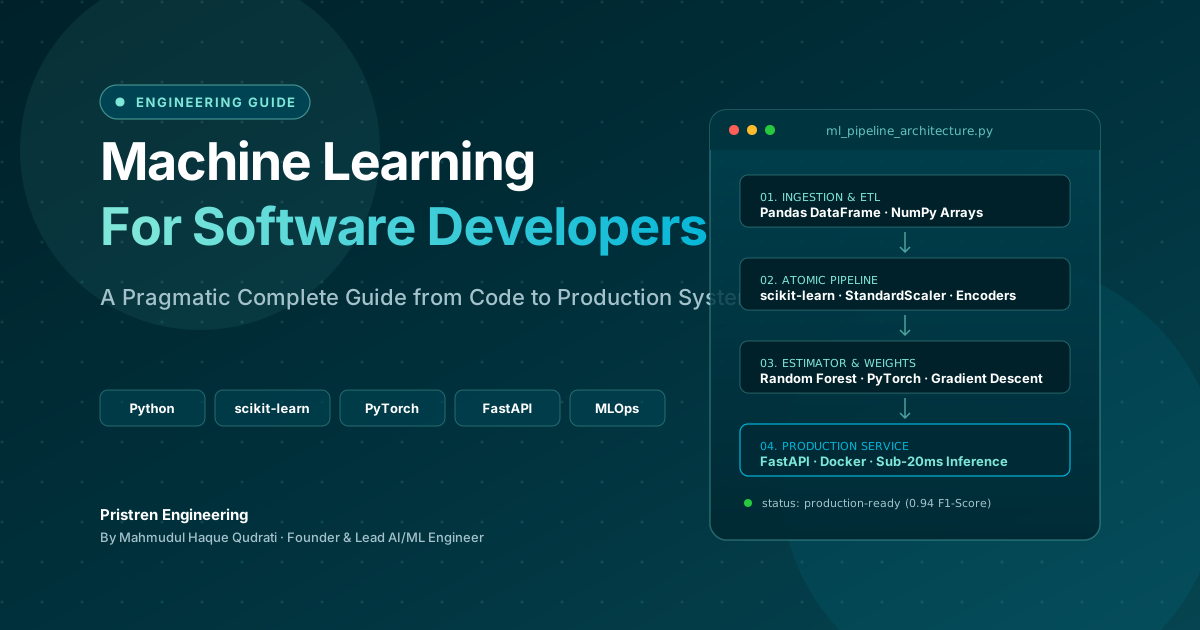
Machine Learning: Complete Guide for Software Developers
Learn machine learning as a software developer with this complete guide covering Python, algorithms, mathematics, projects, deep learning, and a practical roadmap.
 3 min read
Microsoft Starts Canceling Claude Code Licenses: What Developers Need to Know
Microsoft has started canceling Claude Code licenses for its employees, signaling a shift in AI tooling strategy. This post explains the context, implications, and what developers should consider.
 7 min read
ONNX: Export Any ML Model and Run It Anywhere
ONNX (Open Neural Network Exchange) is the universal model format - export from PyTorch, scikit-learn, or HuggingFace and run 3x faster inference with ONNX Runtime on CPU or GPU.
// discussion
Comments