Moondream2: A 1.9B VLM That Runs on a Raspberry Pi
Moondream2 is a 1.9B parameter vision-language model that fits in 1.2GB RAM when quantized, enabling image captioning, visual Q&A, and object detection on embedded hardware and edge devices.

Mahmudul Haque Qudrati
CEO & ML Engineer
April 2, 2026
7 min read
One AI engineering post, weekly
LLM benchmarks, prompt techniques, and token-cost breakdowns — not another AI news roundup.
Most vision-language models start at 7B parameters. LLaVA-7B requires 14GB VRAM in float16. For applications that need vision understanding without cloud API latency - embedded systems, mobile apps, privacy-sensitive processing - the model must fit in available RAM.
Moondream2 achieves 1.9B parameters through architectural choices that sacrifice breadth for efficiency: a smaller vision encoder, aggressive weight sharing, and training data focused on the most common vision-language tasks.
Hardware Requirements
In 4-bit quantization via GGUF format, Moondream2 requires 1.2GB RAM - enough to run on a Raspberry Pi 5 (8GB model), a mid-range smartphone, or any laptop with integrated graphics. Speed varies:
- M2 MacBook Pro (CPU): ~3 seconds per image captioning
- Raspberry Pi 5: ~15 seconds per image captioning
- RTX 3080 (GPU): ~0.5 seconds per image captioning
The HuggingFace Moondream2 page provides GGUF, safetensors, and ONNX formats.
Team workspace
Ship faster with chat, meetings, and projects in one place — Zlyqor.
Python API
python
from transformers import AutoModelForCausalLM, AutoTokenizer
from PIL import Image

model = AutoModelForCausalLM.from_pretrained(
    "vikhyatk/moondream2",
    revision="2025-01-09",
    trust_remote_code=True,
)
tokenizer = AutoTokenizer.from_pretrained("vikhyatk/moondream2", revision="2025-01-09")

image = Image.open("photo.jpg")
enc_image = model.encode_image(image)

# Image captioning
caption = model.answer_question(enc_image, "Describe this image.", tokenizer)
print(caption)

# Visual Q&A
answer = model.answer_question(enc_image, "How many people are in the image?", tokenizer)
print(answer)

# Object detection (returns bounding boxes)
objects = model.detect(image, "person")
print(objects)  # [{"x_min": 0.2, "y_min": 0.1, "x_max": 0.5, "y_max": 0.9}, ...]
Moondream Server for Batch Inference
The Moondream GitHub includes a FastAPI server that batches image requests and caches vision encodings. For pipelines processing thousands of images, caching the encoded image representation (before the text generation step) reduces compute by ~60% when the same image is queried with multiple questions.
bash
# Start the moondream server
pip install moondream
python -m moondream.server --model 2b-int8
Comparison to LLaVA-7B
| Metric | Moondream2 | LLaVA-7B |
|---|---|---|
| Parameters | 1.9B | 7B |
| RAM (4-bit) | 1.2GB | 4GB |
| Image captioning quality | Good | Better |
| Object detection | Built-in | Requires prompt tuning |
| Edge deployment | Yes | No (too slow) |
| VQA accuracy (VQAv2) | ~74% | ~80% |
For edge deployments where LLaVA-7B is impractical, Moondream2 captures most of the value at a fraction of the resource cost. For server-side inference where quality is the priority, LLaVA-7B or larger models are preferable.
#moondream2#edge-ai#vlm#small-model#vision
Mahmudul Haque Qudrati
CEO & ML Engineer
Visionary technologist, software engineer, and machine learning specialist. Founder and CEO of Pristren, directing engineering teams that ship production-grade AI/ML pipelines, mission-critical full-stack applications, and developer tooling. Creator of Zlyqor, the unified team workspace platform. Author of 540+ technical guides and benchmark research reports on large language models, agentic workflows, Model Context Protocol (MCP), and modern web stacks.

More from Mahmudul
Related Articles
 11 min read
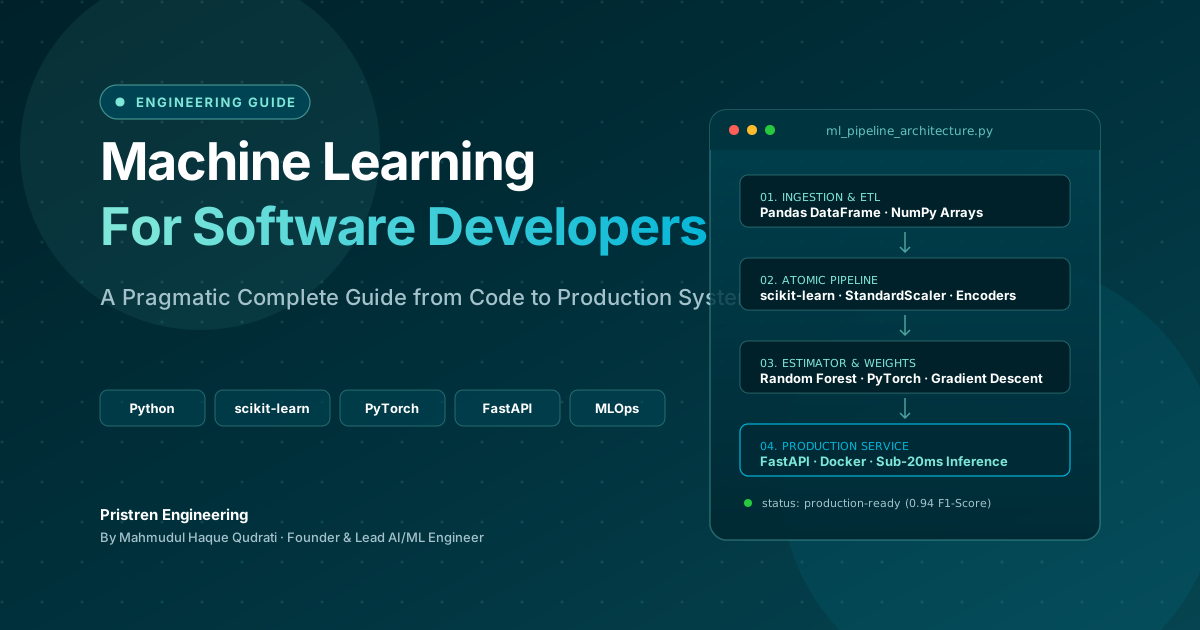
Machine Learning: Complete Guide for Software Developers
Learn machine learning as a software developer with this complete guide covering Python, algorithms, mathematics, projects, deep learning, and a practical roadmap.
 7 min read
ONNX: Export Any ML Model and Run It Anywhere
ONNX (Open Neural Network Exchange) is the universal model format - export from PyTorch, scikit-learn, or HuggingFace and run 3x faster inference with ONNX Runtime on CPU or GPU.
 9 min read
Gradient Descent Explained: How Machine Learning Models Actually Learn
Gradient descent is the engine behind every modern ML model. Here is how it works, why learning rate matters, and when to use Adam over SGD.
// discussion
Comments