MusicGen: Meta's Text-to-Music Model That Runs Locally
Meta's MusicGen generates 30-second music clips from text descriptions or melody conditioning using an EnCodec audio tokenizer and autoregressive transformer - fully open and self-hostable.

Mahmudul Haque Qudrati
CEO & ML Engineer
May 15, 2026
7 min read
One AI engineering post, weekly
LLM benchmarks, prompt techniques, and token-cost breakdowns — not another AI news roundup.
Suno and Udio produce impressive music but are closed APIs with usage limits and licensing ambiguity. MusicGen from Meta's FAIR team is fully open: Apache 2.0 license, self-hostable on a single GPU, and capable of high-quality instrumental generation from text prompts or melody conditioning.
Architecture: EnCodec + Transformer
MusicGen uses a two-stage approach:
-
EnCodec - Meta's audio codec model converts raw audio waveforms into discrete tokens across multiple codebooks (4 - 8 codebooks at different quality levels). A 30-second clip at 32 kHz becomes a sequence of approximately 1500 tokens per codebook.
-
Transformer decoder - an autoregressive model generates the EnCodec token sequence conditioned on text embeddings (from a frozen T5 encoder). The model generates all codebooks in a single forward pass using a "delay pattern" that interleaves tokens from different codebooks.
python
from transformers import AutoProcessor, MusicgenForConditionalGeneration
import torch
import scipy.io.wavfile

processor = AutoProcessor.from_pretrained("facebook/musicgen-stereo-large")
model = MusicgenForConditionalGeneration.from_pretrained(
    "facebook/musicgen-stereo-large",
    torch_dtype=torch.float16,
).to("cuda")

descriptions = [
    "upbeat jazz piano trio, 120 BPM, walking bass, brushed drums, no vocals",
    "ambient electronic, slow evolving pads, 60 BPM, cinematic, minor key",
]

inputs = processor(text=descriptions, padding=True, return_tensors="pt").to("cuda")

# Generate 15 seconds of audio (256 tokens ≈ 5 seconds, so 750 for 15s)
audio_values = model.generate(**inputs, max_new_tokens=750)

# Save as WAV
sampling_rate = model.config.audio_encoder.sampling_rate  # 32000
for i, audio in enumerate(audio_values.cpu().numpy()):
    scipy.io.wavfile.write(f"output_{i}.wav", rate=sampling_rate, data=audio.T)
Team workspace
Ship faster with chat, meetings, and projects in one place — Zlyqor.
Melody Conditioning
MusicGen can continue or harmonize with an existing melody:
python
from transformers import AutoProcessor, MusicgenForConditionalGeneration
import torchaudio

processor = AutoProcessor.from_pretrained("facebook/musicgen-melody")
model = MusicgenForConditionalGeneration.from_pretrained("facebook/musicgen-melody").to("cuda")

# Load reference melody
melody_waveform, sr = torchaudio.load("melody_reference.wav")

inputs = processor(
    audio=melody_waveform.numpy(),
    sampling_rate=sr,
    text=["orchestral arrangement, strings, cinematic"],
    return_tensors="pt",
    padding=True,
).to("cuda")

audio_values = model.generate(**inputs, max_new_tokens=500)
Model Sizes and Quality Trade-offs
| Variant | Parameters | VRAM | Quality |
|---|---|---|---|
| musicgen-small | 300M | ~4GB | Adequate for prototyping |
| musicgen-medium | 1.5B | ~8GB | Good for most use cases |
| musicgen-large | 3.3B | ~16GB | High quality |
| musicgen-stereo-large | 3.3B | ~16GB | Stereo output, recommended |
MusicGen vs Suno/Udio
Suno and Udio generate vocals and lyrics in addition to instrumentals - MusicGen is instrumental only. On pure instrumental quality, MusicGen large is competitive with early Suno but falls short of Suno v3/v4. The trade-offs: MusicGen is open, self-hostable, and has no usage limits or licensing concerns about using generated music commercially.
Real Use Cases
Background music for YouTube videos (avoiding copyright claims), game soundtrack generation for indie developers, podcast intro/outro generation, and rapid music prototyping for composers who want to hear a harmonic idea before writing notation.
Links
#musicgen#meta#music-generation#audio-ai#encodec
Mahmudul Haque Qudrati
CEO & ML Engineer
Visionary technologist, software engineer, and machine learning specialist. Founder and CEO of Pristren, directing engineering teams that ship production-grade AI/ML pipelines, mission-critical full-stack applications, and developer tooling. Creator of Zlyqor, the unified team workspace platform. Author of 540+ technical guides and benchmark research reports on large language models, agentic workflows, Model Context Protocol (MCP), and modern web stacks.


More from Mahmudul
Related Articles
 11 min read
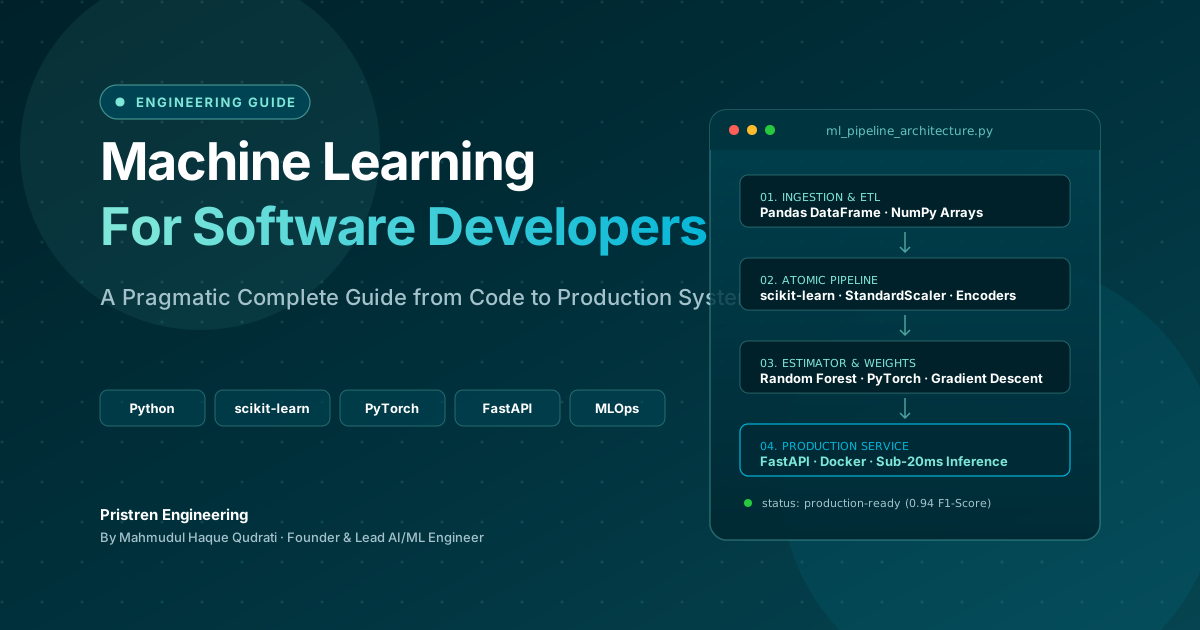
Machine Learning: Complete Guide for Software Developers
Learn machine learning as a software developer with this complete guide covering Python, algorithms, mathematics, projects, deep learning, and a practical roadmap.
 7 min read
ONNX: Export Any ML Model and Run It Anywhere
ONNX (Open Neural Network Exchange) is the universal model format - export from PyTorch, scikit-learn, or HuggingFace and run 3x faster inference with ONNX Runtime on CPU or GPU.
 9 min read
Gradient Descent Explained: How Machine Learning Models Actually Learn
Gradient descent is the engine behind every modern ML model. Here is how it works, why learning rate matters, and when to use Adam over SGD.
// discussion
Comments