NVIDIA Nemotron-4 340B and Llama-3.1-Nemotron-70B: Enterprise LLMs From NVIDIA
NVIDIA entered the foundation model market with two distinct plays: Nemotron-4 340B for synthetic data generation pipelines, and Llama-3.1-Nemotron-70B-Instruct with an Arena Hard score of 85.1% for enterprise inference.

Mahmudul Haque Qudrati
CEO & ML Engineer
April 5, 2026
5 min read
Contents
- Two Models, Two Use Cases
- Nemotron-4 340B: Synthetic Data Pipeline
- Reward Model for Preference Scoring
- Llama-3.1-Nemotron-70B-Instruct: Benchmark Results
- NVIDIA NIM Microservices
- When to Choose Nemotron
- How Does Nemotron Work?
- Best Practices for Using Nemotron
- Pricing and Availability
- Is Nemotron Worth It in 2025?
- Links
One AI engineering post, weekly
LLM benchmarks, prompt techniques, and token-cost breakdowns — not another AI news roundup.
NVIDIA released two distinct Nemotron products in 2024, and they serve different purposes:
Nemotron-4 340B is designed primarily as a synthetic data generation engine. Its value is not raw reasoning performance — it is the ability to produce high-quality, diverse training data at scale. Teams use it to bootstrap smaller specialized models without needing human annotation at scale.
Llama-3.1-Nemotron-70B-Instruct is NVIDIA's fine-tune of Meta's Llama 3.1 70B for enterprise instruction following. It scores 85.1% on Arena Hard, placing it above standard Llama 3.1 70B and competitive with larger models.
Nemotron-4 340B: Synthetic Data Pipeline
The core use case is generating training data for downstream model fine-tuning. NVIDIA designed the model to be run as a teacher in a teacher-student training setup:
python
from openai import OpenAI

client = OpenAI(
    base_url="https://integrate.api.nvidia.com/v1",
    api_key="YOUR_NVIDIA_KEY",
)

# Generate diverse question-answer pairs for fine-tuning a customer support model
response = client.chat.completions.create(
    model="nvidia/nemotron-4-340b-instruct",
    messages=[
        {
            "role": "user",
            "content": """Generate 5 diverse customer support questions about SaaS billing,
            each with a high-quality answer. Format as JSON array with 'question' and 'answer' keys."""
        }
    ],
    temperature=0.9,
    top_p=0.95,
)
The higher temperature encourages diversity across the generated pairs. You can then filter these with a reward model before using them for fine-tuning.
Team workspace
Ship faster with chat, meetings, and projects in one place — Zlyqor.
Reward Model for Preference Scoring
NVIDIA also released a reward model (Nemotron-4-340B-Reward) that scores generated text on five dimensions: helpfulness, correctness, coherence, complexity, and verbosity. This is useful for building RLHF pipelines without human preference labels:
python
reward_response = client.chat.completions.create(
    model="nvidia/nemotron-4-340b-reward",
    messages=[
        {"role": "user", "content": "What is gradient descent?"},
        {"role": "assistant", "content": "Gradient descent is an optimization algorithm..."},
    ],
)
# Response contains reward scores as logprobs, not text
Llama-3.1-Nemotron-70B-Instruct: Benchmark Results
| Benchmark | Llama 3.1 70B Instruct | Nemotron-70B | Improvement |
|---|---|---|---|
| Arena Hard | 55.7% | 85.1% | +29.4 points |
| AlpacaEval 2.0 LC | 57.3% | 85.0% | +27.7 points |
| MT-Bench | 8.22 | 8.98 | +0.76 |
The improvement comes from a multi-stage alignment process: SFT on curated data, then iterative DPO rounds using the Nemotron reward model to score and filter preference pairs. The reward model trains the preference model, which trains the next iteration of the instruct model.
NVIDIA NIM Microservices
For enterprise teams, NVIDIA NIM (NVIDIA Inference Microservices) packages these models as containers that can be deployed on any cloud or on-premises GPU infrastructure:
bash
docker run -it --gpus all \
  -e NGC_API_KEY=$NGC_API_KEY \
  -p 8000:8000 \
  nvcr.io/nim/meta/llama-3.1-nemotron-70b-instruct:latest
The container exposes an OpenAI-compatible API on port 8000, handles model loading and optimization automatically, and includes TensorRT-LLM for optimized inference throughput.
When to Choose Nemotron
- You are building a synthetic data pipeline and want a large, capable teacher model
- You need an aligned 70B-class model and do not want to run your own RLHF pipeline
- You are already on NVIDIA infrastructure and want the NIM deployment model
- You want a reward model for filtering generated data before fine-tuning
How Does Nemotron Work?
Nemotron-4 340B is a transformer-based autoregressive language model trained on a large corpus of text. It uses a mixture of experts (MoE) architecture to achieve high capacity with efficient inference. The model is fine-tuned with supervised learning on instruction data and then aligned via reinforcement learning from human feedback (RLHF) using the Nemotron reward model. The reward model itself is trained on human preference data across five dimensions. For Llama-3.1-Nemotron-70B, NVIDIA applied a multi-stage alignment: first supervised fine-tuning on curated data, then iterative direct preference optimization (DPO) where the reward model scores candidate responses and the instruct model is updated to prefer higher-scoring ones.
Best Practices for Using Nemotron
- Synthetic data generation: Use Nemotron-4 340B with temperature 0.8–1.0 and top_p 0.95 to generate diverse training examples. Always filter generated data with the reward model to remove low-quality samples.
- Fine-tuning downstream models: Use the generated and filtered data to fine-tune smaller models (e.g., 7B or 13B) for specific tasks. This avoids the cost of running the 340B model at inference time.
- Deployment with NIM: Use the NIM container for production inference. It includes TensorRT-LLM optimizations that can double throughput compared to vanilla vLLM.
- Reward model filtering: When using the reward model, set thresholds for each dimension based on your task. For example, for factual tasks, prioritize correctness over verbosity.
- Iterative DPO: If you have your own preference data, you can continue training Llama-3.1-Nemotron-70B using the Nemotron reward model as a scorer.
Pricing and Availability
NVIDIA Nemotron models are available via the NVIDIA API (pay-per-token) and through the NVIDIA AI Enterprise software platform (annual subscription). As of 2025, pricing for the API is approximately $0.01 per 1K tokens for Nemotron-4 340B and $0.005 per 1K tokens for Llama-3.1-Nemotron-70B. Enterprise customers can also license the models for on-premises deployment via NIM, with pricing based on GPU hours. For the latest pricing, check the NVIDIA API catalog or contact NVIDIA sales.
Is Nemotron Worth It in 2025?
For teams building custom LLMs, Nemotron-4 340B is a strong choice for synthetic data generation, especially if you already have NVIDIA GPU infrastructure. The reward model adds value for RLHF pipelines. Llama-3.1-Nemotron-70B offers top-tier performance for a 70B model, beating many larger models on benchmarks. However, consider the cost: running a 340B model requires significant GPU memory (multiple A100 80GB GPUs). If you don't need the scale, smaller models like Llama 3.1 8B may suffice. Overall, Nemotron is worth it if you need high-quality synthetic data or a state-of-the-art 70B instruct model, and you have the infrastructure to support it.
Links
Frequently Asked Questions
What is NVIDIA Nemotron-4 340B and Llama-3.1-Nemotron-70B?
NVIDIA Nemotron-4 340B is a large language model designed for synthetic data generation, while Llama-3.1-Nemotron-70B is a fine-tuned version of Meta's Llama 3.1 70B optimized for instruction following. Both are part of NVIDIA's enterprise LLM offerings, with the 340B model serving as a teacher for generating training data and the 70B model providing high-performance inference.
How does NVIDIA Nemotron-4 340B and Llama-3.1-Nemotron-70B work?
Nemotron-4 340B uses a transformer-based mixture-of-experts architecture trained on large text corpora. It is fine-tuned with supervised learning and aligned via RLHF using a reward model. Llama-3.1-Nemotron-70B undergoes multi-stage alignment: supervised fine-tuning on curated data, then iterative direct preference optimization (DPO) where the Nemotron reward model scores responses to improve the instruct model.
What are the best practices for using NVIDIA Nemotron models?
Best practices include: using Nemotron-4 340B with temperature 0.8–1.0 for diverse synthetic data generation; filtering generated data with the reward model; fine-tuning smaller downstream models; deploying via NIM containers for optimized inference; and setting reward thresholds based on task requirements.
How much does NVIDIA Nemotron cost?
As of 2025, NVIDIA API pricing is approximately $0.01 per 1K tokens for Nemotron-4 340B and $0.005 per 1K tokens for Llama-3.1-Nemotron-70B. Enterprise on-premises licensing via NIM is based on GPU hours. Check the NVIDIA API catalog for current pricing.
Is NVIDIA Nemotron worth it in 2025?
Nemotron is worth it if you need high-quality synthetic data or a top-performing 70B instruct model and have the GPU infrastructure. The 340B model excels for data generation, while the 70B model beats many larger models on benchmarks. However, consider costs and whether smaller models meet your needs.
#nvidia#nemotron#enterprise#reward-model#synthetic-data
Mahmudul Haque Qudrati
CEO & ML Engineer
Visionary technologist, software engineer, and machine learning specialist. Founder and CEO of Pristren, directing engineering teams that ship production-grade AI/ML pipelines, mission-critical full-stack applications, and developer tooling. Creator of Zlyqor, the unified team workspace platform. Author of 540+ technical guides and benchmark research reports on large language models, agentic workflows, Model Context Protocol (MCP), and modern web stacks.


More from Mahmudul
Related Articles
 11 min read
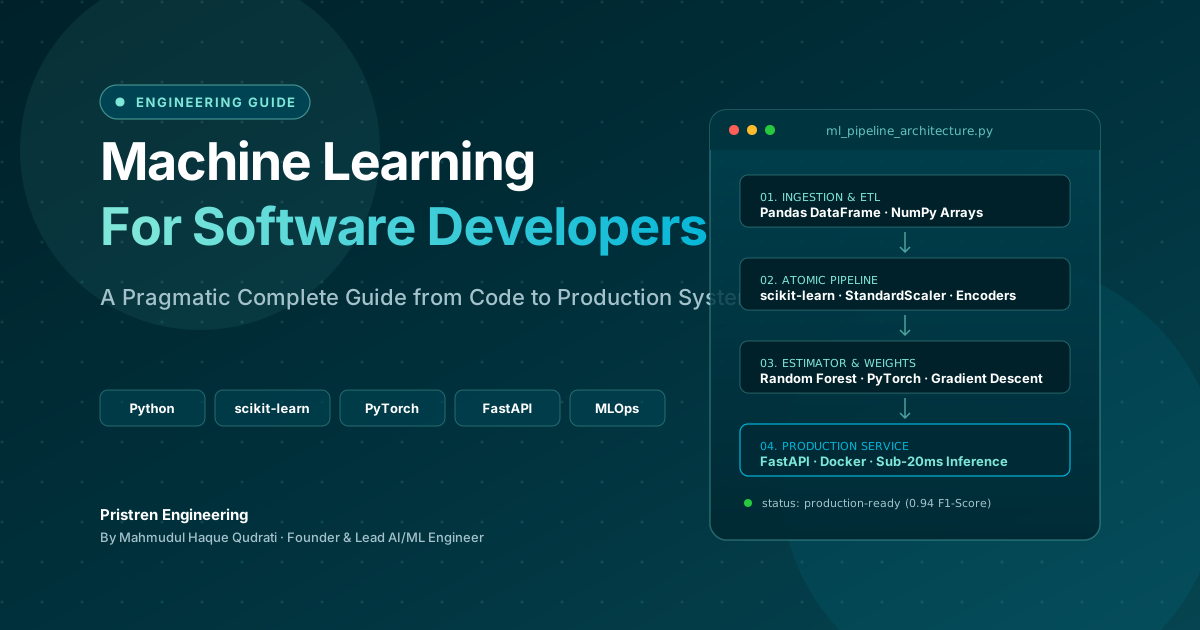
Machine Learning: Complete Guide for Software Developers
Learn machine learning as a software developer with this complete guide covering Python, algorithms, mathematics, projects, deep learning, and a practical roadmap.
 7 min read
ONNX: Export Any ML Model and Run It Anywhere
ONNX (Open Neural Network Exchange) is the universal model format - export from PyTorch, scikit-learn, or HuggingFace and run 3x faster inference with ONNX Runtime on CPU or GPU.
 9 min read
Using LLMs for Business Analysis and Decision Support: What Works, What Doesn't
Where LLMs genuinely add value in business analysis, where they are unreliable, and the analyst workflow that gets results without creating liability.
// discussion
Comments