PEFT and LoRA: Fine-Tune a 7B LLM on a Single GPU in 2026
The PEFT library with LoRA and QLoRA enables fine-tuning 7B parameter LLMs on a single consumer GPU by updating only a small fraction of parameters, reducing VRAM from 14GB to under 5GB.

Mahmudul Haque Qudrati
CEO & ML Engineer
May 16, 2026
4 min read
Contents
- PEFT Library Overview
- LoRA: How It Works
- Memory Usage: 7B fp16 vs QLoRA
- Full QLoRA Training Script
- Merging and Pushing to HuggingFace Hub
- Dataset Formats
- Best Practices for PEFT and LoRA in 2026
- Cost Analysis: PEFT vs Full Fine-Tuning
- Common Pitfalls and How to Avoid Them
- Future Trends: PEFT in 2026
- Conclusion
One AI engineering post, weekly
LLM benchmarks, prompt techniques, and token-cost breakdowns — not another AI news roundup.
The PEFT (Parameter-Efficient Fine-Tuning) library from HuggingFace implements four main techniques:
- LoRA: Low-rank adaptation - adds trainable rank decomposition matrices to attention layers
- QLoRA: LoRA on a 4-bit quantized base model - the memory breakthrough
- Prefix tuning: Prepends learned virtual tokens to the input
- IA3: Infused Adapter by Inhibiting and Amplifying - even smaller than LoRA
LoRA and QLoRA dominate production use because they're compatible with most architectures and merge back into the base model at inference time.
LoRA: How It Works
LoRA decomposes weight updates into low-rank matrices. For a weight matrix W (d × k), instead of updating W directly, LoRA learns two matrices: A (d × r) and B (r × k), where r << min(d, k). The effective weight update is BA, but only A and B are trained.
Key hyperparameters:
- r (rank): 8-64 typically. Higher r = more capacity but more memory. Start with r=16.
- lora_alpha: Scaling factor, usually 2× the rank value (alpha=32 for r=16)
- target_modules: Which layers to apply LoRA to. For LLaMA:
["q_proj", "v_proj"]or all attention layers
Team workspace
Ship faster with chat, meetings, and projects in one place — Zlyqor.
Memory Usage: 7B fp16 vs QLoRA
| Configuration | VRAM Required |
|---|---|
| 7B fp16 (full fine-tune) | 28GB+ |
| 7B fp16 (inference only) | 14GB |
| 7B int8 + LoRA | 10GB |
| 7B int4 (QLoRA) | 4-5GB |
| 7B int4 + gradient checkpointing | 3.5-4GB |
QLoRA makes 7B fine-tuning possible on a single RTX 4090 (24GB) or even an RTX 3090/4080 (16-24GB).
Full QLoRA Training Script
python
import torch
from transformers import AutoModelForCausalLM, AutoTokenizer, BitsAndBytesConfig, TrainingArguments
from peft import LoraConfig, get_peft_model, prepare_model_for_kbit_training
from trl import SFTTrainer
from datasets import load_dataset

# 4-bit quantization config
bnb_config = BitsAndBytesConfig(
    load_in_4bit=True,
    bnb_4bit_quant_type="nf4",
    bnb_4bit_compute_dtype=torch.bfloat16,
    bnb_4bit_use_double_quant=True,
)

model = AutoModelForCausalLM.from_pretrained(
    "meta-llama/Llama-2-7b-hf",
    quantization_config=bnb_config,
    device_map="auto",
)
tokenizer = AutoTokenizer.from_pretrained("meta-llama/Llama-2-7b-hf")
tokenizer.pad_token = tokenizer.eos_token

model = prepare_model_for_kbit_training(model)

lora_config = LoraConfig(
    r=16,
    lora_alpha=32,
    target_modules=["q_proj", "k_proj", "v_proj", "o_proj"],
    lora_dropout=0.05,
    bias="none",
    task_type="CAUSAL_LM",
)
model = get_peft_model(model, lora_config)
model.print_trainable_parameters()
# trainable params: 33,554,432 || all params: 6,771,970,048 || trainable%: 0.4955

dataset = load_dataset("timdettmers/openassistant-guanaco", split="train")

training_args = TrainingArguments(
    output_dir="./llama2-7b-finetuned",
    num_train_epochs=1,
    per_device_train_batch_size=2,
    gradient_accumulation_steps=8,  # Effective batch size = 16
    gradient_checkpointing=True,
    optim="paged_adamw_32bit",
    learning_rate=2e-4,
    bf16=True,
    logging_steps=25,
    save_strategy="epoch",
)

trainer = SFTTrainer(
    model=model,
    train_dataset=dataset,
    args=training_args,
    dataset_text_field="text",
    max_seq_length=2048,
)
trainer.train()
Merging and Pushing to HuggingFace Hub
After training, merge the LoRA weights back into the base model for standard inference:
python
from peft import PeftModel
from transformers import AutoModelForCausalLM

base_model = AutoModelForCausalLM.from_pretrained("meta-llama/Llama-2-7b-hf", torch_dtype=torch.float16)
model = PeftModel.from_pretrained(base_model, "./llama2-7b-finetuned/checkpoint-final")
merged_model = model.merge_and_unload()

merged_model.push_to_hub("your-username/llama2-7b-custom")
tokenizer.push_to_hub("your-username/llama2-7b-custom")
Dataset Formats
The TRL SFTTrainer accepts two common formats:
Alpaca format (instruction/input/output fields):
json
{"instruction": "Summarize this text", "input": "Long text here...", "output": "Short summary."}
ShareGPT format (conversations array):
json
{"conversations": [{"from": "human", "value": "Hello"}, {"from": "gpt", "value": "Hi there!"}]}
The QLoRA paper demonstrates that QLoRA fine-tuned Guanaco-65B matches ChatGPT on the Vicuna benchmark - proving that 4-bit quantization with LoRA does not meaningfully degrade fine-tune quality versus full precision training.
Best Practices for PEFT and LoRA in 2026
Choosing the Right Rank
Start with r=16 for most tasks. For domain adaptation (e.g., legal, medical), r=32 may capture more nuanced patterns. For simple instruction tuning, r=8 is often sufficient. Monitor validation loss to avoid overfitting.
Target Modules Selection
For decoder-only models like LLaMA, target ["q_proj", "v_proj"] is a safe default. Adding k_proj and o_proj increases capacity but also memory. For encoder-decoder models (T5, Flan-T5), target attention and feed-forward layers.
Learning Rate Scheduling
Use a cosine schedule with warmup (10% of steps). QLoRA typically works well with learning rates between 1e-4 and 3e-4. For full LoRA (no quantization), lower to 1e-5 to 5e-5.
Gradient Checkpointing
Always enable gradient checkpointing when VRAM is tight. It trades compute for memory, reducing VRAM by ~30% with minimal slowdown.
Mixed Precision Training
Use bf16 if your GPU supports it (Ampere and later). Otherwise, fp16 with gradient scaling. This halves memory usage compared to fp32.
Cost Analysis: PEFT vs Full Fine-Tuning
| Method | GPU Hours (7B) | Cloud Cost (approx) |
|---|---|---|
| Full fine-tune (fp16) | 48 hrs on A100 | $200-400 |
| QLoRA (int4) | 12 hrs on RTX 4090 | $10-20 (spot) |
| LoRA (int8) | 20 hrs on RTX 4090 | $15-30 (spot) |
QLoRA reduces costs by 10-20x, making fine-tuning accessible to individuals and small teams.
Common Pitfalls and How to Avoid Them
Overfitting on Small Datasets
If your dataset has <1000 examples, use higher dropout (0.1-0.2) and lower rank (r=8). Monitor training loss vs eval loss.
Tokenizer Mismatch
Ensure the tokenizer matches the base model. Adding new tokens requires resizing embeddings and may degrade performance.
Forgetting to Merge Weights
For deployment, always merge LoRA weights into the base model. Loading separate adapters adds latency and complexity.
Future Trends: PEFT in 2026
By 2026, PEFT techniques have evolved:
- DoRA: Weight-decomposed low-rank adaptation, outperforming LoRA on several benchmarks.
- LoRA-FA: Freezes the random projection matrix A, reducing memory further.
- Multi-task LoRA: Shares adapters across tasks with task-specific scaling.
Despite these innovations, LoRA and QLoRA remain the go-to choices due to their simplicity and broad support.
Conclusion
PEFT and LoRA have democratized LLM fine-tuning. With QLoRA, anyone with a consumer GPU can fine-tune a 7B model for under $20. The key is understanding hyperparameters, quantization trade-offs, and proper training setup. Start with the provided script, experiment with rank and target modules, and iterate from there.
Frequently Asked Questions
What is PEFT and LoRA: Fine-Tune a 7B LLM on a Single GPU in 2026?
PEFT (Parameter-Efficient Fine-Tuning) is a library that enables fine-tuning large language models by updating only a small fraction of parameters. LoRA (Low-Rank Adaptation) is a technique within PEFT that adds trainable low-rank matrices to attention layers. In 2026, combining PEFT with LoRA and QLoRA (4-bit quantization) allows fine-tuning a 7B parameter LLM on a single consumer GPU like an RTX 4090, reducing VRAM requirements from 28GB+ to under 5GB.
How does PEFT and LoRA: Fine-Tune a 7B LLM on a Single GPU in 2026 work?
PEFT and LoRA work by freezing the base model weights and inserting small trainable matrices (LoRA adapters) into the attention layers. During training, only these adapters are updated, drastically reducing memory usage. QLoRA further quantizes the base model to 4-bit precision, enabling the entire process to fit in less than 5GB of VRAM. The adapters can later be merged back into the base model for inference.
What are the best practices for PEFT and LoRA: Fine-Tune a 7B LLM on a Single GPU in 2026?
Best practices include: starting with rank r=16, targeting attention modules (q_proj, v_proj), using a learning rate of 2e-4 with cosine scheduling, enabling gradient checkpointing, using bf16 mixed precision, and monitoring validation loss to avoid overfitting. For small datasets, increase dropout and use lower rank. Always merge adapters before deployment.
How much does PEFT and LoRA: Fine-Tune a 7B LLM on a Single GPU in 2026 cost?
Using QLoRA on a single RTX 4090, fine-tuning a 7B model typically costs $10-20 in cloud GPU time (spot instances) for a 12-hour run. Full fine-tuning on an A100 would cost $200-400. PEFT reduces costs by 10-20x, making it affordable for individuals and small teams.
Is PEFT and LoRA: Fine-Tune a 7B LLM on a Single GPU in 2026 worth it in 2026?
Yes, PEFT and LoRA are highly worth it in 2026. They enable fine-tuning state-of-the-art 7B models on consumer hardware, drastically lowering the barrier to entry. The quality of QLoRA fine-tuning is comparable to full fine-tuning, as shown in the QLoRA paper. For most use cases, the trade-off in memory vs. performance is negligible, making it the standard approach for customizing LLMs.
#peft#lora#fine-tuning#qlora#huggingface
Mahmudul Haque Qudrati
CEO & ML Engineer
Visionary technologist, software engineer, and machine learning specialist. Founder and CEO of Pristren, directing engineering teams that ship production-grade AI/ML pipelines, mission-critical full-stack applications, and developer tooling. Creator of Zlyqor, the unified team workspace platform. Author of 540+ technical guides and benchmark research reports on large language models, agentic workflows, Model Context Protocol (MCP), and modern web stacks.

More from Mahmudul
Related Articles
 11 min read
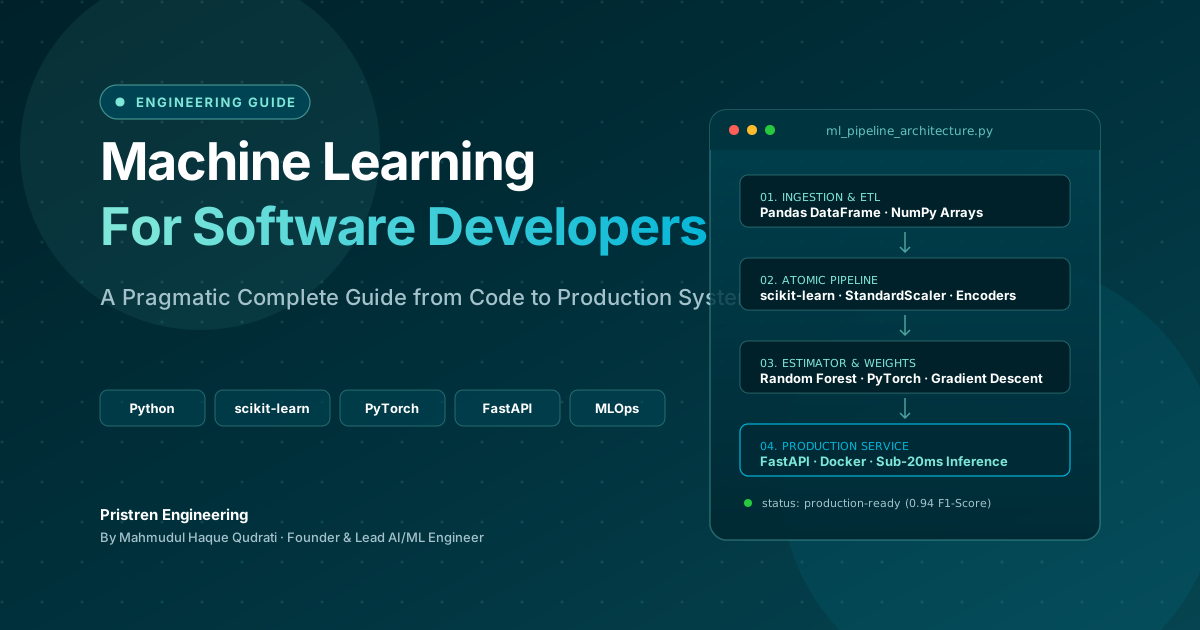
Machine Learning: Complete Guide for Software Developers
Learn machine learning as a software developer with this complete guide covering Python, algorithms, mathematics, projects, deep learning, and a practical roadmap.
 7 min read
ONNX: Export Any ML Model and Run It Anywhere
ONNX (Open Neural Network Exchange) is the universal model format - export from PyTorch, scikit-learn, or HuggingFace and run 3x faster inference with ONNX Runtime on CPU or GPU.
 9 min read
Gradient Descent Explained: How Machine Learning Models Actually Learn
Gradient descent is the engine behind every modern ML model. Here is how it works, why learning rate matters, and when to use Adam over SGD.
// discussion
Comments