Phi-3 Mini: Running a 3.8B Parameter LLM On Your Phone
Phi-3 Mini at 3.8B parameters outperforms Mixtral 8x7B on several benchmarks and runs in browsers via WebGPU or on Android/iOS via ONNX. Here's how.

Mahmudul Haque Qudrati
CEO & ML Engineer
March 31, 2026
7 min read
One AI engineering post, weekly
LLM benchmarks, prompt techniques, and token-cost breakdowns — not another AI news roundup.
Microsoft's Phi-3 Mini challenges the assumption that bigger always means better. At just 3.8 billion parameters, it outperforms models 10-20x its size on key benchmarks - a result of careful training data curation using a "textbook quality" synthetic dataset approach.
MT-Bench score: 8.38 vs Mixtral 8x7B at 8.30. That's a 47B parameter model losing to a 3.8B model on instruction following.
Why It's Fast Enough for the Edge
Phi-3 Mini's 3.8B parameters (in INT4 quantization: ~2GB) fit in the memory constraints of:
- Modern smartphones (iPhone 15 Pro, Pixel 8 Pro)
- WebGPU in Chrome/Edge (4GB GPU budget)
- Raspberry Pi 5 with 8GB RAM
- Single consumer GPU (RTX 3060 12GB)
The full paper details the training methodology, which relies heavily on filtered web data and synthetically generated "textbook" content.
Team workspace
Ship faster with chat, meetings, and projects in one place — Zlyqor.
128k Context
Despite its small size, Phi-3 Mini supports a 128k token context window - the same as GPT-4o and Llama 3.1. This is unusual for edge-class models and enables long-document tasks even on device.
Running in the Browser With WebGPU
Using transformers.js, Phi-3 Mini runs entirely client-side:
javascript
import { pipeline } from "@xenova/transformers";

const generator = await pipeline(
  "text-generation",
  "Xenova/Phi-3-mini-4k-instruct"
);

const result = await generator("Explain recursion briefly:", {
  max_new_tokens: 200,
  temperature: 0.7,
});

console.log(result[0].generated_text);
No API calls, no server, no data leaving the browser. First load downloads ~2GB of weights to the browser cache; subsequent loads are instant.
Android and iOS Deployment via ONNX
Export to ONNX for mobile inference:
bash
pip install optimum onnxruntime
python -m optimum.exporters.onnx     --model microsoft/Phi-3-mini-128k-instruct     --task text-generation-with-past     onnx_output/
The exported model integrates with ONNX Runtime Mobile for iOS/Android apps. Microsoft's ONNX Runtime GenAI provides a Swift/Kotlin API wrapper.
Ollama for Local Desktop Use
bash
ollama pull phi3:mini
ollama run phi3:mini "Write a regex to extract email addresses."
Benchmark Comparison
| Benchmark | Phi-3 Mini (3.8B) | Mixtral 8x7B (47B) | Llama 3 8B |
|---|---|---|---|
| MT-Bench | 8.38 | 8.30 | 8.15 |
| MMLU | 68.8% | 70.5% | 66.6% |
| HumanEval | 60.9% | 45.1% | 60.4% |
| TriviaQA | 64.5% | 73.2% | 67.6% |
Summary
Phi-3 Mini is the best model in the sub-4B class for instruction following and code generation. Use it for on-device inference where privacy or latency is paramount, or in browser applications that can't rely on an API. Model available at HuggingFace.
#phi-3#microsoft#edge-ai#small-models#on-device
Mahmudul Haque Qudrati
CEO & ML Engineer
Visionary technologist, software engineer, and machine learning specialist. Founder and CEO of Pristren, directing engineering teams that ship production-grade AI/ML pipelines, mission-critical full-stack applications, and developer tooling. Creator of Zlyqor, the unified team workspace platform. Author of 540+ technical guides and benchmark research reports on large language models, agentic workflows, Model Context Protocol (MCP), and modern web stacks.


More from Mahmudul
Related Articles
 11 min read
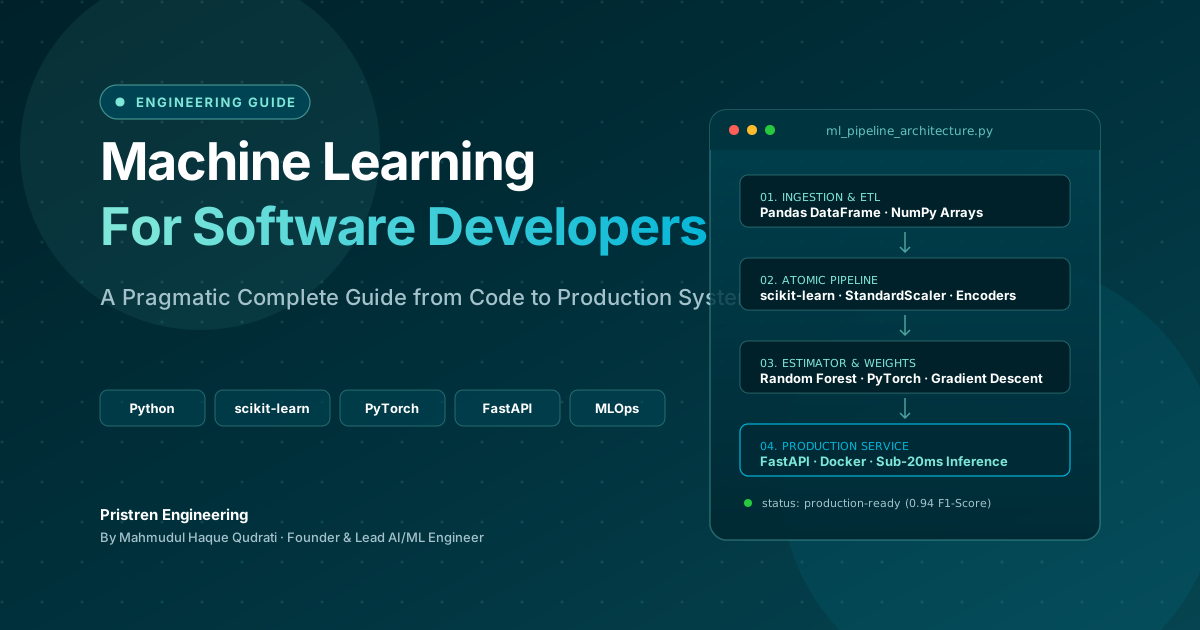
Machine Learning: Complete Guide for Software Developers
Learn machine learning as a software developer with this complete guide covering Python, algorithms, mathematics, projects, deep learning, and a practical roadmap.
 3 min read
Microsoft Starts Canceling Claude Code Licenses: What Developers Need to Know
Microsoft has started canceling Claude Code licenses for its employees, signaling a shift in AI tooling strategy. This post explains the context, implications, and what developers should consider.
 7 min read
ONNX: Export Any ML Model and Run It Anywhere
ONNX (Open Neural Network Exchange) is the universal model format - export from PyTorch, scikit-learn, or HuggingFace and run 3x faster inference with ONNX Runtime on CPU or GPU.
// discussion
Comments