PyTorch Lightning: Write Research-Grade PyTorch Without the Boilerplate
PyTorch Lightning separates research code from engineering code - write your model logic once and get multi-GPU, mixed precision, gradient clipping, and logging for free.

Mahmudul Haque Qudrati
CEO & ML Engineer
April 27, 2026
7 min read
One AI engineering post, weekly
LLM benchmarks, prompt techniques, and token-cost breakdowns — not another AI news roundup.
Training a PyTorch model from scratch means writing hundreds of lines of boilerplate: the training loop, validation loop, optimizer step, gradient zeroing, device management, mixed precision scaler, distributed training setup, checkpoint saving, and metric logging. Every project replicates this code, and every replication introduces subtle bugs.
PyTorch Lightning separates your research code (what your model does) from engineering code (how training runs). Write the model; Lightning handles the rest.
LightningModule: The Core Pattern
python
import torch
import torch.nn as nn
import pytorch_lightning as pl
from torch.optim import AdamW
from torch.optim.lr_scheduler import CosineAnnealingLR

class TextClassifier(pl.LightningModule):
    def __init__(self, vocab_size: int, hidden_dim: int, num_classes: int, lr: float = 1e-3):
        super().__init__()
        self.save_hyperparameters()
        self.embedding = nn.Embedding(vocab_size, hidden_dim)
        self.transformer = nn.TransformerEncoder(
            nn.TransformerEncoderLayer(hidden_dim, nhead=8, batch_first=True),
            num_layers=4,
        )
        self.classifier = nn.Linear(hidden_dim, num_classes)
        self.loss_fn = nn.CrossEntropyLoss()

    def forward(self, x: torch.Tensor) -> torch.Tensor:
        x = self.embedding(x)
        x = self.transformer(x)
        return self.classifier(x[:, 0])  # CLS token

    def training_step(self, batch, batch_idx):
        x, y = batch
        logits = self(x)
        loss = self.loss_fn(logits, y)
        self.log("train_loss", loss, prog_bar=True)
        return loss

    def validation_step(self, batch, batch_idx):
        x, y = batch
        logits = self(x)
        loss = self.loss_fn(logits, y)
        acc = (logits.argmax(dim=-1) == y).float().mean()
        self.log_dict({"val_loss": loss, "val_acc": acc}, prog_bar=True)

    def configure_optimizers(self):
        optimizer = AdamW(self.parameters(), lr=self.hparams.lr, weight_decay=0.01)
        scheduler = CosineAnnealingLR(optimizer, T_max=100)
        return {"optimizer": optimizer, "lr_scheduler": scheduler}
Team workspace
Ship faster with chat, meetings, and projects in one place — Zlyqor.
Trainer: Everything Else
python
from pytorch_lightning import Trainer
from pytorch_lightning.callbacks import ModelCheckpoint, EarlyStopping, LearningRateMonitor
from pytorch_lightning.loggers import WandbLogger

trainer = Trainer(
    max_epochs=100,
    accelerator="gpu",
    devices=4,                     # 4 GPUs  -  DDP automatically
    precision="bf16-mixed",        # mixed precision
    gradient_clip_val=1.0,         # gradient clipping
    accumulate_grad_batches=4,     # gradient accumulation
    callbacks=[
        ModelCheckpoint(monitor="val_loss", save_top_k=3, mode="min"),
        EarlyStopping(monitor="val_loss", patience=10),
        LearningRateMonitor(),
    ],
    logger=WandbLogger(project="my-project"),
)

model = TextClassifier(vocab_size=30000, hidden_dim=256, num_classes=5)
trainer.fit(model, train_dataloader, val_dataloader)
One line to go from 1 GPU to 4 GPUs with DDP. No DistributedDataParallel setup, no manual sampler changes.
LightningDataModule for Reproducible Data
python
class TextDataModule(pl.LightningDataModule):
    def __init__(self, data_dir: str, batch_size: int = 32):
        super().__init__()
        self.data_dir = data_dir
        self.batch_size = batch_size

    def setup(self, stage: str):
        self.train_dataset = TextDataset(self.data_dir, split="train")
        self.val_dataset = TextDataset(self.data_dir, split="val")

    def train_dataloader(self):
        return DataLoader(self.train_dataset, batch_size=self.batch_size, shuffle=True, num_workers=4)

    def val_dataloader(self):
        return DataLoader(self.val_dataset, batch_size=self.batch_size, num_workers=4)
Lightning vs Raw PyTorch
Lightning adds roughly 20% overhead compared to a perfectly optimized raw PyTorch loop, but this matters only in extreme performance scenarios. For research and production ML, Lightning's reproducibility and reduced bug surface are worth the tradeoff.
Resources: PyTorch Lightning docs, GitHub.
#pytorch-lightning#deep-learning#training#gpus#research
Mahmudul Haque Qudrati
CEO & ML Engineer
Visionary technologist, software engineer, and machine learning specialist. Founder and CEO of Pristren, directing engineering teams that ship production-grade AI/ML pipelines, mission-critical full-stack applications, and developer tooling. Creator of Zlyqor, the unified team workspace platform. Author of 540+ technical guides and benchmark research reports on large language models, agentic workflows, Model Context Protocol (MCP), and modern web stacks.


More from Mahmudul
Related Articles
 11 min read
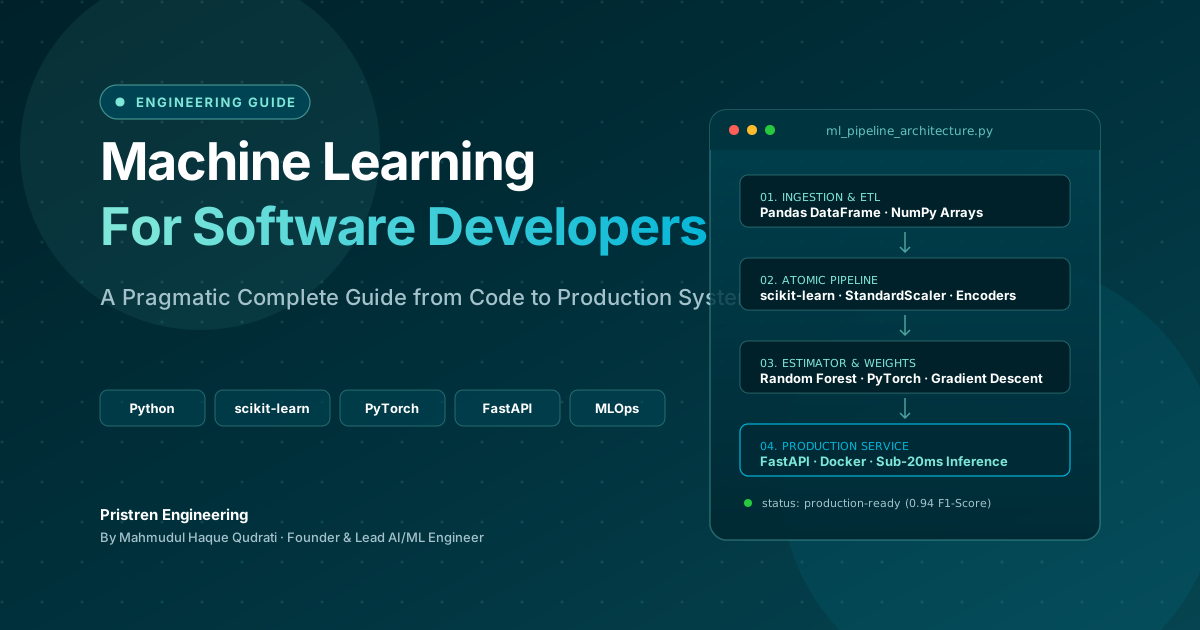
Machine Learning: Complete Guide for Software Developers
Learn machine learning as a software developer with this complete guide covering Python, algorithms, mathematics, projects, deep learning, and a practical roadmap.
 4 min read
How to Get Started with Computer Vision as a Developer?
A hands-on guide for developers entering computer vision: pick the right library, write your first pipeline, and avoid common pitfalls.
 7 min read
ONNX: Export Any ML Model and Run It Anywhere
ONNX (Open Neural Network Exchange) is the universal model format - export from PyTorch, scikit-learn, or HuggingFace and run 3x faster inference with ONNX Runtime on CPU or GPU.
// discussion
Comments