StableLM 2: Stability AI's Compact 1.6B Model for Edge Inference
StableLM 2 1.6B outperforms Phi-1.5 and TinyLlama at its size class and is small enough to run on a Raspberry Pi, in a browser via WebLLM, or on old consumer hardware.

Mahmudul Haque Qudrati
CEO & ML Engineer
May 2, 2026
7 min read
One AI engineering post, weekly
LLM benchmarks, prompt techniques, and token-cost breakdowns — not another AI news roundup.
The AI community focuses on frontier models - 70B, 405B, GPT-4 scale. But there is a substantial and growing demand for models that run on the edge: local laptops without dedicated GPUs, mobile devices, Raspberry Pi deployments, and browser-based inference where latency and privacy are critical. StableLM 2 1.6B was designed specifically for this tier.
Architecture and Training
StableLM 2 1.6B uses a decoder-only transformer with grouped-query attention (GQA) - a middle ground between multi-head attention (more expressive but slow) and multi-query attention (fastest but quality loss). GQA groups multiple query heads to share a single key-value head, balancing quality and inference speed.
The model was trained on 2T tokens from a mix of English and multilingual web text, code, and books, using a cosine learning rate schedule with warmup.
python
from transformers import AutoModelForCausalLM, AutoTokenizer
import torch

tokenizer = AutoTokenizer.from_pretrained("stabilityai/stablelm-2-zephyr-1_6b")
model = AutoModelForCausalLM.from_pretrained(
    "stabilityai/stablelm-2-zephyr-1_6b",
    torch_dtype=torch.float16,
    device_map="auto",
)

prompt = "<|user|>
Write a Python function to check if a number is prime.<|endoftext|>
<|assistant|>
"
inputs = tokenizer(prompt, return_tensors="pt").to(model.device)
output = model.generate(**inputs, max_new_tokens=256, temperature=0.7, do_sample=True)
print(tokenizer.decode(output[0], skip_special_tokens=True))
Team workspace
Ship faster with chat, meetings, and projects in one place — Zlyqor.
StableLM 2 Zephyr: The Instruction-Tuned Variant
The Zephyr suffix indicates instruction tuning using the same DPO-based recipe that HuggingFace applied to Zephyr 7B. StableLM 2 Zephyr 1.6B is the recommended variant for most use cases: it handles conversational instructions reliably without the erratic outputs common in small instruction-tuned models.
Benchmark Position at 1.6B
| Model | ARC-E | HellaSwag | MMLU |
|---|---|---|---|
| TinyLlama 1.1B | 55.3% | 59.2% | 26.0% |
| Phi-1.5 1.3B | 63.3% | 62.8% | 42.1% |
| StableLM 2 1.6B | 66.9% | 69.4% | 39.9% |
StableLM 2 leads on most tasks in the 1-2B class, with Phi-1.5 edging it on MMLU due to its heavy math/code training focus.
Running on a Raspberry Pi
With 4-bit quantization via llama.cpp, StableLM 2 1.6B runs at approximately 3-4 tokens/second on a Raspberry Pi 5:
bash
# Convert to GGUF format first, then:
./llama-cli -m stablelm-2-zephyr-1_6b.Q4_K_M.gguf -p "What is machine learning?" -n 200
WebLLM Browser Inference
The WebLLM project (from MLC AI) compiles small models to WebGPU for browser-side inference. StableLM 2 1.6B is one of the supported models, enabling on-device inference with no server required - useful for privacy-sensitive applications or offline-capable web apps.
Comparison to Phi-3-Mini 3.8B
Microsoft's Phi-3-Mini 3.8B substantially outperforms StableLM 2 1.6B on reasoning and coding benchmarks, but at more than double the parameters requires meaningfully more compute and memory. For truly constrained deployments (single-core devices, <2GB RAM), StableLM 2 remains the better fit.
Links
#stablelm-2#stability-ai#1.6b#edge#compact
Mahmudul Haque Qudrati
CEO & ML Engineer
Visionary technologist, software engineer, and machine learning specialist. Founder and CEO of Pristren, directing engineering teams that ship production-grade AI/ML pipelines, mission-critical full-stack applications, and developer tooling. Creator of Zlyqor, the unified team workspace platform. Author of 540+ technical guides and benchmark research reports on large language models, agentic workflows, Model Context Protocol (MCP), and modern web stacks.

More from Mahmudul
Related Articles
 11 min read
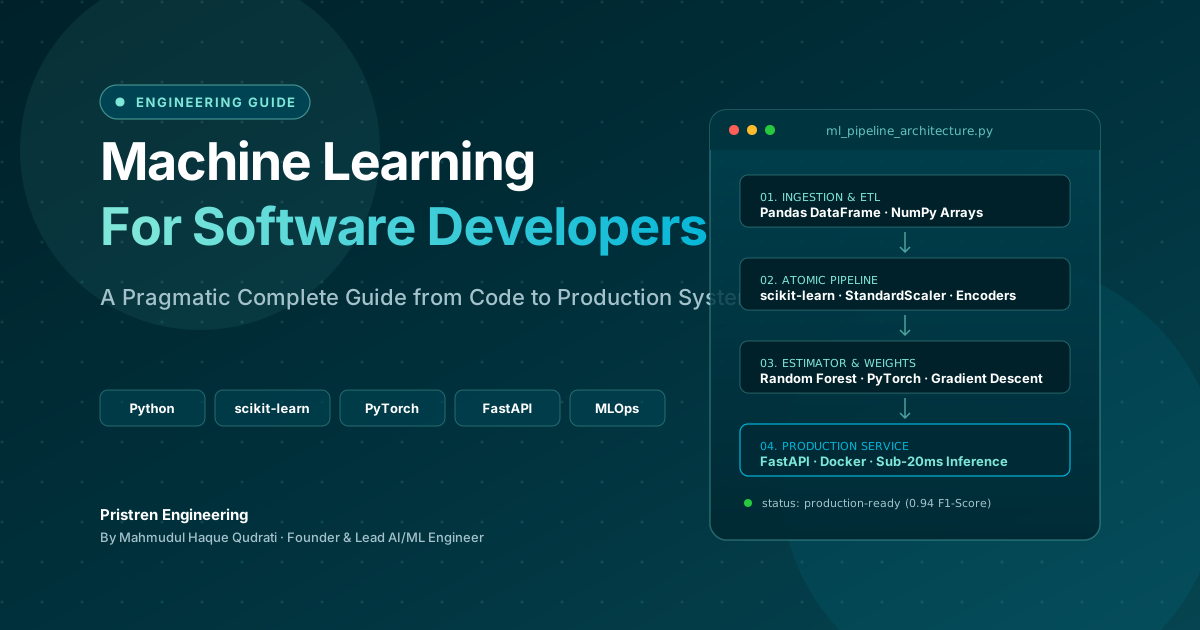
Machine Learning: Complete Guide for Software Developers
Learn machine learning as a software developer with this complete guide covering Python, algorithms, mathematics, projects, deep learning, and a practical roadmap.
 7 min read
ONNX: Export Any ML Model and Run It Anywhere
ONNX (Open Neural Network Exchange) is the universal model format - export from PyTorch, scikit-learn, or HuggingFace and run 3x faster inference with ONNX Runtime on CPU or GPU.
 9 min read
Turso: Edge-Hosted SQLite That Runs Everywhere
Turso runs SQLite at 200+ edge locations via HTTP, with zero cold-start latency and no connection pool management. Here is when it makes sense.
// discussion
Comments