T5 and Flan-T5: The Text-to-Text Framework That Powers Many LLMs
T5 unifies all NLP tasks as sequence-to-sequence text generation, and Flan-T5 extends this with instruction tuning across 1800+ tasks, making it a practical base for fine-tuning custom generation tasks.

Mahmudul Haque Qudrati
CEO & ML Engineer
April 20, 2026
7 min read
One AI engineering post, weekly
LLM benchmarks, prompt techniques, and token-cost breakdowns — not another AI news roundup.
The T5 paper introduced a simple but powerful idea: frame every NLP task as converting input text to output text. Translation, summarization, classification, and question answering all become the same type of problem:
- Classification:
"classify sentiment: This product is terrible."→"negative" - Translation:
"translate English to French: The weather is nice."→"Le temps est beau." - Summarization:
"summarize: [long article...]"→"[short summary]"
This unified interface enables multitask learning - T5 can be trained on all tasks simultaneously - and makes fine-tuning for new tasks straightforward.
T5 vs BERT for Generation Tasks
BERT is an encoder-only model; it cannot generate text. For any task requiring generated output (summarization, translation, question generation, text completion), T5 or another encoder-decoder model is the correct baseline - not BERT or RoBERTa.
Use BERT/RoBERTa for: classification, named entity recognition, token classification. Use T5 for: summarization, translation, question answering with long answers, any generative task.
Team workspace
Ship faster with chat, meetings, and projects in one place — Zlyqor.
Flan-T5: Instruction Tuning at Scale
Flan-T5 is T5 instruction-tuned on 1800+ task datasets from FLAN (Fine-tuned Language Net). This dramatically improves zero-shot and few-shot performance on unseen tasks. Flan-T5-XL (3B) outperforms GPT-3 (175B) on several benchmarks - instruction tuning compensates for scale difference.
Fine-Tuning Flan-T5 With LoRA
python
from transformers import AutoModelForSeq2SeqLM, AutoTokenizer, Seq2SeqTrainer, Seq2SeqTrainingArguments
from peft import get_peft_model, LoraConfig, TaskType

model = AutoModelForSeq2SeqLM.from_pretrained("google/flan-t5-base")
tokenizer = AutoTokenizer.from_pretrained("google/flan-t5-base")

lora_config = LoraConfig(
    task_type=TaskType.SEQ_2_SEQ_LM,
    r=16,
    lora_alpha=32,
    target_modules=["q", "v"],
    lora_dropout=0.05,
)
model = get_peft_model(model, lora_config)
model.print_trainable_parameters()  # ~0.6% of parameters

# Custom dataset: input/output text pairs
def preprocess(examples):
    inputs = tokenizer(examples["input"], max_length=512, truncation=True, padding=True)
    outputs = tokenizer(examples["output"], max_length=128, truncation=True, padding=True)
    inputs["labels"] = outputs["input_ids"]
    return inputs
Inference With Beam Search
python
from transformers import pipeline

summarizer = pipeline(
    "summarization",
    model="google/flan-t5-base",
    max_new_tokens=150,
    num_beams=4,
    early_stopping=True,
)

result = summarizer("summarize: " + long_text)
print(result[0]["summary_text"])
Flan-T5-XXL vs GPT-3.5 Cost Comparison
For high-volume summarization (10M requests/month):
| Option | Monthly cost at 10M requests |
|---|---|
| GPT-3.5-turbo API | ~$5,000 |
| Flan-T5-XXL (2x A10G) | ~$800 |
| Flan-T5-XL (1x A10G) | ~$400 |
Flan-T5-XL (3B) achieves 85-90% of GPT-3.5-turbo quality on structured summarization tasks at 8-12% of the API cost.
#t5#flan-t5#text-to-text#fine-tuning#google
Mahmudul Haque Qudrati
CEO & ML Engineer
Visionary technologist, software engineer, and machine learning specialist. Founder and CEO of Pristren, directing engineering teams that ship production-grade AI/ML pipelines, mission-critical full-stack applications, and developer tooling. Creator of Zlyqor, the unified team workspace platform. Author of 540+ technical guides and benchmark research reports on large language models, agentic workflows, Model Context Protocol (MCP), and modern web stacks.

More from Mahmudul
Related Articles
 11 min read
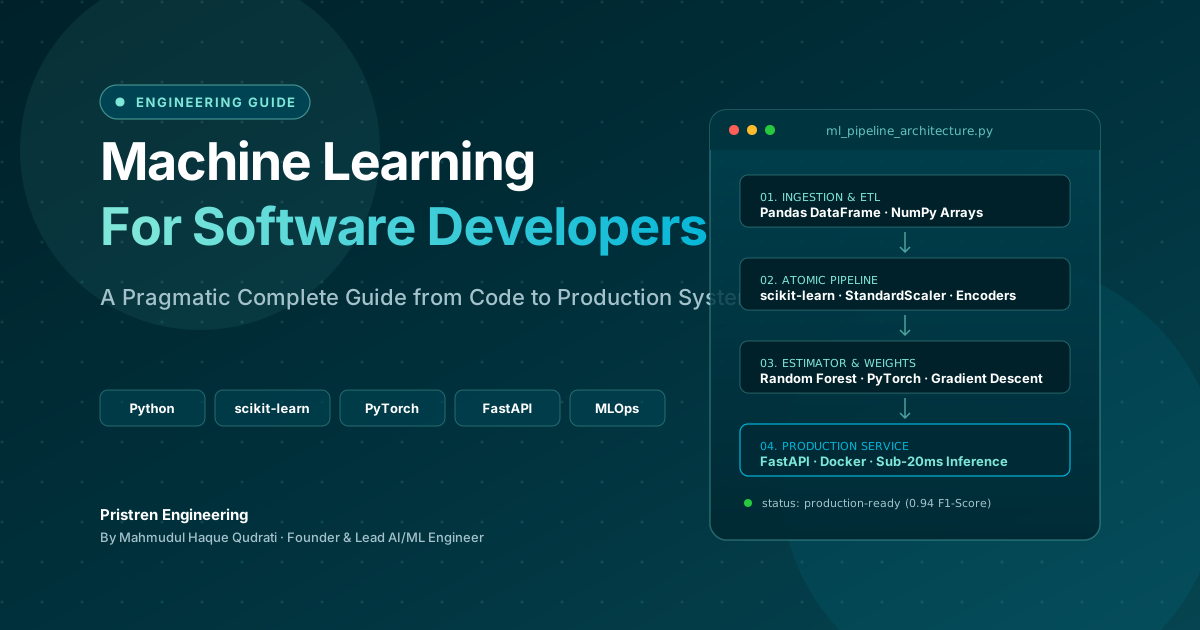
Machine Learning: Complete Guide for Software Developers
Learn machine learning as a software developer with this complete guide covering Python, algorithms, mathematics, projects, deep learning, and a practical roadmap.
 7 min read
ONNX: Export Any ML Model and Run It Anywhere
ONNX (Open Neural Network Exchange) is the universal model format - export from PyTorch, scikit-learn, or HuggingFace and run 3x faster inference with ONNX Runtime on CPU or GPU.
 9 min read
Gradient Descent Explained: How Machine Learning Models Actually Learn
Gradient descent is the engine behind every modern ML model. Here is how it works, why learning rate matters, and when to use Adam over SGD.
// discussion
Comments