Wav2Vec 2.0: Self-Supervised Speech Recognition for Low-Resource Languages
Wav2Vec 2.0 learns speech representations from unlabeled audio and can be fine-tuned with as little as 10 minutes of transcribed speech, making high-quality ASR accessible for low-resource languages.

Mahmudul Haque Qudrati
CEO & ML Engineer
April 24, 2026
7 min read
One AI engineering post, weekly
LLM benchmarks, prompt techniques, and token-cost breakdowns — not another AI news roundup.
The fundamental problem with ASR for low-resource languages: collecting transcribed speech is expensive. Wav2Vec 2.0 solves this by separating pre-training (unlabeled audio only) from fine-tuning (small labeled set).
Pre-training works through contrastive learning:
- Raw audio is processed through a convolutional feature extractor
- Features are quantized into a discrete codebook of speech units
- A transformer context network predicts quantized representations for masked time steps
- The model learns to distinguish true masked tokens from distractors
This self-supervised objective learns phonetic and acoustic structure from unlabeled speech - recordings of any kind, without transcripts.
Fine-Tuning With 10 Minutes of Labeled Data
After pre-training on unlabeled audio, fine-tuning with CTC (Connectionist Temporal Classification) requires remarkably little labeled data. The fine-tuning guide demonstrates fine-tuning on 960 hours for English, but researchers have achieved workable WER with 10 minutes for low-resource languages.
python
from transformers import Wav2Vec2ForCTC, Wav2Vec2Processor
import torch
import librosa

processor = Wav2Vec2Processor.from_pretrained("facebook/wav2vec2-large-960h-lv60-self")
model = Wav2Vec2ForCTC.from_pretrained("facebook/wav2vec2-large-960h-lv60-self")

# Load audio (must be 16kHz)
audio, sr = librosa.load("speech.wav", sr=16000)
input_values = processor(audio, sampling_rate=16000, return_tensors="pt").input_values

with torch.no_grad():
    logits = model(input_values).logits

predicted_ids = torch.argmax(logits, dim=-1)
transcription = processor.batch_decode(predicted_ids)
print(transcription[0])
The HuggingFace Wav2Vec2 page hosts the 960h-lv60-self model - the strongest self-supervised English variant.
Team workspace
Ship faster with chat, meetings, and projects in one place — Zlyqor.
CTC Decoder With Language Model Integration
Pure CTC decoding outputs the most likely character sequence independently at each timestep. Adding a language model (kenlm) significantly reduces WER by incorporating word-level probability:
python
from pyctcdecode import build_ctcdecoder
import kenlm

vocab = list(processor.tokenizer.get_vocab().keys())
language_model = kenlm.Model("language_model.arpa")

decoder = build_ctcdecoder(
    vocab,
    kenlm_model=language_model,
    alpha=0.5,  # LM weight
    beta=1.5,   # Word insertion bonus
)

# Decode logits with LM
logits_np = logits[0].numpy()
transcription_lm = decoder.decode(logits_np)
XLSR-53: Multilingual Variant
XLSR-53 pre-trains on 53 languages simultaneously, enabling cross-lingual transfer. Fine-tune XLSR-53 on a low-resource language and it leverages phonetic knowledge from related languages. This is particularly effective for language families - fine-tuning for Catalan benefits from Spanish pre-training data.
Custom Dataset Fine-Tuning
Prepare data as HuggingFace Dataset with audio (16kHz) and text columns. The fine-tuning guide walks through vocabulary building, CTC tokenizer setup, and DataCollatorCTCWithPadding. Training a language-specific model from XLSR-53 requires approximately 4-8 GPU hours on an A10G for a 100-hour dataset.
#wav2vec2#speech-recognition#self-supervised#asr#fine-tuning
Mahmudul Haque Qudrati
CEO & ML Engineer
Visionary technologist, software engineer, and machine learning specialist. Founder and CEO of Pristren, directing engineering teams that ship production-grade AI/ML pipelines, mission-critical full-stack applications, and developer tooling. Creator of Zlyqor, the unified team workspace platform. Author of 540+ technical guides and benchmark research reports on large language models, agentic workflows, Model Context Protocol (MCP), and modern web stacks.

More from Mahmudul
Related Articles
 11 min read
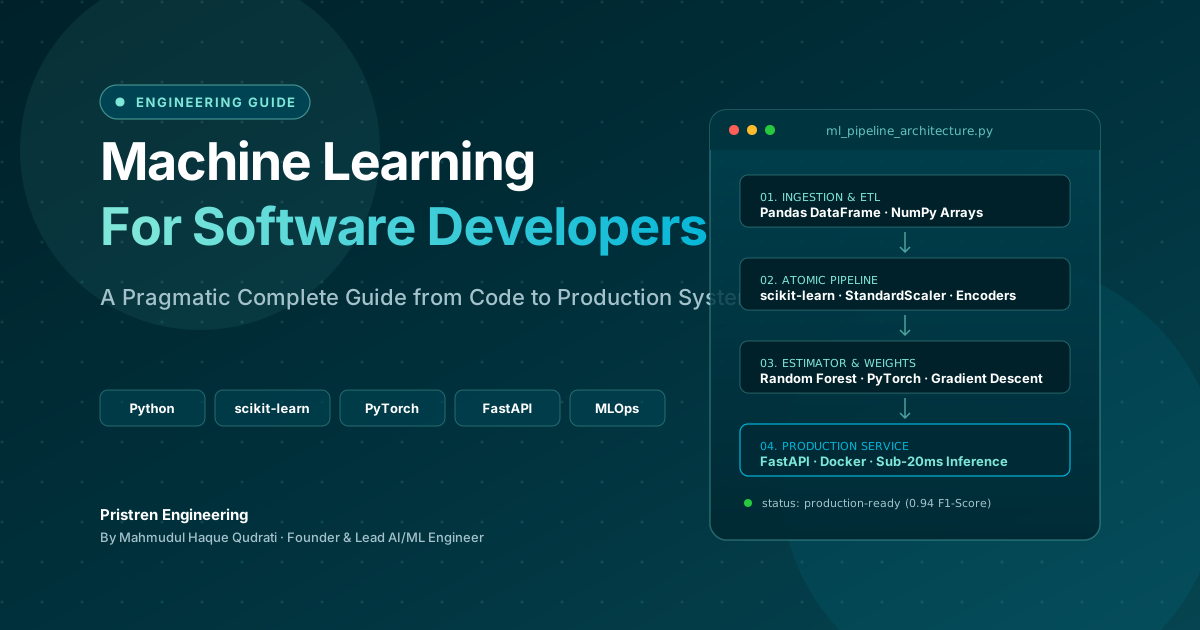
Machine Learning: Complete Guide for Software Developers
Learn machine learning as a software developer with this complete guide covering Python, algorithms, mathematics, projects, deep learning, and a practical roadmap.
 7 min read
ONNX: Export Any ML Model and Run It Anywhere
ONNX (Open Neural Network Exchange) is the universal model format - export from PyTorch, scikit-learn, or HuggingFace and run 3x faster inference with ONNX Runtime on CPU or GPU.
 9 min read
Gradient Descent Explained: How Machine Learning Models Actually Learn
Gradient descent is the engine behind every modern ML model. Here is how it works, why learning rate matters, and when to use Adam over SGD.
// discussion
Comments