Whisper Large v3: OpenAI's Best Open-Source Speech Recognition Model
Whisper Large v3 reduces word error rates across all 99 supported languages and adds word-level timestamps, making it the default choice for production speech recognition pipelines.

Mahmudul Haque Qudrati
CEO & ML Engineer
March 9, 2026
7 min read
One AI engineering post, weekly
LLM benchmarks, prompt techniques, and token-cost breakdowns — not another AI news roundup.
OpenAI's Whisper Large v3 vs Large v2 improvements are measurable across Common Voice benchmarks. WER (word error rate) dropped by 10-20% on most languages, with the largest improvements on lower-resource languages. The model was trained on 5 million hours of audio - roughly double v2 - with better filtering to remove machine-generated transcripts from training data.
Key additions in v3:
- Word-level timestamps (previously only segment-level)
- Better handling of code-switching (mid-sentence language switching)
- Reduced hallucination on silence/music segments
- Improved number and proper noun accuracy
99 Languages and Accuracy
HuggingFace's Whisper Large v3 supports 99 languages with wildly varying accuracy. For English, Spanish, French, German, Japanese, and Mandarin, WER is under 5% on clean audio. For lower-resource languages, expect 15-30% WER. Always benchmark on your specific audio domain before production deployment.
Team workspace
Ship faster with chat, meetings, and projects in one place — Zlyqor.
Python Transcription With faster-whisper
The faster-whisper library provides 4x speed improvement over the original Whisper through CTranslate2 backend:
python
from faster_whisper import WhisperModel

model = WhisperModel(
    "large-v3",
    device="cuda",
    compute_type="float16"
)

segments, info = model.transcribe(
    "audio.mp3",
    beam_size=5,
    word_timestamps=True,
    language="en"
)

print(f"Detected language: {info.language} ({info.language_probability:.2f})")

for segment in segments:
    print(f"[{segment.start:.2f}s -> {segment.end:.2f}s] {segment.text}")
    for word in segment.words:
        print(f"  Word: '{word.word}' at {word.start:.2f}s")
Speaker Diarization With pyannote
Combine Whisper with pyannote.audio for "who said what when" transcripts:
python
from pyannote.audio import Pipeline
from faster_whisper import WhisperModel

# Requires HuggingFace token and model access approval
diarize_pipeline = Pipeline.from_pretrained(
    "pyannote/speaker-diarization-3.1",
    use_auth_token="YOUR_HF_TOKEN"
)

whisper_model = WhisperModel("large-v3", device="cuda", compute_type="float16")

# Run diarization
diarization = diarize_pipeline("audio.wav")

# Run transcription with word timestamps
segments, _ = whisper_model.transcribe("audio.wav", word_timestamps=True)

# Align speakers to words  -  see pyannote documentation for full alignment logic
for turn, _, speaker in diarization.itertracks(yield_label=True):
    print(f"Speaker {speaker}: {turn.start:.1f}s to {turn.end:.1f}s")
Whisper.cpp for CPU Inference
For environments without GPU access, Whisper.cpp provides pure CPU inference. Large v3 in Q5_0 quantization runs at roughly 10x real-time on an M2 MacBook Pro (1 hour of audio in 6 minutes). The whisper-cpp Python bindings make integration straightforward.
Batch Transcription for Long Audio
For files over 30 minutes, chunk audio into 25-30 second segments with 2-second overlap to avoid cutting mid-word. Whisper's context window is 30 seconds; feeding longer audio causes it to loop or hallucinate. faster-whisper handles this automatically when chunk_length is set appropriately.
Production throughput on a single A10G GPU: approximately 300 minutes of audio per hour with Large v3 at float16.
#whisper#openai#speech-recognition#asr#multilingual
Mahmudul Haque Qudrati
CEO & ML Engineer
Visionary technologist, software engineer, and machine learning specialist. Founder and CEO of Pristren, directing engineering teams that ship production-grade AI/ML pipelines, mission-critical full-stack applications, and developer tooling. Creator of Zlyqor, the unified team workspace platform. Author of 540+ technical guides and benchmark research reports on large language models, agentic workflows, Model Context Protocol (MCP), and modern web stacks.

More from Mahmudul
Related Articles
 11 min read
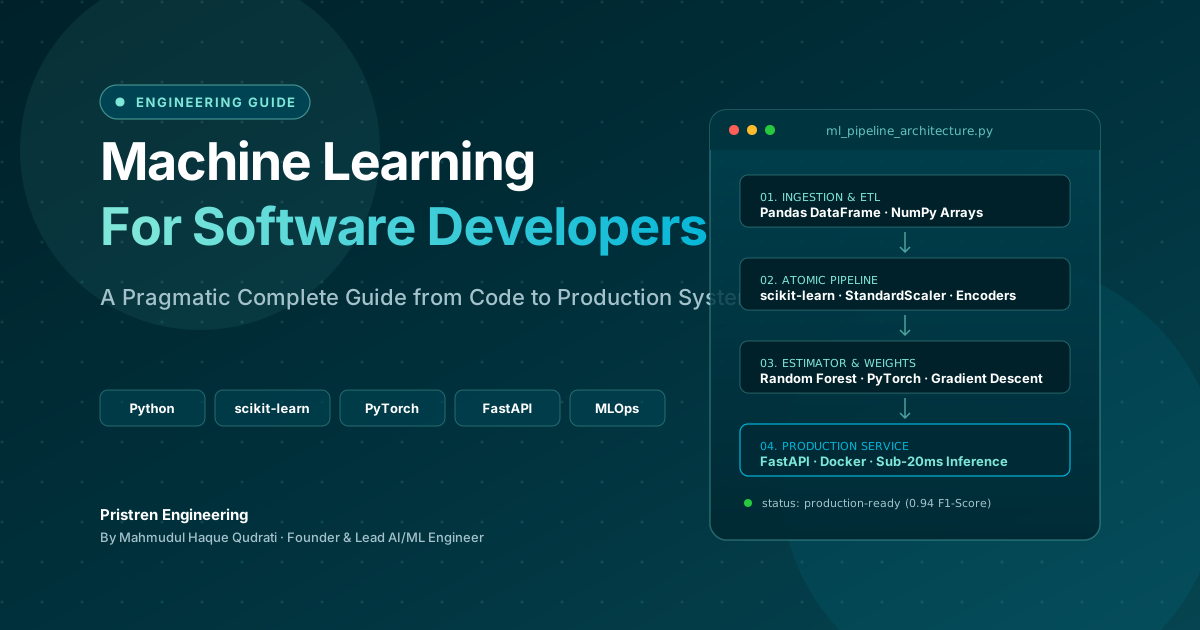
Machine Learning: Complete Guide for Software Developers
Learn machine learning as a software developer with this complete guide covering Python, algorithms, mathematics, projects, deep learning, and a practical roadmap.
 8 min read
GPT-6 Astra AGI: How to Actually Use It and Get Its Best Performance
GPT-6 Astra is OpenAI's most capable model, but 'AGI' is a marketing claim. This guide shows you how to access, use, and get the best from it with practical endpoints, pricing, and agent patterns.
 5 min read
GPT-6 Astra Benchmarks, Pricing, and Safety: What Developers Need to Know
OpenAI's GPT-6 Astra delivers state-of-the-art coding and agentic performance, but costs 50% more than GPT-4o. This guide covers benchmarks, pricing, safety, and practical advice for developers deciding whether to upgrade.
// discussion
Comments