
Axolotl: YAML-Configured LLM Fine-Tuning for Any Dataset Format
Axolotl lets you fine-tune any open-source LLM using a single YAML config file — no Python required — with support for LoRA, QLoRA, and multi-GPU training.

Mahmudul Haque Qudrati
CEO & ML Engineer
March 7, 2026
8 min read

One AI engineering post, weekly
LLM benchmarks, prompt techniques, and token-cost breakdowns — not another AI news roundup.
Axolotl is an open-source fine-tuning framework built on top of HuggingFace Transformers and PEFT that reduces the entire training setup to a single YAML configuration file. You define your model, dataset format, training method, and hardware config in YAML — Axolotl handles the rest.
This makes it particularly valuable for teams that want reproducible, version-controlled fine-tuning runs without maintaining bespoke training scripts.
Supported Dataset Formats
One of Axolotl's biggest strengths is flexible dataset ingestion. It natively supports:
- Alpaca — instruction/input/output triples
- ShareGPT — multi-turn conversations in the ChatML format
- JSONL with custom field mapping — specify source/target fields in YAML
- Raw completion — for continued pre-training on text corpora
You can mix multiple datasets in one run by listing them in the YAML config.
Team workspace
Ship faster with chat, meetings, and projects in one place — Zlyqor.
Sample YAML Configuration
base_model: meta-llama/Meta-Llama-3-8B-Instruct
model_type: LlamaForCausalLM
tokenizer_type: AutoTokenizer

load_in_4bit: true
adapter: qlora
lora_r: 16
lora_alpha: 32
lora_dropout: 0.05
lora_target_modules:
  - q_proj
  - v_proj

datasets:
  - path: mosaicml/dolly_hhrlhf
    type: sharegpt
    conversation: chatml

sequence_len: 4096
sample_packing: true

val_set_size: 0.02
output_dir: ./outputs/llama3-qlora

gradient_accumulation_steps: 4
micro_batch_size: 2
num_epochs: 3
optimizer: adamw_bnb_8bit
lr_scheduler: cosine
learning_rate: 2e-4

wandb_project: my-fine-tune
wandb_run_id: llama3-qlora-run1
Then run:
pip install axolotl
accelerate launch -m axolotl.cli.train config.yaml
Multi-GPU Training
Axolotl integrates directly with DeepSpeed and FSDP. For multi-GPU runs, add a DeepSpeed config path to your YAML:
deepspeed: deepspeed_configs/zero2.json
The zero2.json config handles gradient sharding across GPUs automatically.
Axolotl vs Unsloth
Both tools target LLM fine-tuning, but with different priorities. Unsloth is optimized for maximum single-GPU speed with hand-tuned CUDA kernels. Axolotl is optimized for flexibility: it handles more dataset formats, more training methods, and scales more naturally to multi-GPU and multi-node setups. For a quick single-GPU LoRA run, Unsloth is faster. For complex multi-dataset, multi-GPU production pipelines, Axolotl is the more flexible choice.
Resources
#axolotl#fine-tuning#yaml#lora#multi-gpu
Mahmudul Haque Qudrati
CEO & ML Engineer
Visionary technologist, software engineer, and machine learning specialist. Founder and CEO of Pristren, directing engineering teams that ship production-grade AI/ML pipelines, mission-critical full-stack applications, and developer tooling. Creator of Zlyqor, the unified team workspace platform. Author of 540+ technical guides and benchmark research reports on large language models, agentic workflows, Model Context Protocol (MCP), and modern web stacks.

More from Mahmudul
Machine Learning: Complete Guide for Software Developers
11 min read
GPT-6 Astra AGI: How to Actually Use It and Get Its Best Performance
8 min read
DeepSeek vs MiniMax vs Kimi in Coding Benchmarks: Real Scores, Real Prices, Real Tradeoffs
8 min read
GPT-6 Astra Benchmarks, Pricing, and Safety: What Developers Need to Know
5 min read
Related Articles
 11 min read
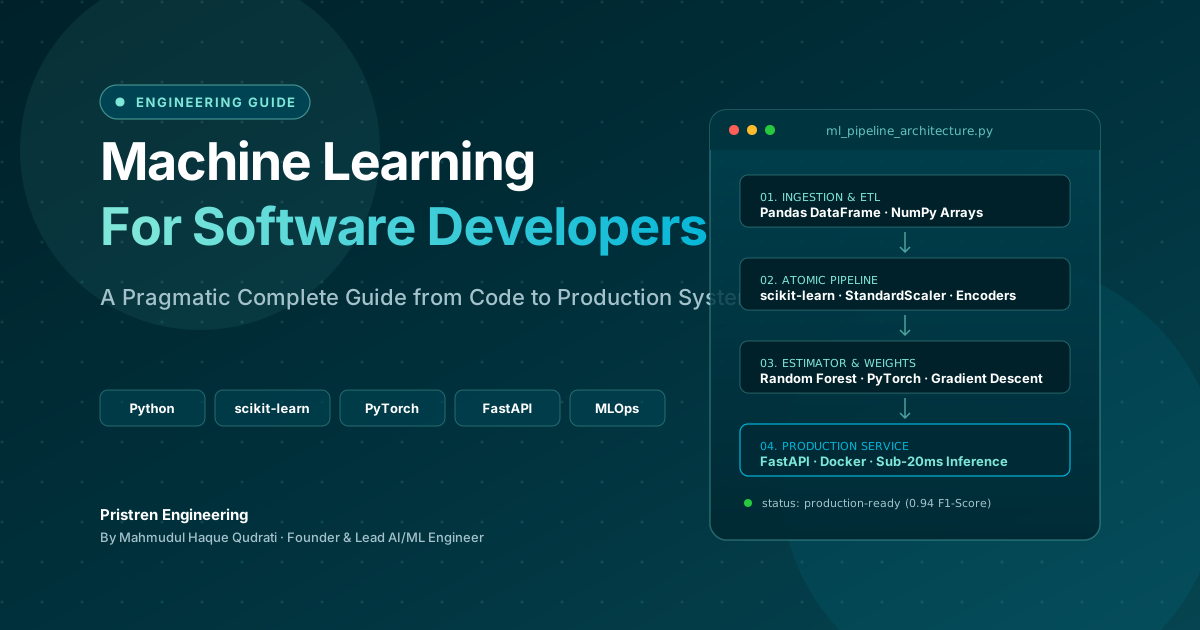
Machine Learning: Complete Guide for Software Developers
Learn machine learning as a software developer with this complete guide covering Python, algorithms, mathematics, projects, deep learning, and a practical roadmap.
 7 min read
ONNX: Export Any ML Model and Run It Anywhere
ONNX (Open Neural Network Exchange) is the universal model format - export from PyTorch, scikit-learn, or HuggingFace and run 3x faster inference with ONNX Runtime on CPU or GPU.
 9 min read
Gradient Descent Explained: How Machine Learning Models Actually Learn
Gradient descent is the engine behind every modern ML model. Here is how it works, why learning rate matters, and when to use Adam over SGD.
// discussion
Comments