AI agents represent the next evolution in artificial intelligence applications. Unlike simple chatbots, AI agents can autonomously plan, reason, and execute complex tasks by leveraging large language models (LLMs) as their cognitive engine.
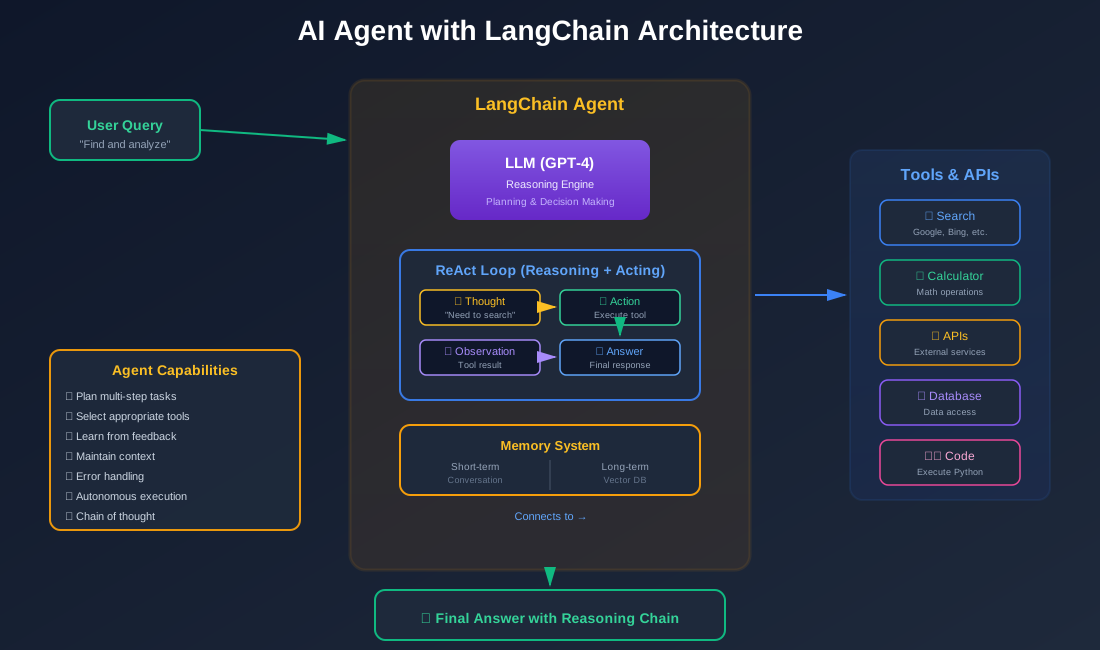
AI Agent Architecture with LangChain
What Are AI Agents?
One AI engineering post, weekly
LLM benchmarks, prompt techniques, and token-cost breakdowns — not another AI news roundup.
AI agents are autonomous systems that can:
Perceive their environment through various inputs
Make decisions based on goals and constraints
Take actions to achieve objectives
Learn and adapt from feedback
Building Blocks of Modern AI Agents
1. Large Language Models (LLMs)
GPT-4, Claude, or other advanced LLMs serve as the "brain" of the agent, providing reasoning and language understanding capabilities.
2. LangChain Framework
LangChain provides the orchestration layer that connects LLMs with tools, memory, and external data sources.
3. Tools and APIs
Agents need access to external tools:
Search engines for information retrieval
Calculators for mathematical operations
APIs for interacting with external services
Code interpreters for executing programs
4. Memory Systems
Agents require both short-term (conversation history) and long-term (vector databases) memory to maintain context and learn from interactions.
Team workspace
Ship faster with chat, meetings, and projects in one place — Zlyqor.
The ReAct pattern alternates between reasoning about what to do and taking actions:
from langchain.agents import initialize_agent, Tool
from langchain.llms import OpenAI

# Define tools
tools = [
    Tool(name="Search", func=search_function),
    Tool(name="Calculator", func=calculate),
]

# Initialize agent
agent = initialize_agent(
    tools=tools,
    llm=OpenAI(temperature=0),
    agent="zero-shot-react-description",
    verbose=True
)

# Execute task
agent.run("What's the weather in Tokyo and convert the temperature to Fahrenheit?")
Plan-and-Execute Pattern
This pattern separates planning from execution:
Planning: Create a high-level plan for achieving the goal
Execution: Execute each step of the plan
Reflection: Evaluate results and adjust if needed
Advanced Techniques
Multi-Agent Systems
Multiple specialized agents collaborate to solve complex problems:
Research agent: Gathers information
Analysis agent: Processes and analyzes data
Writing agent: Generates final output
Retrieval-Augmented Generation (RAG)
Enhance agents with domain-specific knowledge by integrating vector databases:
from langchain.vectorstores import Chroma
from langchain.embeddings import OpenAIEmbeddings

# Create knowledge base
vectorstore = Chroma.from_documents(
    documents=docs,
    embedding=OpenAIEmbeddings()
)

# Agent with RAG
agent_with_rag = create_retrieval_agent(
    llm=llm,
    retriever=vectorstore.as_retriever(),
    tools=tools
)
Tool Learning
Agents can learn to use new tools dynamically through few-shot examples and documentation.
Real-World Applications
Customer Support Agents: Handle inquiries, access databases, process refunds
Research Assistants: Gather information, analyze data, generate reports
Building AI agents with LangChain and GPT-4 opens up incredible possibilities for automation and intelligent assistance. As LLMs become more capable and frameworks more sophisticated, we'll see AI agents handling increasingly complex real-world tasks.
The key to success is starting with well-defined use cases, implementing proper safeguards, and continuously iterating based on real-world performance.
Specialized machine learning engineer at Pristren with deep expertise in neural architectures, computer vision algorithms, NLP pipelines, and edge inference optimization.


 AI Agent Architecture with LangChain


// discussion
Comments