The transformer architecture, introduced in the groundbreaking paper "Attention is All You Need" by Vaswani et al. in 2017, has fundamentally changed the landscape of machine learning and artificial intelligence.
 Transformer Architecture Overview
 Pristren
A comprehensive guide to transformer architecture, attention mechanisms, and how they revolutionized natural language processing and beyond.

Mahmudul Haque Qudrati
CEO & ML Engineer
The transformer architecture, introduced in the groundbreaking paper "Attention is All You Need" by Vaswani et al. in 2017, has fundamentally changed the landscape of machine learning and artificial intelligence.
Transformer Architecture Overview
LLM benchmarks, prompt techniques, and token-cost breakdowns — not another AI news roundup.
Unlike traditional recurrent neural networks (RNNs) and long short-term memory (LSTM) networks, transformers process entire sequences simultaneously using a mechanism called "self-attention." This parallel processing capability makes them significantly faster and more efficient for training on large datasets.
1. Self-Attention Mechanism The self-attention mechanism allows the model to weigh the importance of different words in a sentence when encoding a particular word. This enables the model to capture long-range dependencies and contextual relationships effectively.
2. Multi-Head Attention Instead of performing a single attention function, transformers use multiple attention heads that learn different aspects of the relationships between words. This multi-head approach provides richer representations.
 Multi-Head Attention Mechanism Visualization
3. Positional Encoding Since transformers don't process sequences sequentially, positional encodings are added to give the model information about word positions in the sequence.
4. Feed-Forward Networks Each attention layer is followed by a position-wise feed-forward network that processes the attended representations.
While transformers were initially designed for natural language processing tasks, they've proven remarkably versatile:
Team workspace
Ship faster with chat, meetings, and projects in one place — Zlyqor.
When implementing transformers, consider these key factors:
Recent innovations continue to push the boundaries:
Transformers have become the backbone of modern AI systems, from ChatGPT to DALL-E. Understanding their architecture is essential for anyone working in machine learning today. As research continues, we can expect even more innovative applications and improvements to this foundational technology.
Whether you're building chatbots, image classifiers, or recommendation systems, transformers offer powerful capabilities that can elevate your projects to the next level.
CEO & ML Engineer
Visionary technologist, software engineer, and machine learning specialist. Founder and CEO of Pristren, directing engineering teams that ship production-grade AI/ML pipelines, mission-critical full-stack applications, and developer tooling. Creator of Zlyqor, the unified team workspace platform. Author of 540+ technical guides and benchmark research reports on large language models, agentic workflows, Model Context Protocol (MCP), and modern web stacks.
More from Mahmudul
 11 min read
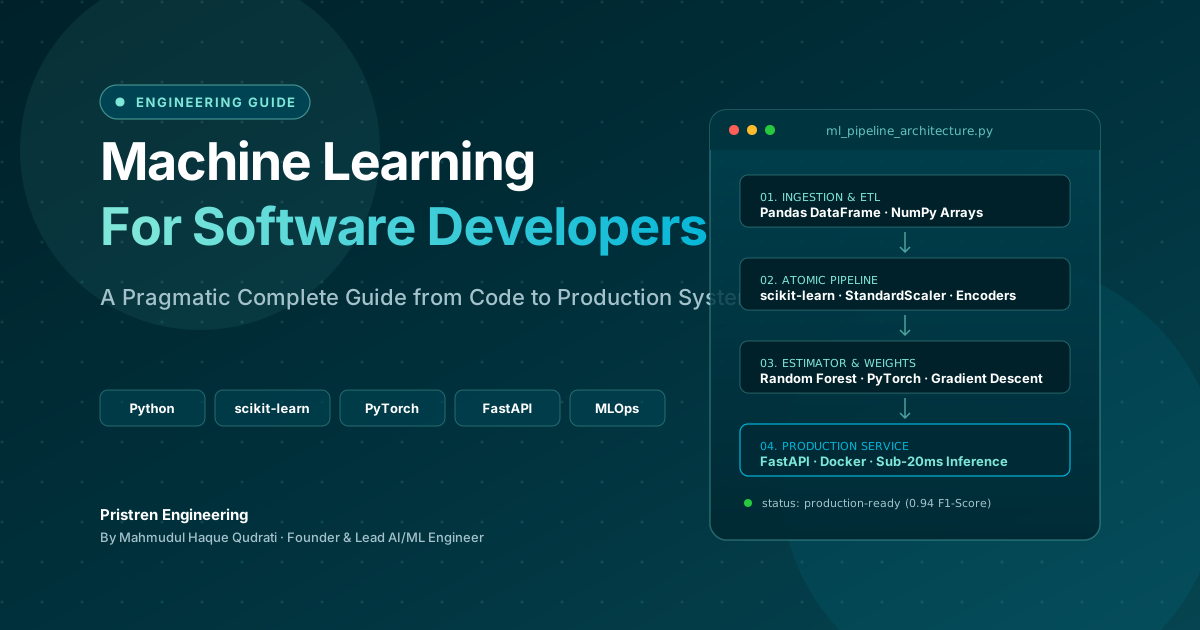
Learn machine learning as a software developer with this complete guide covering Python, algorithms, mathematics, projects, deep learning, and a practical roadmap.
 10 min read
A comparison of conversation buffers, summarized context, and vector database embeddings for persisting conversational memory in complex workflows.
 11 min read
A mathematical and visual walkthrough of multi-head attention, self-attention, and encoder-decoder cross-attention inside language models.


// discussion
Comments