Cohere Embed v3: Multilingual Embeddings Built for Enterprise RAG
Cohere's Embed v3 introduces a critical input_type parameter that tells the model whether it's encoding a query or a document - a distinction that meaningfully improves retrieval precision in production RAG pipelines.

Mahmudul Haque Qudrati
CEO & ML Engineer
March 20, 2026
7 min read
One AI engineering post, weekly
LLM benchmarks, prompt techniques, and token-cost breakdowns — not another AI news roundup.
Most embedding models treat all text the same way. Cohere Embed v3 does not. It takes an explicit input_type parameter that changes how the model encodes text based on its intended use. This is not a minor API detail - it is the primary reason Embed v3 outperforms competitors on asymmetric retrieval tasks (where queries are short and documents are long).
The input_type Parameter
python
import cohere

co = cohere.Client("YOUR_COHERE_KEY")

# Encoding a user search query
query_emb = co.embed(
    texts=["What is the capital of France?"],
    model="embed-english-v3.0",
    input_type="search_query",
    embedding_types=["float"],
).embeddings.float[0]

# Encoding documents to store in a vector database
doc_embs = co.embed(
    texts=[
        "Paris is the capital and largest city of France.",
        "France is a country in Western Europe.",
    ],
    model="embed-english-v3.0",
    input_type="search_document",
    embedding_types=["float"],
).embeddings.float
The four valid values are:
search_query- for user queries at retrieval timesearch_document- for documents being indexedclassification- for text classification tasksclustering- for topic clustering and deduplication
Always use the matching type at index time and query time, otherwise you are leaving retrieval quality on the table.
Team workspace
Ship faster with chat, meetings, and projects in one place — Zlyqor.
Model Variants
- embed-english-v3.0 - 1024 dimensions, English only, highest English performance
- embed-multilingual-v3.0 - 1024 dimensions, 108 languages, within 2-3 points of English-only on most tasks
Both output 1024-dimensional float32 vectors. Pricing is $0.10/1M tokens for both.
Compressed Embedding Formats
Cohere Embed v3 is one of the first production embedding APIs to natively support compressed output formats:
python
# int8 compression  -  4x storage reduction, ~1% quality loss
doc_embs_int8 = co.embed(
    texts=["Your document text here"],
    model="embed-english-v3.0",
    input_type="search_document",
    embedding_types=["int8"],
).embeddings.int8

# binary compression  -  32x storage reduction, ~3-5% quality loss
doc_embs_binary = co.embed(
    texts=["Your document text here"],
    model="embed-english-v3.0",
    input_type="search_document",
    embedding_types=["ubinary"],
).embeddings.ubinary
For a corpus of 10 million documents at 1024 dimensions:
- float32: ~40GB
- int8: ~10GB
- binary: ~1.25GB
The binary format fits a 10M-document index in the RAM of a standard cloud VM, enabling in-memory vector search without specialized hardware.
MTEB Comparison
| Model | MTEB English Retrieval | Multilingual |
|---|---|---|
| Cohere embed-english-v3.0 | 55.0 | English only |
| Cohere embed-multilingual-v3.0 | 54.1 | 108 languages |
| OpenAI text-embedding-3-large | 55.4 | Good |
| Voyage-3 | 58.1 | Limited |
OpenAI edges ahead on raw MTEB retrieval, but Cohere's multilingual coverage (108 languages) and compressed format support make it the stronger choice for international enterprise deployments.
Weaviate Integration
python
import weaviate
from weaviate.classes.init import Auth

client = weaviate.connect_to_weaviate_cloud(
    cluster_url="YOUR_WEAVIATE_URL",
    auth_credentials=Auth.api_key("YOUR_WEAVIATE_KEY"),
    headers={"X-Cohere-Api-Key": "YOUR_COHERE_KEY"},
)

# Weaviate handles Cohere embedding automatically with text2vec-cohere
collection = client.collections.get("Document")
results = collection.query.near_text(
    query="machine learning optimization techniques",
    limit=5,
)
Links
#cohere-embed#multilingual#embeddings#rag#enterprise
Mahmudul Haque Qudrati
CEO & ML Engineer
Visionary technologist, software engineer, and machine learning specialist. Founder and CEO of Pristren, directing engineering teams that ship production-grade AI/ML pipelines, mission-critical full-stack applications, and developer tooling. Creator of Zlyqor, the unified team workspace platform. Author of 540+ technical guides and benchmark research reports on large language models, agentic workflows, Model Context Protocol (MCP), and modern web stacks.


More from Mahmudul
Related Articles
 11 min read
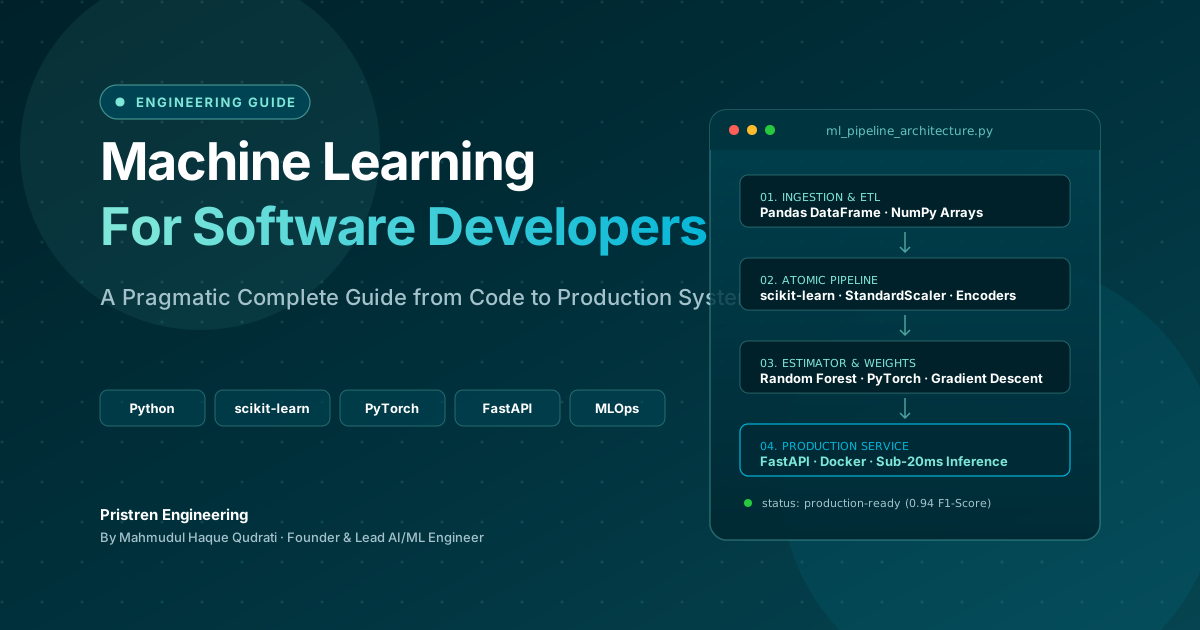
Machine Learning: Complete Guide for Software Developers
Learn machine learning as a software developer with this complete guide covering Python, algorithms, mathematics, projects, deep learning, and a practical roadmap.
 9 min read
When to Fine-Tune an LLM (And When to Rely on RAG Instead)
Fine-tuning updates model weights, while RAG inserts context. Learn how to combine these strategies or choose the right one for your data.
 7 min read
ONNX: Export Any ML Model and Run It Anywhere
ONNX (Open Neural Network Exchange) is the universal model format - export from PyTorch, scikit-learn, or HuggingFace and run 3x faster inference with ONNX Runtime on CPU or GPU.
// discussion
Comments