Sentence Transformers: The Go-To Library for Text Embeddings in 2026
The Sentence Transformers library provides a unified interface for generating text embeddings, enabling semantic search, clustering, and fine-tuning on custom similarity tasks with minimal code.

Mahmudul Haque Qudrati
CEO & ML Engineer
March 21, 2026
7 min read
One AI engineering post, weekly
LLM benchmarks, prompt techniques, and token-cost breakdowns — not another AI news roundup.
Raw BERT produces token embeddings, not sentence embeddings. Averaging BERT token outputs gives poor semantic representations - similar sentences get dissimilar vectors. Sentence Transformers (SBERT) fixes this by fine-tuning BERT-style models with siamese networks on natural language inference pairs, producing embeddings where cosine similarity directly correlates with semantic similarity.
The HuggingFace Sentence Transformers collection hosts 200+ pre-trained models covering different size/quality tradeoffs.
Encoding and Cosine Similarity
python
from sentence_transformers import SentenceTransformer, util
import torch

model = SentenceTransformer("all-MiniLM-L6-v2")

sentences = [
    "The quick brown fox jumps over the lazy dog",
    "A fast auburn fox leaps above a sleepy canine",
    "The stock market closed higher today",
]

embeddings = model.encode(sentences, convert_to_tensor=True)

# Pairwise cosine similarity
cos_sim = util.cos_sim(embeddings, embeddings)
print(f"Sentences 0 and 1 similarity: {cos_sim[0][1]:.4f}")  # ~0.72 (semantically similar)
print(f"Sentences 0 and 2 similarity: {cos_sim[0][2]:.4f}")  # ~0.05 (unrelated)
Team workspace
Ship faster with chat, meetings, and projects in one place — Zlyqor.
Semantic Search With util.semantic_search
python
from sentence_transformers import SentenceTransformer, util

model = SentenceTransformer("all-mpnet-base-v2")

corpus = [
    "Python is a high-level programming language",
    "Machine learning requires large datasets",
    "Neural networks are inspired by the human brain",
    "Flask is a lightweight web framework",
]

corpus_embeddings = model.encode(corpus, convert_to_tensor=True)
query = "web development frameworks"
query_embedding = model.encode(query, convert_to_tensor=True)

hits = util.semantic_search(query_embedding, corpus_embeddings, top_k=2)
for hit in hits[0]:
    print(f"Score: {hit['score']:.4f} | {corpus[hit['corpus_id']]}")
Fine-Tuning on Custom Pairs
Use MultipleNegativesRankingLoss when you have (anchor, positive) pairs without explicit negatives - the other items in the batch serve as negatives:
python
from sentence_transformers import SentenceTransformer, InputExample, losses
from torch.utils.data import DataLoader

model = SentenceTransformer("all-MiniLM-L6-v2")

train_examples = [
    InputExample(texts=["What is machine learning?", "ML is a type of AI that learns from data"]),
    InputExample(texts=["How do I fix a bug?", "Debugging requires isolating the failing component"]),
]

train_dataloader = DataLoader(train_examples, shuffle=True, batch_size=16)
train_loss = losses.MultipleNegativesRankingLoss(model)

model.fit(
    train_objectives=[(train_dataloader, train_loss)],
    epochs=3,
    warmup_steps=100,
)
model.save("my-finetuned-model")
Best Models Comparison
| Model | Dimensions | Speed | Quality |
|---|---|---|---|
| all-MiniLM-L6-v2 | 384 | Very fast | Good |
| all-mpnet-base-v2 | 768 | Fast | Better |
| multi-qa-mpnet-base-dot-v1 | 768 | Fast | Best for QA |
| BGE-M3 | 1024 | Moderate | Best overall |
The GitHub repository includes pretrained model benchmarks on STS, QA, and retrieval tasks. For most production RAG use cases, all-mpnet-base-v2 is the baseline to beat before reaching for larger models.
#sentence-transformers#embeddings#semantic-search#sbert#fine-tuning
Mahmudul Haque Qudrati
CEO & ML Engineer
Visionary technologist, software engineer, and machine learning specialist. Founder and CEO of Pristren, directing engineering teams that ship production-grade AI/ML pipelines, mission-critical full-stack applications, and developer tooling. Creator of Zlyqor, the unified team workspace platform. Author of 540+ technical guides and benchmark research reports on large language models, agentic workflows, Model Context Protocol (MCP), and modern web stacks.


More from Mahmudul
Related Articles
 11 min read
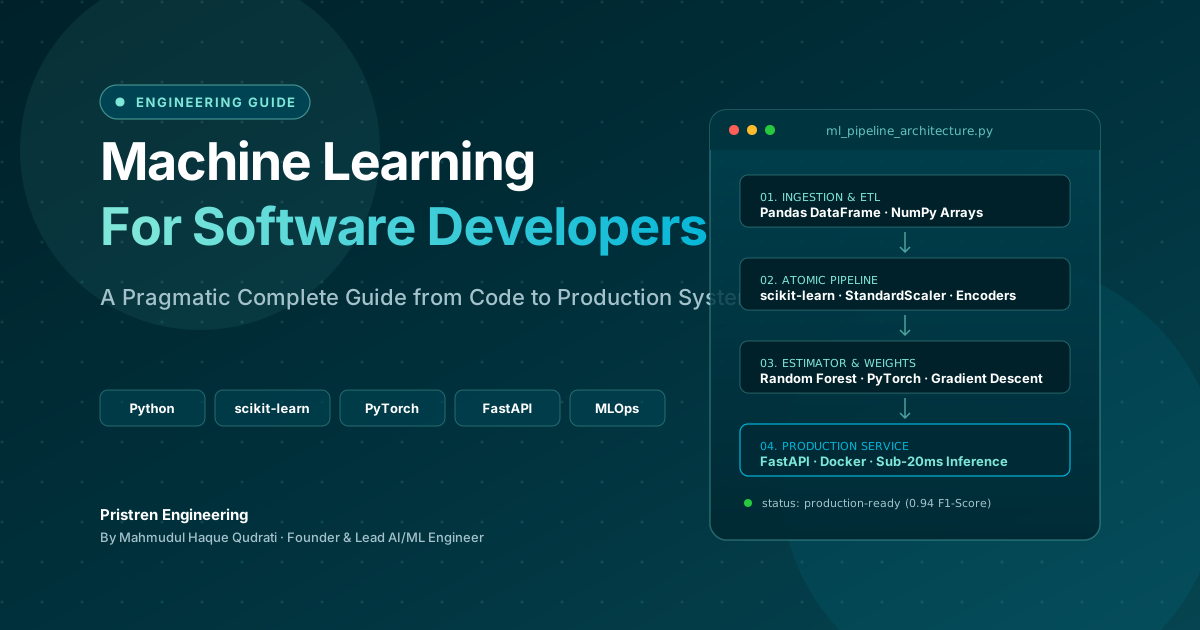
Machine Learning: Complete Guide for Software Developers
Learn machine learning as a software developer with this complete guide covering Python, algorithms, mathematics, projects, deep learning, and a practical roadmap.
 7 min read
ONNX: Export Any ML Model and Run It Anywhere
ONNX (Open Neural Network Exchange) is the universal model format - export from PyTorch, scikit-learn, or HuggingFace and run 3x faster inference with ONNX Runtime on CPU or GPU.
 6 min read
OpenAI API Guide 2026: Models, Structured Outputs, Batch API, and Cost Optimization
Complete OpenAI API reference for 2026 - model catalog, chat completions, function calling, structured outputs with JSON schema, embeddings, rate limits, and cost management.
// discussion
Comments