PaliGemma: Google's Compact Vision-Language Model for Fine-Tuning
PaliGemma combines SigLIP vision encoding with Gemma 2B language generation in a 3B model explicitly designed to be fine-tuned rather than used zero-shot.

Mahmudul Haque Qudrati
CEO & ML Engineer
March 20, 2026
7 min read
One AI engineering post, weekly
LLM benchmarks, prompt techniques, and token-cost breakdowns — not another AI news roundup.
Most vision-language models are released with zero-shot capability as the headline feature. PaliGemma takes a different stance: it is designed as a transfer learning base. Google trained it to be fine-tuned on specific vision tasks rather than to be a general-purpose assistant out of the box. This design choice shapes everything about how you should use it.
Architecture: SigLIP + Gemma 2B
PaliGemma has two components:
- SigLIP vision encoder - processes images at 224×224 (or 448×448 in the larger variant), producing 256 visual tokens via sigmoid loss contrastive pretraining (more stable than CLIP's softmax)
- Gemma 2B language model - takes the visual tokens concatenated with text tokens and generates output autoregressively
Total parameter count is approximately 3B, making it practical on a single A100 or even high-end consumer GPUs with quantization.
Team workspace
Ship faster with chat, meetings, and projects in one place — Zlyqor.
What Fine-Tuning Tasks Look Like
PaliGemma was pretrained on a mixture of tasks using a unified text format. Fine-tuning for a new task follows the same pattern:
python
from transformers import PaliGemmaForConditionalGeneration, PaliGemmaProcessor
from PIL import Image
import torch

model_id = "google/paligemma-3b-pt-224"
processor = PaliGemmaProcessor.from_pretrained(model_id)
model = PaliGemmaForConditionalGeneration.from_pretrained(
    model_id, torch_dtype=torch.bfloat16, device_map="auto"
)

image = Image.open("chart.png")
prompt = "caption en"  # or "answer en What is the trend shown?"

inputs = processor(text=prompt, images=image, return_tensors="pt").to(model.device)
with torch.inference_mode():
    output = model.generate(**inputs, max_new_tokens=100)
print(processor.decode(output[0], skip_special_tokens=True))
Supported Fine-Tuning Tasks
PaliGemma's pretraining covered: image captioning, visual question answering, object detection (outputs bounding box coordinates in text), image segmentation (outputs segmentation tokens), OCR, and chart understanding. Fine-tuning on custom datasets for any of these tasks is straightforward because the model already has the relevant capabilities - you are adapting rather than teaching from scratch.
PaliGemma 2: The Updated Backbone
PaliGemma 2 replaced Gemma 2B with the Gemma 2 backbone and expanded to three sizes: 3B, 10B, and 28B. The 10B variant achieves strong performance on DocVQA (document visual QA) and ChartQA without task-specific engineering, making it the recommended starting point for enterprise document workflows.
When to Use PaliGemma vs GPT-4V
GPT-4V excels at general zero-shot visual reasoning but is expensive, opaque, and rate-limited. PaliGemma is better when you have labeled data for a specific task, need to run inference at scale on your own infrastructure, or require full control over the model weights for compliance reasons. For receipt parsing, form extraction, or domain-specific captioning, a fine-tuned PaliGemma 3B will typically outperform GPT-4V at a fraction of the cost.
Links
#paligemma#google#vision-language#fine-tuning#siglip
Mahmudul Haque Qudrati
CEO & ML Engineer
Visionary technologist, software engineer, and machine learning specialist. Founder and CEO of Pristren, directing engineering teams that ship production-grade AI/ML pipelines, mission-critical full-stack applications, and developer tooling. Creator of Zlyqor, the unified team workspace platform. Author of 540+ technical guides and benchmark research reports on large language models, agentic workflows, Model Context Protocol (MCP), and modern web stacks.

More from Mahmudul
Related Articles
 11 min read
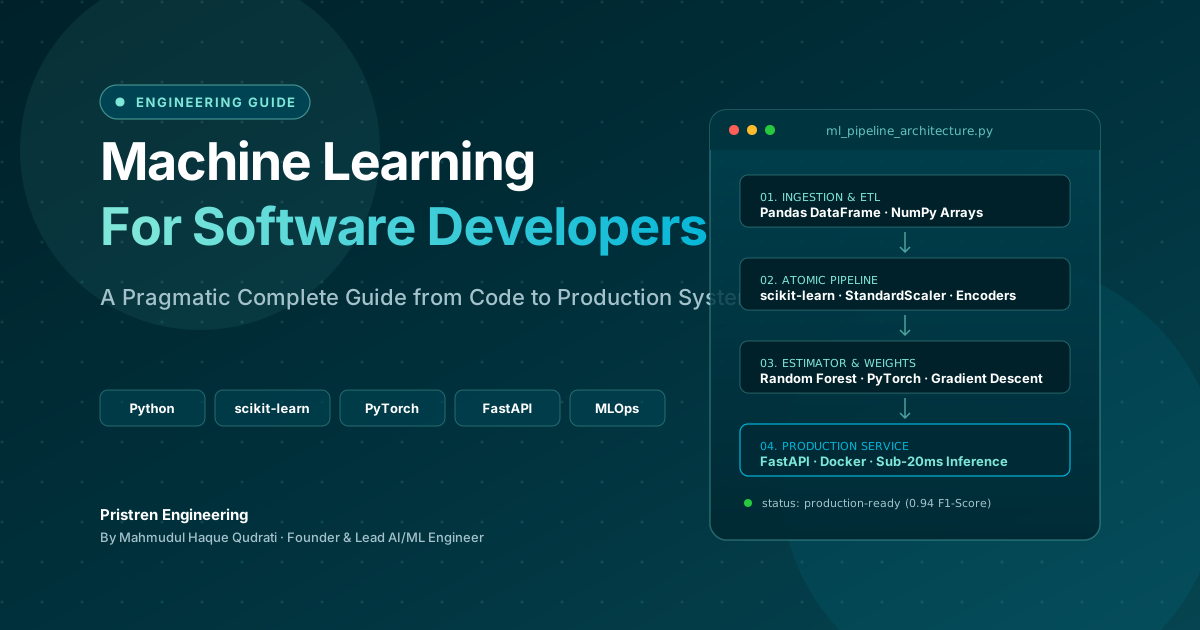
Machine Learning: Complete Guide for Software Developers
Learn machine learning as a software developer with this complete guide covering Python, algorithms, mathematics, projects, deep learning, and a practical roadmap.
 7 min read
ONNX: Export Any ML Model and Run It Anywhere
ONNX (Open Neural Network Exchange) is the universal model format - export from PyTorch, scikit-learn, or HuggingFace and run 3x faster inference with ONNX Runtime on CPU or GPU.
 9 min read
Gradient Descent Explained: How Machine Learning Models Actually Learn
Gradient descent is the engine behind every modern ML model. Here is how it works, why learning rate matters, and when to use Adam over SGD.
// discussion
Comments