
ColPali: Visual RAG Without OCR Using Late Interaction Embeddings
ColPali treats PDF pages as images and uses vision-language embeddings with ColBERT-style late interaction scoring, bypassing the lossy OCR pipeline that breaks table, chart, and layout-heavy document retrieval.

Mahmudul Haque Qudrati
CEO & ML Engineer
March 25, 2026
7 min read

One AI engineering post, weekly
LLM benchmarks, prompt techniques, and token-cost breakdowns — not another AI news roundup.
Standard PDF RAG pipelines look like: extract text with OCR → chunk → embed → retrieve. This pipeline quietly discards 30-60% of information in typical business documents:
- Tables: OCR flattens rows into prose, destroying relational structure
- Charts and graphs: Converted to alt-text or skipped entirely
- Two-column layouts: Text order scrambles when OCR reads column by column
- Formulas and equations: OCR produces garbled LaTeX or nothing
- Annotations and highlights: Invisible to text extractors
ColPali asks a different question: what if we never extract text at all?
The ColPali Approach
ColPali renders each PDF page as an image and embeds it using a vision-language model — no OCR, no text extraction. At query time, the text query is matched against page image embeddings using late interaction scoring.
Architecture:
- PaliGemma backbone: Google's vision-language model processes page images into patch embeddings (one embedding per 14x14 pixel patch for a 1024x1024 image = ~5000 patch vectors per page)
- Late interaction (ColBERT-style): Query tokens are matched against document patch tokens with MaxSim scoring — each query token finds its best-matching page patch
- Aggregated score: Sum of MaxSim scores across query tokens becomes the relevance score
The HuggingFace ColPali model includes the full PaliGemma fine-tune.
Team workspace
Ship faster with chat, meetings, and projects in one place — Zlyqor.
DocVQA Benchmark
On the ViDoRe benchmark (visual document retrieval), ColPali achieves significantly higher nDCG@5 than OCR-based pipelines, particularly on document types where OCR degrades:
- Financial reports with tables: +18 nDCG@5 over BM25+OCR
- Scientific papers with figures: +24 nDCG@5
- Slide decks: +31 nDCG@5
Running ColPali
from colpali_engine.models import ColPali, ColPaliProcessor
from PIL import Image
import torch

model = ColPali.from_pretrained(
    "vidore/colpali-v1.2",
    torch_dtype=torch.bfloat16,
    device_map="cuda"
)
processor = ColPaliProcessor.from_pretrained("vidore/colpali-v1.2")

# Convert PDF pages to images (e.g., with pdf2image)
page_images = [Image.open("page_1.png"), Image.open("page_2.png")]

# Embed pages
page_inputs = processor.process_images(page_images).to("cuda")
with torch.no_grad():
    page_embeddings = model(**page_inputs)

# Embed query
queries = ["What was the Q3 revenue?"]
query_inputs = processor.process_queries(queries).to("cuda")
with torch.no_grad():
    query_embeddings = model(**query_inputs)

# Score pages against query
scores = processor.score_multi_vector(query_embeddings, page_embeddings)
best_page = scores.argmax().item()
print(f"Most relevant page: {best_page}")
Vespa.ai Integration
For production-scale deployment with millions of pages, Vespa.ai supports ColBERT-style multi-vector indexing natively. The ColPali team provides Vespa application packages in the repository. Vespa's tensor computations handle the MaxSim scoring at scale without loading all page embeddings into GPU memory.
When to Use ColPali
ColPali is the right choice for: annual reports, technical manuals, research papers with figures, slide decks, and any documents where layout carries meaning. For plain-text documents (support tickets, emails, plain blog posts), traditional embedding + BM25 hybrid remains faster and cheaper.
#colpali#multimodal-rag#vision#pdf#late-interaction
Mahmudul Haque Qudrati
CEO & ML Engineer
Visionary technologist, software engineer, and machine learning specialist. Founder and CEO of Pristren, directing engineering teams that ship production-grade AI/ML pipelines, mission-critical full-stack applications, and developer tooling. Creator of Zlyqor, the unified team workspace platform. Author of 540+ technical guides and benchmark research reports on large language models, agentic workflows, Model Context Protocol (MCP), and modern web stacks.

More from Mahmudul
Machine Learning: Complete Guide for Software Developers
11 min read
GPT-6 Astra AGI: How to Actually Use It and Get Its Best Performance
8 min read
DeepSeek vs MiniMax vs Kimi in Coding Benchmarks: Real Scores, Real Prices, Real Tradeoffs
8 min read
GPT-6 Astra Benchmarks, Pricing, and Safety: What Developers Need to Know
5 min read
Related Articles
 11 min read
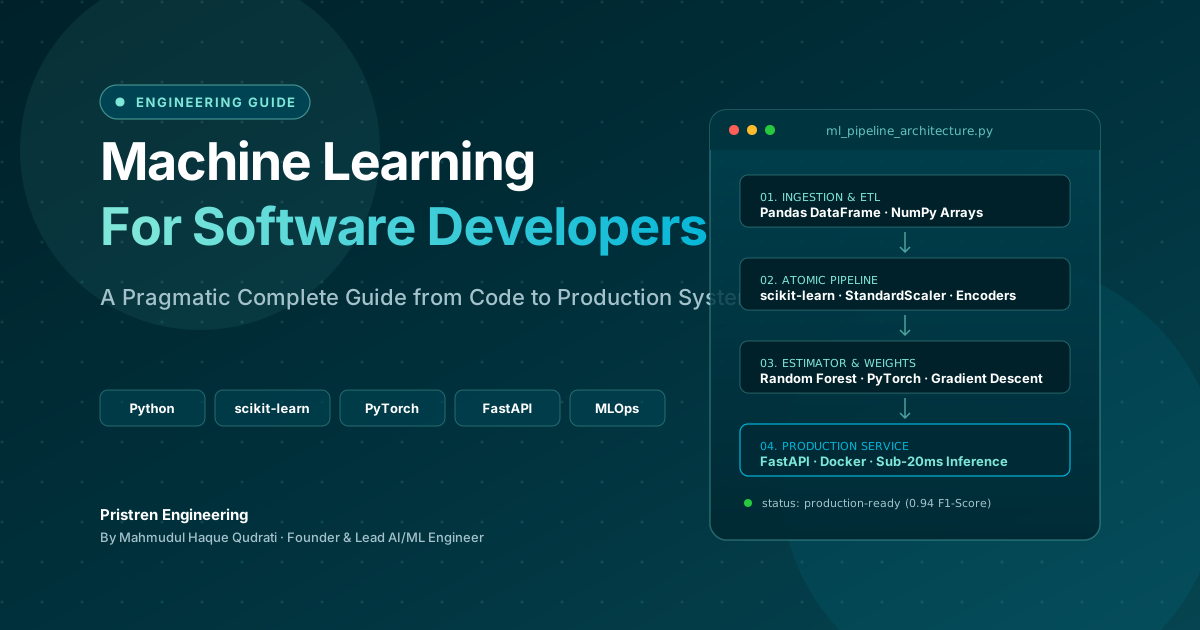
Machine Learning: Complete Guide for Software Developers
Learn machine learning as a software developer with this complete guide covering Python, algorithms, mathematics, projects, deep learning, and a practical roadmap.
 7 min read
ONNX: Export Any ML Model and Run It Anywhere
ONNX (Open Neural Network Exchange) is the universal model format - export from PyTorch, scikit-learn, or HuggingFace and run 3x faster inference with ONNX Runtime on CPU or GPU.
 9 min read
Gradient Descent Explained: How Machine Learning Models Actually Learn
Gradient descent is the engine behind every modern ML model. Here is how it works, why learning rate matters, and when to use Adam over SGD.
// discussion
Comments