The distinction between generative and discriminative models is one of the most foundational in machine learning. It explains why some models can generate new examples while others can only classify existing ones, why LLMs work the way they do, and when to reach for each type in practice. Understanding this distinction will make you a better ML practitioner.
Generative vs Discriminative Models: The Fundamental ML Distinction
Discriminative models learn decision boundaries. Generative models learn data distributions. Understanding this split explains why LLMs can generate text and when each approach wins.

Mahmudul Haque Qudrati
CEO & ML Engineer
May 18, 2026
9 min read
One AI engineering post, weekly
LLM benchmarks, prompt techniques, and token-cost breakdowns — not another AI news roundup.
Discriminative models learn the boundary between classes. Given an input X (an email), predict the most likely label Y (spam or not spam). They learn:
P(Y | X) -- probability of label Y given input X
This is directly useful for classification. The model does not need to understand what spam looks like in general -- it only needs to know whether THIS email is more likely to be spam or not spam.
Generative models learn the distribution of the data itself. They model:
P(X)           -- probability distribution over inputs
P(X, Y)        -- joint distribution of inputs and labels
P(X | Y)       -- what input X looks like given label Y
From this richer model, you can:
- Generate new samples from
P(X)orP(X | Y) - Classify (by computing
P(Y | X) = P(X | Y) * P(Y) / P(X)via Bayes' theorem) - Detect anomalies (low
P(X)examples are unusual)
Discriminative Models: Most of What You Use Daily
The models you reach for most often in applied ML are discriminative:
- Logistic regression: Directly models
P(Y=1 | X) - Support Vector Machines: Learns the maximum-margin decision boundary
- Random Forest and gradient boosted trees: Ensemble of decision boundaries
- Neural network classifiers: The final softmax layer outputs
P(Y | X) - BERT for text classification: Encodes input text, then classifies
These models excel at their purpose: classification and regression on labeled data. They are sample-efficient (you can learn a good decision boundary with fewer examples than you need to learn the full data distribution), fast to train, and interpretable relative to generative models.
The limitation: they can only answer "what class does this example belong to?" They cannot answer "what does an example from class Y look like?" and they cannot generate new examples.
Team workspace
Ship faster with chat, meetings, and projects in one place — Zlyqor.
Generative Models: Learning the Data Distribution
Generative models have a longer history and a wider variety of architectures:
Naive Bayes: A simple probabilistic classifier that models P(X | Y) and P(Y), then uses Bayes' theorem for classification. Despite the "Naive" in the name (it assumes feature independence), it works surprisingly well for text classification and runs at near-zero computational cost.
Gaussian Mixture Models (GMMs): Model the data as a mixture of Gaussian distributions. Each Gaussian represents a cluster. Used for clustering and density estimation.
Variational Autoencoders (VAEs): Learn a compressed latent space that captures the structure of the data. Given a latent vector, the decoder generates a new example. The encoder compresses data to the latent space for reconstruction and generation.
Generative Adversarial Networks (GANs): Two neural networks (generator and discriminator) trained in opposition. The generator tries to produce realistic samples; the discriminator tries to distinguish real from generated. GANs dominated image generation from 2016-2022.
Diffusion models: Learn to reverse a gradual noising process. Adding Gaussian noise to data step by step, then learning to denoise. Stable Diffusion, DALL-E 3, and Midjourney use diffusion models. Currently the dominant approach for high-quality image generation.
Language models (GPT, LLaMA, Claude): Model P(token | all previous tokens). By learning the probability distribution over text, they can generate new text by sampling from this distribution.
Why Language Models Are Generative
This connects directly to how LLMs work. A language model does not learn "is this text positive or negative?" It learns "given these words, what is the next most likely word?"
Formally:
P(text) = P(token_1) * P(token_2 | token_1) * P(token_3 | token_1, token_2) * ...
By modeling the full probability distribution over text, an LLM can:
- Generate new text by sampling from this distribution token by token
- Classify by comparing
P(text | class A)vsP(text | class B)(using the model as a discriminator) - Complete a prompt (continue the most likely sequence)
- Score the likelihood of a given text (perplexity)
The generative training objective (predict the next token) is what gives LLMs their versatility. A model trained to predict next tokens across all of human writing learns grammar, facts, reasoning patterns, code, math, and more -- because all of these are reflected in the distribution of text.
When Discriminative Models Win
Classification tasks with abundant labeled data. If you have 50,000 labeled customer support tickets, a fine-tuned BERT classifier will outperform a generative model used for classification. Discriminative models concentrate their capacity on learning the decision boundary, not the full data distribution.
Tabular data prediction. Gradient boosted trees (XGBoost, LightGBM) are discriminative and are state of the art on most tabular classification and regression tasks. Generative models rarely add value here.
Speed and simplicity. A logistic regression classifier is faster to train, faster to serve, and easier to debug than a generative model. When the simpler discriminative approach is accurate enough, use it.
When Generative Models Win
Data augmentation. If you have limited labeled training data, generative models can synthesize new examples. A generative model trained on your data can produce additional training examples for the discriminative classifier, improving performance.
Anomaly detection. Model P(X) on normal data. At inference time, examples with low P(X) are anomalous. Discriminative models require labeled anomaly examples, which are often scarce. Generative anomaly detection requires only normal examples.
Creative generation. Any task that requires creating new content -- text, images, audio, code -- requires a generative model. Discriminative models cannot create; they can only evaluate.
Zero-shot and few-shot tasks. Large generative language models can perform classification, extraction, and transformation tasks without any task-specific training data, by specifying the task in the prompt. Discriminative models require labeled examples for every task.
Density estimation. Understanding the structure of your data, identifying the most typical and most unusual examples, generating synthetic datasets for privacy reasons -- these all require learning P(X).
The Practical Landscape in 2026
The rise of large language models has blurred the line somewhat. GPT-4 and Claude, while fundamentally generative, can perform discriminative tasks (classification, extraction) via prompting -- often matching fine-tuned discriminative models for low-resource tasks.
The decision tree for practitioners:
- Do you need to generate new content? Generative model required.
- Do you have labeled data and a fixed classification task? Use a discriminative model (BERT-family classifier or gradient boosted trees for tabular).
- Do you have no labeled data? Use a generative LLM for zero-shot classification.
- Do you need anomaly detection without labeled anomalies? Use a generative model.
- Do you need to augment scarce labeled data? Generative model for synthesis, then discriminative for the final classifier.
Keep Reading
- GPT Architecture Explained -- deep dive into the dominant generative architecture
- BERT Explained for Developers -- the leading discriminative encoder model
- Natural Language Inference Guide -- a technique that uses discriminative NLI models to perform generative-style zero-shot classification
Pristren builds AI-powered software for teams. Zlyqor is our all-in-one workspace -- chat, projects, time tracking, AI meeting summaries, and invoicing -- in one tool. Try it free.
#generative-ai#discriminative-models#llms#gans#diffusion-models
Mahmudul Haque Qudrati
CEO & ML Engineer
Visionary technologist, software engineer, and machine learning specialist. Founder and CEO of Pristren, directing engineering teams that ship production-grade AI/ML pipelines, mission-critical full-stack applications, and developer tooling. Creator of Zlyqor, the unified team workspace platform. Author of 540+ technical guides and benchmark research reports on large language models, agentic workflows, Model Context Protocol (MCP), and modern web stacks.

More from Mahmudul
Machine Learning: Complete Guide for Software Developers
11 min read
GPT-6 Astra AGI: How to Actually Use It and Get Its Best Performance
8 min read
DeepSeek vs MiniMax vs Kimi in Coding Benchmarks: Real Scores, Real Prices, Real Tradeoffs
8 min read
GPT-6 Astra Benchmarks, Pricing, and Safety: What Developers Need to Know
5 min read
Related Articles
 11 min read
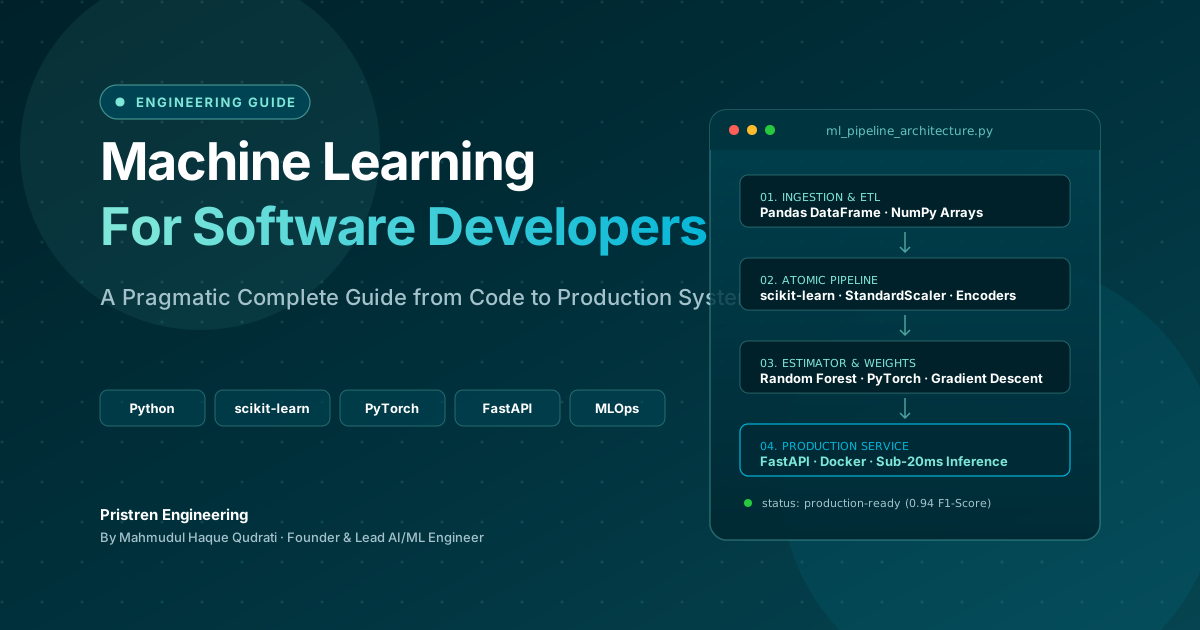
Machine Learning: Complete Guide for Software Developers
Learn machine learning as a software developer with this complete guide covering Python, algorithms, mathematics, projects, deep learning, and a practical roadmap.
 12 min read
DeepSeek-R1: Architectures, Training Methods, and Why Reasoning Models Matter
An in-depth look at reinforcement learning, Chain-of-Thought reasoning, and why DeepSeek-R1 represents a shift in LLM capabilities and cost.
 9 min read
When to Fine-Tune an LLM (And When to Rely on RAG Instead)
Fine-tuning updates model weights, while RAG inserts context. Learn how to combine these strategies or choose the right one for your data.
// discussion
Comments