GGUF Quantization Explained: Q4_K_M vs Q8_0 and When Each Matters
Quantization shrinks LLM weights from float32 to int4 or int8 - here is exactly what each GGUF level means, how memory usage scales, and the quality tradeoffs.

Mahmudul Haque Qudrati
CEO & ML Engineer
April 22, 2026
7 min read
One AI engineering post, weekly
LLM benchmarks, prompt techniques, and token-cost breakdowns — not another AI news roundup.
A Llama 3.1 70B model in float32 takes 280 GB of RAM - impractical on any consumer hardware. Quantization reduces the precision of model weights from 32-bit or 16-bit floats to 8-bit or 4-bit integers. The result: dramatically lower memory requirements with a small, usually acceptable quality loss.
GGUF (GPT-Generated Unified Format) is the file format used by llama.cpp and tools like Ollama and LM Studio. It stores quantized weights with metadata about the quantization scheme.
Quantization Levels Explained
| Level | Bits | Method | Quality | Notes |
|---|---|---|---|---|
| Q4_0 | 4 | Simple block quant | Moderate | Fastest, lowest quality |
| Q4_K_M | 4 | K-quant, medium | Good | Best 4-bit for most use cases |
| Q4_K_S | 4 | K-quant, small | Moderate | Smaller than Q4_K_M |
| Q5_K_M | 5 | K-quant, medium | Very good | ~20% more RAM than Q4_K_M |
| Q6_K | 6 | K-quant | Near-lossless | Excellent for 13B and smaller |
| Q8_0 | 8 | 8-bit block quant | Near-perfect | 2x size of Q4, minimal quality loss |
| F16 | 16 | Half precision | Reference | ~2x Q8_0, baseline quality |
K-quant methods (K_M, K_S, K_L) use a smarter quantization scheme than naive Q4_0: they group weights into blocks and allocate higher precision to weights that matter more (typically attention layers). Q4_K_M is the community default for 4-bit inference.
Team workspace
Ship faster with chat, meetings, and projects in one place — Zlyqor.
Memory Requirements by Model Size and Quant
| Model | Q4_K_M | Q5_K_M | Q8_0 | F16 |
|---|---|---|---|---|
| 7B | 4.1 GB | 5.0 GB | 7.7 GB | 14 GB |
| 13B | 7.4 GB | 9.0 GB | 14 GB | 26 GB |
| 34B | 19 GB | 23 GB | 36 GB | 68 GB |
| 70B | 40 GB | 48 GB | 75 GB | 140 GB |
Quality Impact on Benchmarks
On standard benchmarks (MMLU, HellaSwag, TruthfulQA), Q4_K_M loses 1 - 3% relative to F16 for 7B/13B models and 0.5 - 1.5% for 70B models. The larger the model, the more quantization-resistant it is - a Q4_K_M Llama 70B often outperforms an F16 Llama 13B despite using similar RAM.
Q8_0 is effectively lossless for most benchmarks - quality within 0.1 - 0.5% of F16 at half the memory.
GGUF vs GPTQ vs AWQ
| Format | Ecosystem | GPU support | CPU support |
|---|---|---|---|
| GGUF | llama.cpp, Ollama, LM Studio | Yes (partial offload) | Yes |
| GPTQ | AutoGPTQ, vLLM | GPU only | No |
| AWQ | vLLM, AutoAWQ | GPU only | No |
GGUF is unique in supporting CPU inference and partial GPU offloading - run a 70B model on a 16 GB GPU + CPU RAM combined.
How to Pick the Right Quantization
- Consumer GPU with 8 GB VRAM (RTX 4070, 3070): Q4_K_M for 7B or 8B models
- 16 GB VRAM (A4000, RTX 3090): Q4_K_M for 13B, or Q5_K_M for 7B if quality matters
- 24 GB VRAM (RTX 3090, A5000): Q4_K_M for 34B, or Q8_0 for 13B
- Apple M2/M3 36 GB unified: Q4_K_M for 70B or Q8_0 for 34B
- 2x A100 80 GB: F16 70B
Find GGUF models at HuggingFace - filter by model family and look for publishers like Bartowski or TheBloke.
#gguf#quantization#llama.cpp#memory#quality
Mahmudul Haque Qudrati
CEO & ML Engineer
Visionary technologist, software engineer, and machine learning specialist. Founder and CEO of Pristren, directing engineering teams that ship production-grade AI/ML pipelines, mission-critical full-stack applications, and developer tooling. Creator of Zlyqor, the unified team workspace platform. Author of 540+ technical guides and benchmark research reports on large language models, agentic workflows, Model Context Protocol (MCP), and modern web stacks.

More from Mahmudul
Related Articles
 11 min read
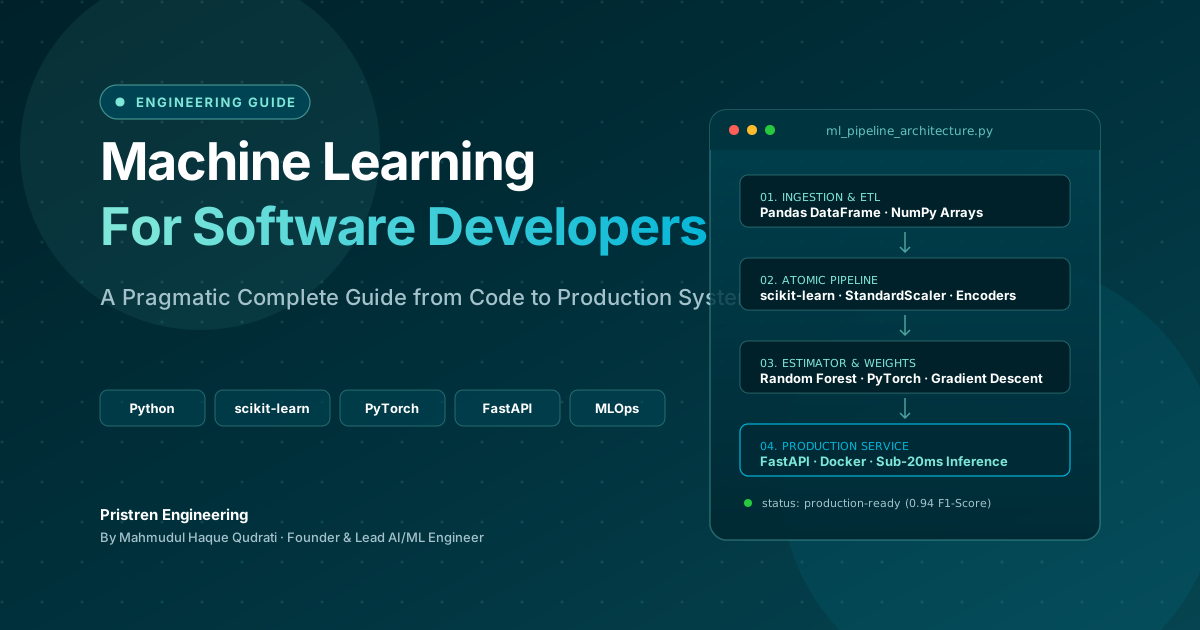
Machine Learning: Complete Guide for Software Developers
Learn machine learning as a software developer with this complete guide covering Python, algorithms, mathematics, projects, deep learning, and a practical roadmap.
 7 min read
ONNX: Export Any ML Model and Run It Anywhere
ONNX (Open Neural Network Exchange) is the universal model format - export from PyTorch, scikit-learn, or HuggingFace and run 3x faster inference with ONNX Runtime on CPU or GPU.
 9 min read
Gradient Descent Explained: How Machine Learning Models Actually Learn
Gradient descent is the engine behind every modern ML model. Here is how it works, why learning rate matters, and when to use Adam over SGD.
// discussion
Comments