Great Expectations: Automated Data Quality Checks for ML Pipelines
Great Expectations lets you define what good data looks like, validate it automatically in your pipeline, and generate documentation - catching data issues before they corrupt your models.

Mahmudul Haque Qudrati
CEO & ML Engineer
April 7, 2026
7 min read
One AI engineering post, weekly
LLM benchmarks, prompt techniques, and token-cost breakdowns — not another AI news roundup.
Garbage in, garbage out is not a metaphor - it is the most common cause of ML model failures in production. A model trained on clean data and served corrupted data degrades silently. Great Expectations (GX) gives your pipeline a data quality layer that fails loudly when data does not meet your expectations.
Core Concepts
Expectation: a testable assertion about your data. "Column X should not be null." "Column Y mean should be between 100 and 200."
Expectation Suite: a collection of expectations for a dataset.
Checkpoint: runs an Expectation Suite against data and produces a validation result.
Data Docs: auto-generated HTML documentation showing your expectations and validation history.
Team workspace
Ship faster with chat, meetings, and projects in one place — Zlyqor.
Defining Expectations
python
import great_expectations as gx
import pandas as pd

context = gx.get_context()

df = pd.read_csv("orders.csv")
validator = context.sources.pandas_default.read_dataframe(df)

# Basic column expectations
validator.expect_column_values_to_not_be_null("order_id")
validator.expect_column_values_to_be_unique("order_id")
validator.expect_column_values_to_be_in_set("status", ["pending", "shipped", "delivered", "cancelled"])

# Statistical expectations
validator.expect_column_mean_to_be_between("total_usd", min_value=10.0, max_value=500.0)
validator.expect_column_min_to_be_between("total_usd", min_value=0.0, max_value=1.0)
validator.expect_column_values_to_be_between("total_usd", min_value=0, max_value=10000)

# Schema expectations
validator.expect_column_to_exist("created_at")
validator.expect_table_row_count_to_be_between(min_value=1000, max_value=10_000_000)

validator.save_expectation_suite(discard_failed_expectations=False)
Connecting to Real Databases
python
import great_expectations as gx

context = gx.get_context()

# PostgreSQL
pg_datasource = context.sources.add_postgres(
    name="production_db",
    connection_string="postgresql://user:pass@host:5432/dbname",
)
asset = pg_datasource.add_table_asset("orders", table_name="orders")

# BigQuery
bq_datasource = context.sources.add_bigquery(
    name="bigquery_prod",
    project="my-project",
)
Checkpoints for Pipeline Integration
python
checkpoint = context.add_or_update_checkpoint(
    name="daily_orders_checkpoint",
    validations=[
        {
            "batch_request": asset.build_batch_request(),
            "expectation_suite_name": "orders_suite",
        }
    ],
)

results = checkpoint.run()

if not results["success"]:
    raise ValueError("Data quality check failed  -  pipeline halted")
Embed this in your Airflow DAG or Prefect flow to halt pipelines on data quality failures.
Generating Data Docs
bash
great_expectations docs build
great_expectations docs serve  # opens browser with validation history
Data Docs show every expectation, when it was last validated, and the pass/fail rate over time. Share this URL with data consumers to document your SLAs.
GX Cloud vs Self-Hosted
GX Core (open source): all the above features, self-managed. Free.
GX Cloud: managed UI, team collaboration, alerting. Free tier for small teams.
GX vs Soda Core
Soda Core is an alternative that uses YAML-defined checks instead of Python. Simpler for non-engineers. GX is more powerful for complex statistical expectations and better Python integration.
Resources: Great Expectations, GitHub, docs.
#great-expectations#data-quality#validation#testing#mlops
Mahmudul Haque Qudrati
CEO & ML Engineer
Visionary technologist, software engineer, and machine learning specialist. Founder and CEO of Pristren, directing engineering teams that ship production-grade AI/ML pipelines, mission-critical full-stack applications, and developer tooling. Creator of Zlyqor, the unified team workspace platform. Author of 540+ technical guides and benchmark research reports on large language models, agentic workflows, Model Context Protocol (MCP), and modern web stacks.


More from Mahmudul
Related Articles
 11 min read
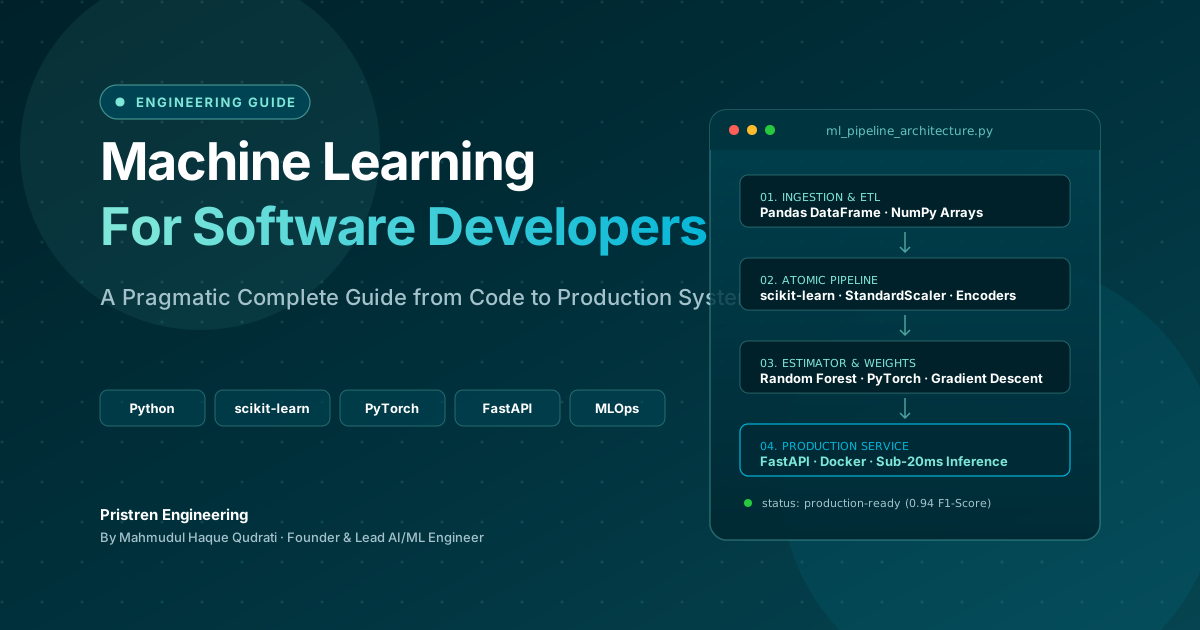
Machine Learning: Complete Guide for Software Developers
Learn machine learning as a software developer with this complete guide covering Python, algorithms, mathematics, projects, deep learning, and a practical roadmap.
 10 min read
Testing HTTP APIs Effectively: Beyond the Happy Path
Unit vs integration tests, test database strategies, auth in tests, and making sure your 400, 401, 403, 404, and 500 responses are all verified.
 9 min read
Storybook Guide: Building and Documenting Your Component Library
Storybook gives you isolated component development, visual regression testing, and design documentation. Here is when it is worth the investment.
// discussion
Comments