RoBERTa: BERT Done Right - When and How to Use It for Classification
RoBERTa improves on BERT through better pre-training - dynamic masking, no next-sentence prediction, larger batches, and more data - delivering consistent GLUE leaderboard advantages for classification tasks.

Mahmudul Haque Qudrati
CEO & ML Engineer
April 8, 2026
7 min read
One AI engineering post, weekly
LLM benchmarks, prompt techniques, and token-cost breakdowns — not another AI news roundup.
BERT's pre-training had three weaknesses that RoBERTa corrected:
- Static masking: BERT masks the same tokens every epoch. RoBERTa uses dynamic masking - different tokens masked each epoch, forcing more robust representations.
- Next Sentence Prediction (NSP): BERT's NSP objective was shown to hurt performance. RoBERTa removes it entirely, training only on masked language modeling.
- Training scale: BERT trained on 16GB for 1M steps. RoBERTa trained on 160GB for 500K steps with larger batch sizes.
The result: RoBERTa-base consistently outperforms BERT-base on GLUE tasks by 3-7 points without architectural changes. The HuggingFace RoBERTa page provides base and large variants.
Fine-Tuning in Under 30 Lines
python
from transformers import RobertaForSequenceClassification, RobertaTokenizer, Trainer, TrainingArguments
from datasets import load_dataset

tokenizer = RobertaTokenizer.from_pretrained("roberta-base")
model = RobertaForSequenceClassification.from_pretrained("roberta-base", num_labels=4)

dataset = load_dataset("ag_news")

def tokenize_fn(batch):
    return tokenizer(batch["text"], truncation=True, padding="max_length", max_length=256)

tokenized = dataset.map(tokenize_fn, batched=True)
tokenized = tokenized.rename_column("label", "labels")

args = TrainingArguments(
    output_dir="roberta-ag-news",
    num_train_epochs=3,
    per_device_train_batch_size=32,
    evaluation_strategy="epoch",
    load_best_model_at_end=True,
)

trainer = Trainer(model=model, args=args, train_dataset=tokenized["train"], eval_dataset=tokenized["test"])
trainer.train()
Team workspace
Ship faster with chat, meetings, and projects in one place — Zlyqor.
Multi-Label Classification
For multi-label tasks (a text belonging to multiple categories simultaneously), change the loss function:
python
import torch
from transformers import RobertaForSequenceClassification

model = RobertaForSequenceClassification.from_pretrained("roberta-base", num_labels=10, problem_type="multi_label_classification")
# Trainer handles BCEWithLogitsLoss automatically when labels are float tensors
# Labels should be float tensors: [0.0, 1.0, 0.0, 1.0, ...]
Few-Shot Classification With SetFit
For low-data scenarios (<50 labeled examples), SetFit outperforms RoBERTa fine-tuning by using contrastive sentence transformer training:
python
from setfit import SetFitModel, SetFitTrainer
from datasets import Dataset

train_data = Dataset.from_dict({
    "text": ["positive example 1", "negative example 1", ...],  # 8-16 examples per class
    "label": [1, 0, ...]
})

model = SetFitModel.from_pretrained("sentence-transformers/paraphrase-mpnet-base-v2")
trainer = SetFitTrainer(model=model, train_dataset=train_data)
trainer.train()
SetFit requires no GPU for fine-tuning with small datasets and reaches full RoBERTa fine-tune quality with 50x less data.
Production ONNX Export
Export fine-tuned RoBERTa to ONNX following the same pattern as DistilBERT. RoBERTa-base in ONNX on CPU achieves 15-25ms latency per request - acceptable for most classification use cases without GPU infrastructure.
#roberta#bert#text-classification#nlp#fine-tuning
Mahmudul Haque Qudrati
CEO & ML Engineer
Visionary technologist, software engineer, and machine learning specialist. Founder and CEO of Pristren, directing engineering teams that ship production-grade AI/ML pipelines, mission-critical full-stack applications, and developer tooling. Creator of Zlyqor, the unified team workspace platform. Author of 540+ technical guides and benchmark research reports on large language models, agentic workflows, Model Context Protocol (MCP), and modern web stacks.


More from Mahmudul
Related Articles
 11 min read
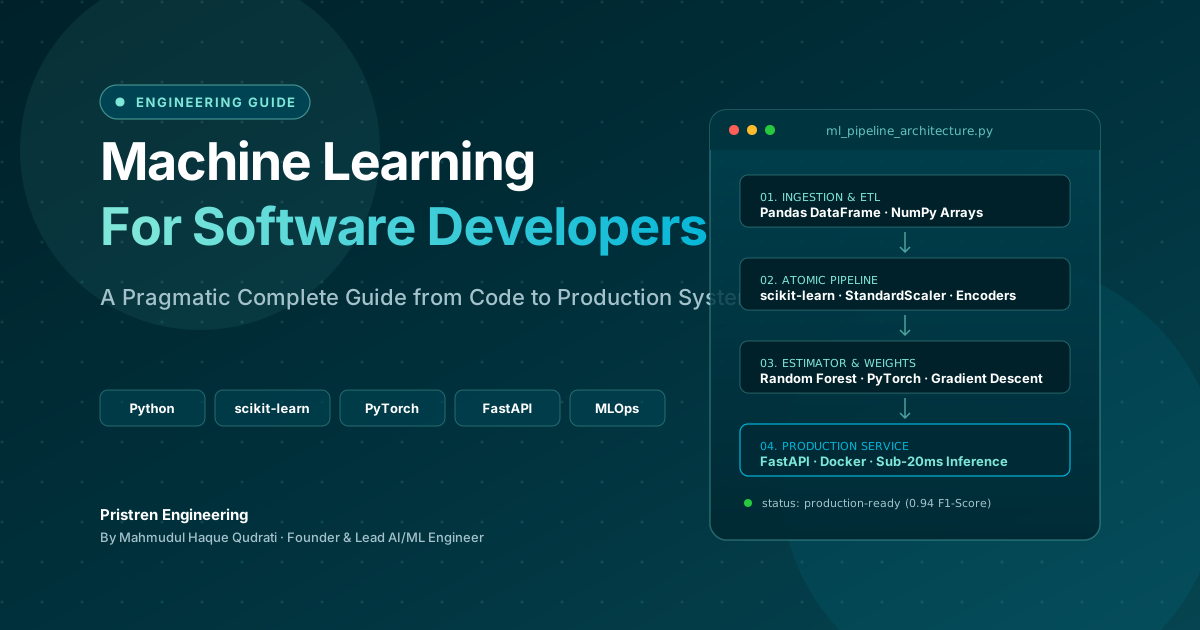
Machine Learning: Complete Guide for Software Developers
Learn machine learning as a software developer with this complete guide covering Python, algorithms, mathematics, projects, deep learning, and a practical roadmap.
 11 min read
Understanding Transformer Attention Mechanisms: Self-Attention vs Cross-Attention
A mathematical and visual walkthrough of multi-head attention, self-attention, and encoder-decoder cross-attention inside language models.
 7 min read
ONNX: Export Any ML Model and Run It Anywhere
ONNX (Open Neural Network Exchange) is the universal model format - export from PyTorch, scikit-learn, or HuggingFace and run 3x faster inference with ONNX Runtime on CPU or GPU.
// discussion
Comments