Idefics2: HuggingFace's Open Multimodal Model Built on Mistral and SigLIP
Idefics2 is an 8B open multimodal model that handles interleaved image-text sequences, arbitrary image resolutions, and fine-tuning for document and chart understanding.

Mahmudul Haque Qudrati
CEO & ML Engineer
March 25, 2026
7 min read
One AI engineering post, weekly
LLM benchmarks, prompt techniques, and token-cost breakdowns — not another AI news roundup.
The HuggingFace Multimodal team (M4) released Idefics2 as a fully open alternative to closed multimodal APIs. At 8B parameters - Mistral 7B language backbone plus SigLIP vision encoder - it is deployable on a single A100 80GB and competitive with much larger proprietary models on several benchmarks.
Architecture Highlights
Idefics2 connects a SigLIP vision encoder to a Mistral 7B language model via a learned perceiver resampler. Unlike models that resize all images to a fixed resolution and pad the rest, Idefics2 preserves native aspect ratios by tiling: large images are split into sub-images that are encoded independently, then concatenated. This means a 1024×512 image and a 512×1024 image are both handled without distortion.
python
from transformers import AutoProcessor, AutoModelForVision2Seq
from PIL import Image
import torch

processor = AutoProcessor.from_pretrained("HuggingFaceM4/idefics2-8b")
model = AutoModelForVision2Seq.from_pretrained(
    "HuggingFaceM4/idefics2-8b",
    torch_dtype=torch.bfloat16,
    device_map="auto",
)

image = Image.open("document.png")
messages = [
    {
        "role": "user",
        "content": [
            {"type": "image"},
            {"type": "text", "text": "What is the total revenue shown in this table?"},
        ],
    }
]

prompt = processor.apply_chat_template(messages, add_generation_prompt=True)
inputs = processor(text=prompt, images=[image], return_tensors="pt").to(model.device)

with torch.no_grad():
    output = model.generate(**inputs, max_new_tokens=200)
print(processor.decode(output[0], skip_special_tokens=True))
Team workspace
Ship faster with chat, meetings, and projects in one place — Zlyqor.
Interleaved Image-Text Sequences
Idefics2 can handle multiple images interleaved with text in a single prompt - a capability most VLMs lack. This is critical for tasks like: comparing two charts, answering questions about a multi-page document, or following instructions that reference multiple reference images. The model maintains coherent reasoning across the full interleaved sequence.
The OBELICS Dataset
Idefics2 was trained on OBELICS (Open Benchmark of Large Interleaved Corpora and Sequences), a 115B token dataset of web-scraped interleaved image-text documents. Unlike earlier multimodal datasets that pair single images with captions, OBELICS contains full web pages with multiple images and surrounding text - which explains why Idefics2 performs well on document-level tasks.
Fine-Tuning for Document Understanding
For teams needing custom document or chart extraction, Idefics2 provides a strong starting point:
python
from trl import SFTTrainer
from transformers import TrainingArguments

training_args = TrainingArguments(
    output_dir="idefics2-finetuned",
    per_device_train_batch_size=2,
    gradient_accumulation_steps=4,
    learning_rate=2e-5,
    num_train_epochs=3,
    bf16=True,
)
# SFTTrainer handles vision inputs automatically when dataset includes image columns
Comparison to LLaVA and PaliGemma
LLaVA 1.6 uses a similar Mistral backbone but fixed-resolution image encoding. PaliGemma is purpose-built for fine-tuning but smaller (3B). Idefics2 occupies a useful middle ground: large enough for strong zero-shot performance, open enough to fine-tune, and natively supports multi-image interleaved prompts.
Links
#idefics2#huggingface#multimodal#siglip#open-source
Mahmudul Haque Qudrati
CEO & ML Engineer
Visionary technologist, software engineer, and machine learning specialist. Founder and CEO of Pristren, directing engineering teams that ship production-grade AI/ML pipelines, mission-critical full-stack applications, and developer tooling. Creator of Zlyqor, the unified team workspace platform. Author of 540+ technical guides and benchmark research reports on large language models, agentic workflows, Model Context Protocol (MCP), and modern web stacks.

More from Mahmudul
Related Articles
 11 min read
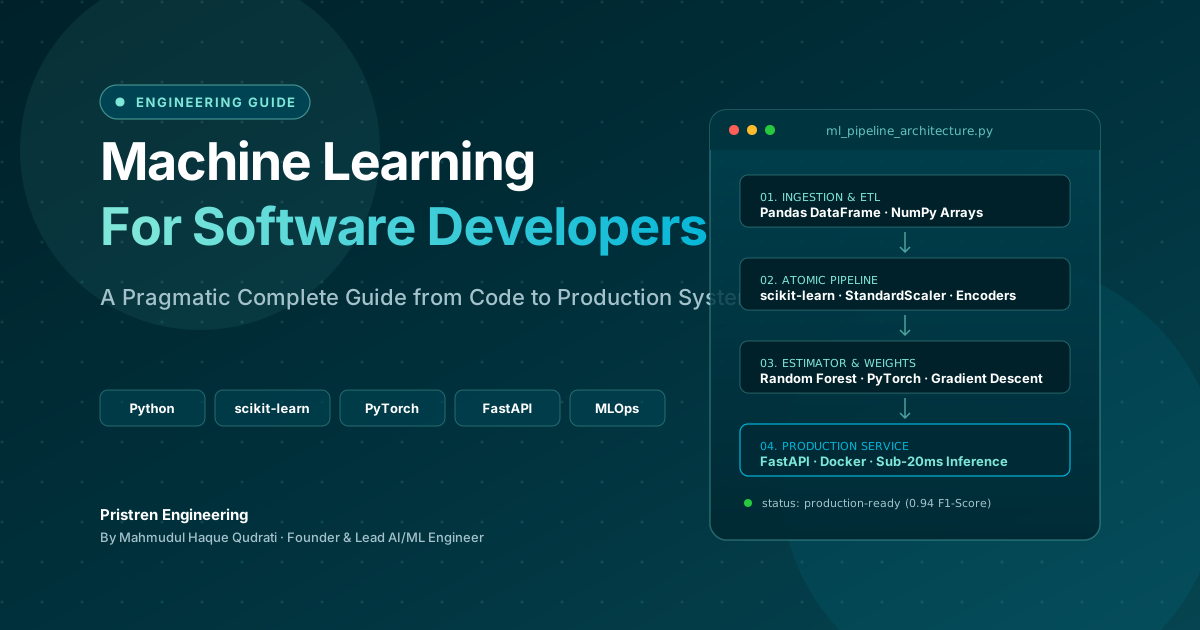
Machine Learning: Complete Guide for Software Developers
Learn machine learning as a software developer with this complete guide covering Python, algorithms, mathematics, projects, deep learning, and a practical roadmap.
 4 min read
Open Code Review – An AI-powered code review CLI tool: A Practical Overview
Open Code Review is an open-source CLI tool from Alibaba that uses AI to review code changes. It runs locally, supports multiple LLMs, and costs about $0.01 per review. Here's a practical breakdown.
 7 min read
ONNX: Export Any ML Model and Run It Anywhere
ONNX (Open Neural Network Exchange) is the universal model format - export from PyTorch, scikit-learn, or HuggingFace and run 3x faster inference with ONNX Runtime on CPU or GPU.
// discussion
Comments