Modal: Run GPU Python Functions as Serverless Jobs in 30 Seconds
Modal lets you decorate any Python function to run on cloud GPUs with sub-5-second cold starts, persistent model caching, and OpenAI-compatible web endpoints.

Mahmudul Haque Qudrati
CEO & ML Engineer
April 9, 2026
8 min read
One AI engineering post, weekly
LLM benchmarks, prompt techniques, and token-cost breakdowns — not another AI news roundup.
Modal is a cloud platform that makes GPU-backed Python functions as easy to deploy as regular functions. You add a decorator, push your code, and Modal handles provisioning, scaling, and teardown. Cold starts are under 5 seconds for cached images - dramatically faster than Lambda or Cloud Run for GPU workloads.
The Core Pattern
python
import modal

app = modal.App("llm-inference")

# Define a container image with your dependencies
image = modal.Image.debian_slim().pip_install(
    "torch", "transformers", "accelerate"
)

# This function runs on an A100 in the cloud
@app.function(gpu="A100", image=image, timeout=300)
def generate(prompt: str) -> str:
    from transformers import pipeline
    pipe = pipeline("text-generation", model="mistralai/Mistral-7B-Instruct-v0.2")
    return pipe(prompt, max_new_tokens=200)[0]["generated_text"]

@app.local_entrypoint()
def main():
    result = generate.remote("Explain quantum entanglement simply:")
    print(result)
Run with: modal run inference.py
Team workspace
Ship faster with chat, meetings, and projects in one place — Zlyqor.
Persistent Volumes for Model Weights
Downloading a 7B model on every cold start would take minutes. Modal Volumes solve this:
python
volume = modal.Volume.from_name("model-weights", create_if_missing=True)

@app.function(gpu="A100", volumes={"/models": volume})
def download_model():
    from huggingface_hub import snapshot_download
    snapshot_download("mistralai/Mistral-7B-Instruct-v0.2", local_dir="/models/mistral-7b")
    volume.commit()
Run the download once. Subsequent function calls mount the volume and skip the download entirely.
Web Endpoints
Turn any function into an HTTP API with @modal.web_endpoint:
python
@app.function(gpu="T4", image=image)
@modal.web_endpoint(method="POST")
def inference_api(item: dict) -> dict:
    result = generate_text(item["prompt"])
    return {"output": result}
Modal gives you a stable HTTPS URL. Scales to zero when idle, scales up automatically under load.
Scheduled Jobs
python
@app.function(schedule=modal.Cron("0 8 * * *"))
def daily_report():
    # runs every day at 8 AM UTC
    generate_and_send_report()
Modal vs AWS Lambda
Lambda tops out at 15-minute execution time, has no native GPU support, and cold starts on large packages (PyTorch) can take 30+ seconds. Modal was built specifically for ML workloads: GPU support is first-class, cold starts with cached images are under 5 seconds, and execution time limits are much more generous (1 hour by default). For anything involving torch or model inference, Modal is significantly less painful.
Pricing
Modal charges per second of GPU time: T4 at $0.000164/second, A10G at $0.000306/second, A100 (40GB) at $0.000900/second. No charges when functions aren't running. The free tier includes $30/month of compute.
Resources
#modal#serverless-gpu#python#deployment#inference
Mahmudul Haque Qudrati
CEO & ML Engineer
Visionary technologist, software engineer, and machine learning specialist. Founder and CEO of Pristren, directing engineering teams that ship production-grade AI/ML pipelines, mission-critical full-stack applications, and developer tooling. Creator of Zlyqor, the unified team workspace platform. Author of 540+ technical guides and benchmark research reports on large language models, agentic workflows, Model Context Protocol (MCP), and modern web stacks.


More from Mahmudul
Related Articles
 11 min read
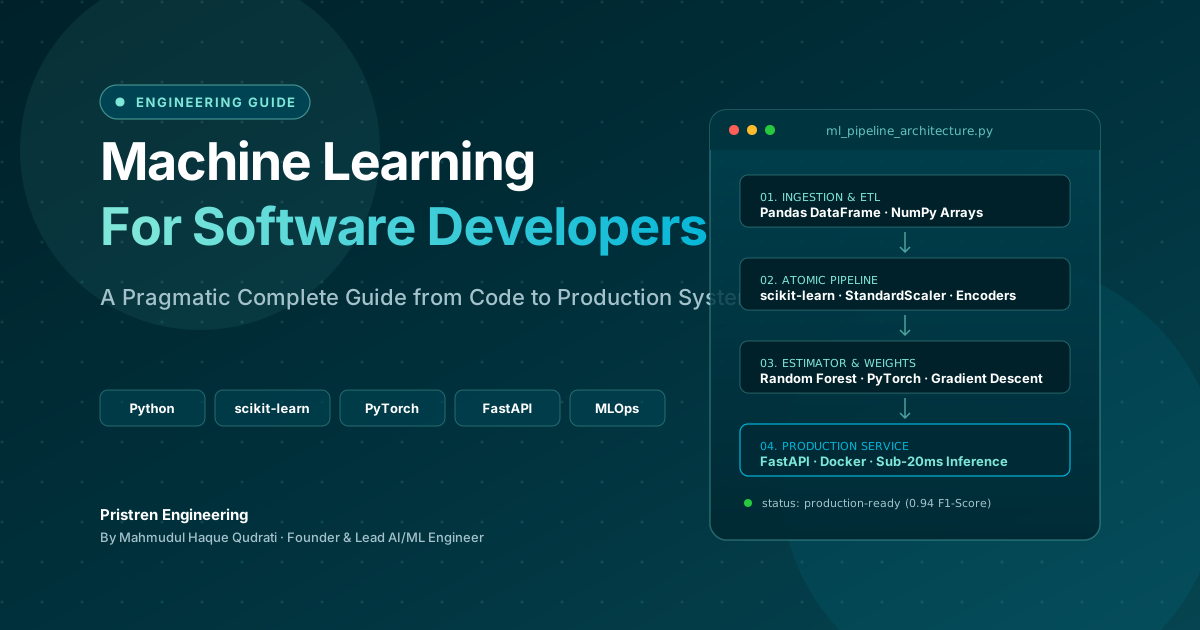
Machine Learning: Complete Guide for Software Developers
Learn machine learning as a software developer with this complete guide covering Python, algorithms, mathematics, projects, deep learning, and a practical roadmap.
 6 min read
How to Use Claude to Make Videos Like Vox and Others
Claude can help you make Vox-style videos by generating scripts, editing with code, and automating animation. Here's a practical guide with real workflows and costs.
 5 min read
OpenAI Ends Cursor Model Access on Nov 12, 2026: What Developers Need to Know
OpenAI will terminate Cursor's access to its models on November 12, 2026, following SpaceX's acquisition. This guide explains the timeline, why it happened, and practical steps to migrate your workflow.
// discussion
Comments