Optuna: Modern Hyperparameter Optimization That Beats Grid Search
Optuna uses Tree-structured Parzen Estimators to learn from previous trials and focus on promising regions - finding better hyperparameters in fewer trials than grid or random search.

Mahmudul Haque Qudrati
CEO & ML Engineer
April 23, 2026
7 min read
One AI engineering post, weekly
LLM benchmarks, prompt techniques, and token-cost breakdowns — not another AI news roundup.
GridSearchCV exhaustively tries every combination. With 5 hyperparameters and 5 values each, that is 5^5 = 3,125 trials. Most of those are wasted on obviously bad combinations.
Optuna uses Bayesian optimization with Tree-structured Parzen Estimators (TPE). It builds a probabilistic model of which hyperparameters lead to good results and samples more from promising regions. You get better results with fewer trials.
Basic Optuna Setup
python
import optuna
import lightgbm as lgb
from sklearn.model_selection import cross_val_score
from sklearn.datasets import load_breast_cancer

X, y = load_breast_cancer(return_X_y=True)

def objective(trial: optuna.Trial) -> float:
    params = {
        "n_estimators": trial.suggest_int("n_estimators", 100, 2000),
        "num_leaves": trial.suggest_int("num_leaves", 20, 300),
        "learning_rate": trial.suggest_float("learning_rate", 1e-4, 0.3, log=True),
        "min_child_samples": trial.suggest_int("min_child_samples", 5, 100),
        "subsample": trial.suggest_float("subsample", 0.5, 1.0),
        "colsample_bytree": trial.suggest_float("colsample_bytree", 0.5, 1.0),
    }
    model = lgb.LGBMClassifier(**params, random_state=42)
    scores = cross_val_score(model, X, y, cv=5, scoring="roc_auc", n_jobs=-1)
    return scores.mean()

study = optuna.create_study(direction="maximize")
study.optimize(objective, n_trials=100, n_jobs=1)

print(f"Best AUC: {study.best_value:.4f}")
print(f"Best params: {study.best_params}")
Team workspace
Ship faster with chat, meetings, and projects in one place — Zlyqor.
Pruning: Stop Bad Trials Early
Optuna can prune trials that are clearly worse than the best so far, saving significant compute:
python
import optuna
import pytorch_lightning as pl
from optuna.integration import PyTorchLightningPruningCallback

def objective(trial: optuna.Trial) -> float:
    lr = trial.suggest_float("lr", 1e-5, 1e-2, log=True)
    hidden_size = trial.suggest_categorical("hidden_size", [64, 128, 256, 512])

    model = MyModel(lr=lr, hidden_size=hidden_size)
    trainer = pl.Trainer(
        max_epochs=50,
        callbacks=[PyTorchLightningPruningCallback(trial, monitor="val_loss")],
    )
    trainer.fit(model, train_loader, val_loader)
    return trainer.callback_metrics["val_loss"].item()

study = optuna.create_study(
    direction="minimize",
    pruner=optuna.pruners.MedianPruner(n_startup_trials=5, n_warmup_steps=10),
)
study.optimize(objective, n_trials=100)
The MedianPruner stops a trial if its intermediate value is worse than the median of completed trials at the same step.
Distributed Optimization
Run Optuna across multiple machines using a shared database:
python
import optuna

# All workers share this study via PostgreSQL
study = optuna.create_study(
    study_name="distributed_lgbm",
    storage="postgresql://user:pass@db-host/optuna",
    direction="maximize",
    load_if_exists=True,
)
study.optimize(objective, n_trials=50)  # run on each machine
RDB storage also enables persistent studies - restart a study without losing previous results.
Visualization
python
from optuna.visualization import (
    plot_optimization_history,
    plot_param_importances,
    plot_parallel_coordinate,
)

# Which trials converged to best values
fig = plot_optimization_history(study)
fig.show()

# Which hyperparameters matter most (Fanova-based)
fig = plot_param_importances(study)
fig.show()

# Parallel coordinates  -  see correlations between params and objective
fig = plot_parallel_coordinate(study)
fig.show()
Optuna Dashboard
bash
pip install optuna-dashboard
optuna-dashboard postgresql://user:pass@db-host/optuna
Real-time dashboard showing trial progress, parameter importances, and contour plots - accessible to the whole team.
#optuna#hyperparameter-optimization#bayesian#tpe#automl
Mahmudul Haque Qudrati
CEO & ML Engineer
Visionary technologist, software engineer, and machine learning specialist. Founder and CEO of Pristren, directing engineering teams that ship production-grade AI/ML pipelines, mission-critical full-stack applications, and developer tooling. Creator of Zlyqor, the unified team workspace platform. Author of 540+ technical guides and benchmark research reports on large language models, agentic workflows, Model Context Protocol (MCP), and modern web stacks.


More from Mahmudul
Related Articles
 11 min read
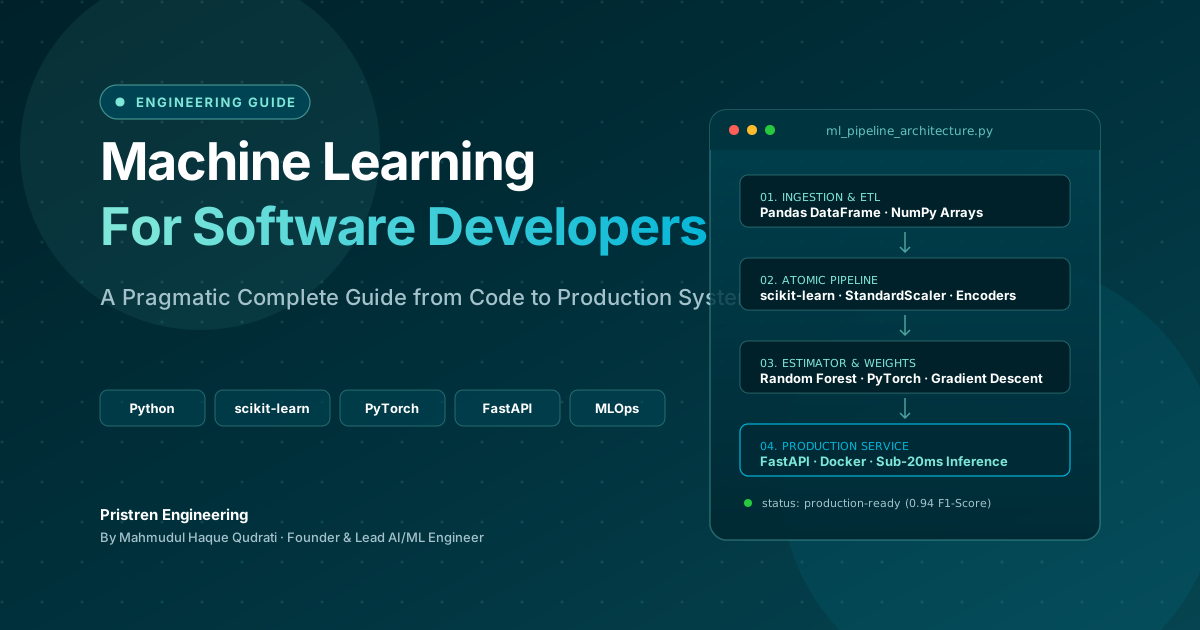
Machine Learning: Complete Guide for Software Developers
Learn machine learning as a software developer with this complete guide covering Python, algorithms, mathematics, projects, deep learning, and a practical roadmap.
 7 min read
ONNX: Export Any ML Model and Run It Anywhere
ONNX (Open Neural Network Exchange) is the universal model format - export from PyTorch, scikit-learn, or HuggingFace and run 3x faster inference with ONNX Runtime on CPU or GPU.
 9 min read
Gradient Descent Explained: How Machine Learning Models Actually Learn
Gradient descent is the engine behind every modern ML model. Here is how it works, why learning rate matters, and when to use Adam over SGD.
// discussion
Comments