
SAM 2: Meta's Real-Time Video Segmentation Model
SAM 2 extends the original Segment Anything Model to video with a streaming memory bank, enabling zero-shot object tracking and segmentation across arbitrary video sequences.

Mahmudul Haque Qudrati
CEO & ML Engineer
March 17, 2026
7 min read

One AI engineering post, weekly
LLM benchmarks, prompt techniques, and token-cost breakdowns — not another AI news roundup.
The original Segment Anything Model (SAM 1) was image-only. You could apply it frame-by-frame to video, but without temporal consistency — each frame started fresh, and the same object might get different masks across frames. Meta AI's SAM 2 solves this with a streaming memory bank that maintains object state across frames.
Key architectural additions:
- Memory encoder: Encodes frame features and masks into memory tokens
- Memory bank: Stores recent frames and prompted frames as spatial memories
- Memory attention: Cross-attends current frame features to memory bank before decoding
The result: prompt an object once at frame 0 (with a click or bounding box), and SAM 2 tracks and segments it through the rest of the video.
Prompting Modes
SAM 2 inherits SAM 1's flexible prompting:
- Points: Click to include (+) or exclude (-) regions
- Bounding boxes: Coarse box → precise mask
- Masks: Refine a previous mask
- Text (via integration with CLIP): Experimental natural language prompting
For video, you prompt on one or more keyframes and the model propagates forward and backward in time.
Team workspace
Ship faster with chat, meetings, and projects in one place — Zlyqor.
SA-V Dataset
HuggingFace's SAM 2 was trained on SA-V, a dataset 35x larger than SA-1B (the original SAM dataset). SA-V contains 51,000 videos with 643,000 masklet annotations — objects tracked across entire video sequences. The diversity spans sports, cooking, outdoor scenes, and social media content.
Python API
import torch
from sam2.build_sam import build_sam2_video_predictor

predictor = build_sam2_video_predictor(
    "sam2_hiera_large.yaml",
    "sam2_hiera_large.pt",
    device="cuda"
)

# Load video frames (as JPEG directory or tensor)
with torch.inference_mode(), torch.autocast("cuda", dtype=torch.bfloat16):
    state = predictor.init_state(video_path="./video_frames/")

    # Prompt object at frame 0 with a point
    frame_idx, obj_ids, mask_logits = predictor.add_new_points_or_box(
        inference_state=state,
        frame_idx=0,
        obj_id=1,
        points=[[350, 200]],  # (x, y) in pixels
        labels=[1],           # 1=foreground, 0=background
    )

    # Propagate through video
    for frame_idx, obj_ids, mask_logits in predictor.propagate_in_video(state):
        masks = (mask_logits > 0.0).cpu().numpy()
        print(f"Frame {frame_idx}: {masks.sum()} pixels segmented")
Real-Time Performance
SAM 2 Hiera-L runs at ~45 FPS on an A100 GPU for 1024x1024 frames. The smaller Hiera-S variant achieves ~140 FPS. For real-time applications (30fps video), Hiera-B+ is sufficient on a consumer RTX 4080.
Use Cases
Video editing: Rotoscope a subject for background replacement without frame-by-frame masking.
Medical imaging: Track tumors or instruments across CT/MRI scan slices.
Robotics: Identify and track objects for manipulation tasks without domain-specific training.
Sports analytics: Track individual players through occlusion, camera cuts, and fast motion.
The SAM 2 GitHub includes demo notebooks for all major use cases and a Gradio web demo for rapid prototyping.
#sam-2#meta#segmentation#video#computer-vision
Mahmudul Haque Qudrati
CEO & ML Engineer
Visionary technologist, software engineer, and machine learning specialist. Founder and CEO of Pristren, directing engineering teams that ship production-grade AI/ML pipelines, mission-critical full-stack applications, and developer tooling. Creator of Zlyqor, the unified team workspace platform. Author of 540+ technical guides and benchmark research reports on large language models, agentic workflows, Model Context Protocol (MCP), and modern web stacks.


More from Mahmudul
Machine Learning: Complete Guide for Software Developers
11 min read
GPT-6 Astra AGI: How to Actually Use It and Get Its Best Performance
8 min read
DeepSeek vs MiniMax vs Kimi in Coding Benchmarks: Real Scores, Real Prices, Real Tradeoffs
8 min read
GPT-6 Astra Benchmarks, Pricing, and Safety: What Developers Need to Know
5 min read
Related Articles
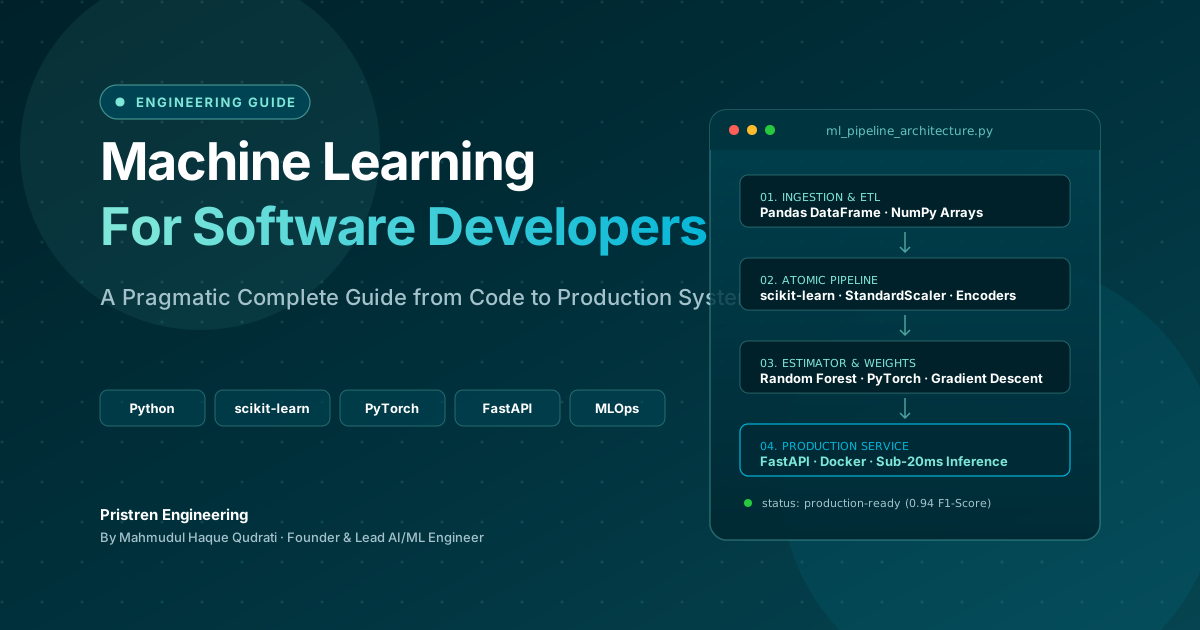 11 min read
Machine Learning: Complete Guide for Software Developers
Learn machine learning as a software developer with this complete guide covering Python, algorithms, mathematics, projects, deep learning, and a practical roadmap.
 4 min read
How to Get Started with Computer Vision as a Developer?
A hands-on guide for developers entering computer vision: pick the right library, write your first pipeline, and avoid common pitfalls.
 7 min read
ONNX: Export Any ML Model and Run It Anywhere
ONNX (Open Neural Network Exchange) is the universal model format - export from PyTorch, scikit-learn, or HuggingFace and run 3x faster inference with ONNX Runtime on CPU or GPU.
// discussion
Comments