Scikit-learn in 2026: Still Relevant and What's New in v1.4+
Scikit-learn remains the best library for classical ML on tabular data - v1.4+ adds HDBSCAN, TunedThresholdClassifierCV, and better Pipeline verbosity while staying beginner-friendly.

Mahmudul Haque Qudrati
CEO & ML Engineer
April 15, 2026
7 min read
One AI engineering post, weekly
LLM benchmarks, prompt techniques, and token-cost breakdowns — not another AI news roundup.
Deep learning gets the headlines, but for tabular data - the majority of business ML use cases - scikit-learn and gradient boosting still win. Sklearn gives you consistent APIs, excellent documentation, and decades of battle-tested algorithms in one package.
The rule of thumb: if your dataset has fewer than 1M rows and structured features, start with sklearn. Always use sklearn for your baseline before trying anything more complex.
What Is New in v1.4+
HDBSCAN clustering (v1.3+): hierarchical density-based clustering, better than DBSCAN for varying-density clusters.
python
from sklearn.cluster import HDBSCAN

hdbscan = HDBSCAN(min_cluster_size=10, min_samples=5)
labels = hdbscan.fit_predict(X)
TunedThresholdClassifierCV (v1.5+): automatically tunes the decision threshold for binary classifiers to optimize a business metric.
python
from sklearn.calibration import TunedThresholdClassifierCV
from sklearn.ensemble import GradientBoostingClassifier

clf = GradientBoostingClassifier()
tuned_clf = TunedThresholdClassifierCV(
    clf, scoring="f1", cv=5
)
tuned_clf.fit(X_train, y_train)
print(tuned_clf.best_threshold_)  # e.g. 0.37 instead of default 0.5
Team workspace
Ship faster with chat, meetings, and projects in one place — Zlyqor.
The Essential Pipeline Pattern
python
from sklearn.pipeline import Pipeline
from sklearn.preprocessing import StandardScaler, OneHotEncoder
from sklearn.compose import ColumnTransformer
from sklearn.ensemble import RandomForestClassifier
from sklearn.model_selection import cross_val_score

numeric_features = ["age", "income", "tenure"]
categorical_features = ["country", "plan", "device"]

preprocessor = ColumnTransformer([
    ("num", StandardScaler(), numeric_features),
    ("cat", OneHotEncoder(handle_unknown="ignore", sparse_output=False), categorical_features),
])

pipeline = Pipeline([
    ("preprocessor", preprocessor),
    ("classifier", RandomForestClassifier(n_estimators=100, random_state=42)),
])

scores = cross_val_score(pipeline, X, y, cv=5, scoring="roc_auc")
print(f"AUC: {scores.mean():.3f} ± {scores.std():.3f}")
Pipelines prevent data leakage - the scaler fits on training data only in each CV fold.
Hyperparameter Search
python
from sklearn.model_selection import GridSearchCV

param_grid = {
    "classifier__n_estimators": [100, 300],
    "classifier__max_depth": [None, 5, 10],
    "classifier__min_samples_split": [2, 5],
}

search = GridSearchCV(pipeline, param_grid, cv=5, scoring="roc_auc", n_jobs=-1)
search.fit(X_train, y_train)
print(search.best_params_)
For larger search spaces, use Optuna instead of GridSearchCV.
SHAP for Model Explanation
python
import shap

explainer = shap.TreeExplainer(search.best_estimator_["classifier"])
shap_values = explainer.shap_values(X_test)
shap.summary_plot(shap_values, X_test, feature_names=numeric_features + categorical_features)
Sklearn vs XGBoost vs LightGBM for Tabular
Sklearn's GradientBoostingClassifier is slower than XGBoost/LightGBM but good for baselines. For competition-level performance on tabular data, XGBoost or LightGBM outperform sklearn's tree methods. The sklearn API is consistent across all: fit(), predict(), predict_proba().
Resources: Scikit-learn, GitHub, v1.4 changelog.
#scikit-learn#sklearn#ml#python#classical-ml
Mahmudul Haque Qudrati
CEO & ML Engineer
Visionary technologist, software engineer, and machine learning specialist. Founder and CEO of Pristren, directing engineering teams that ship production-grade AI/ML pipelines, mission-critical full-stack applications, and developer tooling. Creator of Zlyqor, the unified team workspace platform. Author of 540+ technical guides and benchmark research reports on large language models, agentic workflows, Model Context Protocol (MCP), and modern web stacks.

More from Mahmudul
Related Articles
 11 min read
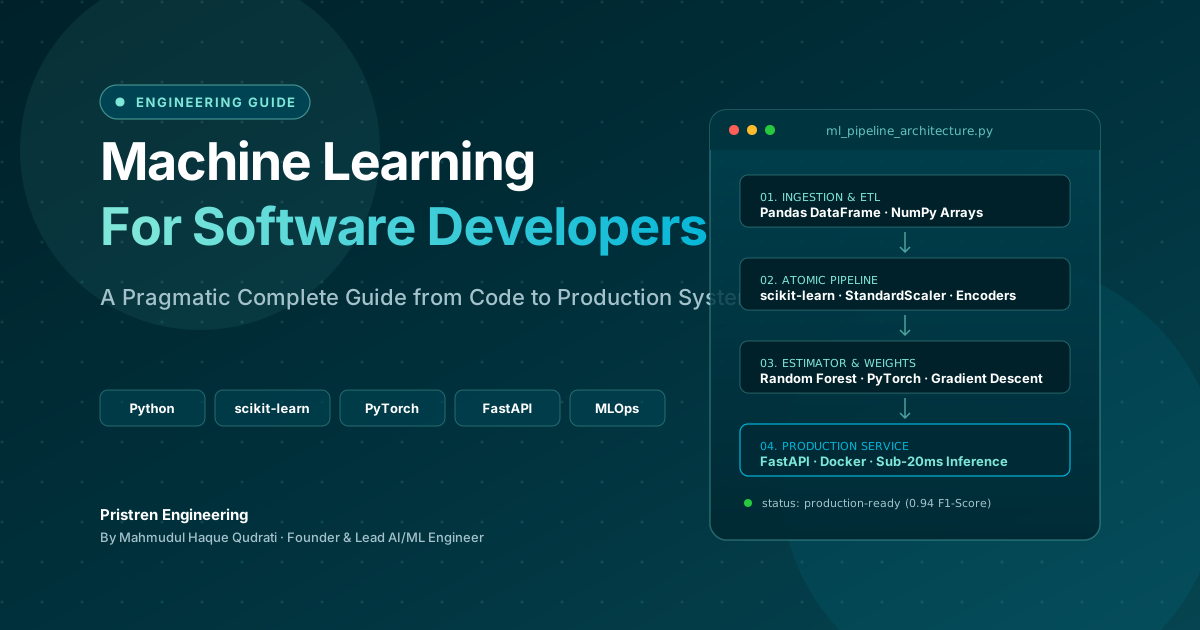
Machine Learning: Complete Guide for Software Developers
Learn machine learning as a software developer with this complete guide covering Python, algorithms, mathematics, projects, deep learning, and a practical roadmap.
 5 min read
Google Search Console API: Automate SEO Reporting and Monitoring With Python
The GSC Search Analytics API lets you pull performance data programmatically, build automated reports, and set up traffic drop alerts - no more manual CSV exports.
 7 min read
ONNX: Export Any ML Model and Run It Anywhere
ONNX (Open Neural Network Exchange) is the universal model format - export from PyTorch, scikit-learn, or HuggingFace and run 3x faster inference with ONNX Runtime on CPU or GPU.
// discussion
Comments