
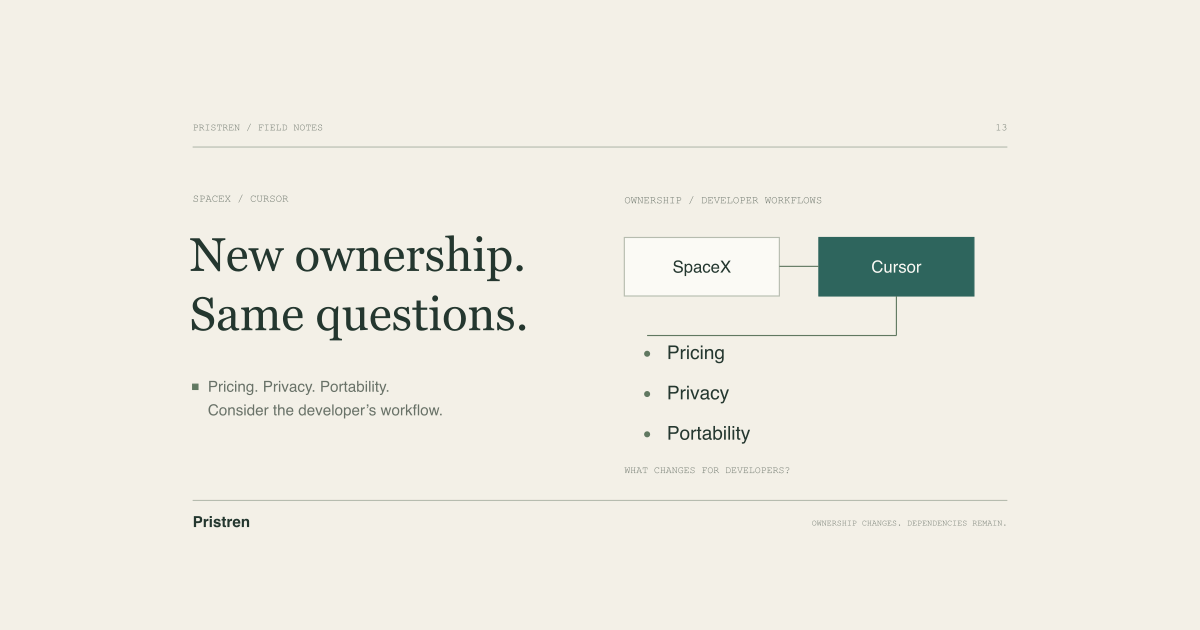
SpaceX is acquiring Cursor, the AI-powered code editor that has become a favorite among developers for its agentic coding capabilities. The news broke on March 12, 2026, and has since dominated discussions on Hacker News and tech Twitter. This is not a typical acquisition. SpaceX is not a software company. They build rockets, satellites, and spacecraft. So why would they buy a code editor?
Let's look at what we know, what it means for Cursor users, and the broader implications for the AI coding tools market.
What the Deal Looks Like
According to reports, SpaceX is purchasing Cursor's parent company, Anysphere, for an undisclosed sum. Sources close to the deal estimate the acquisition price at around $2.5 billion, which includes both cash and SpaceX equity. The deal is expected to close in Q2 2026.
Cursor will continue to operate as a standalone product under SpaceX's software division. The current Cursor team, including co-founders Michael Truell and Sualeh Asif, will remain in place. No immediate changes to pricing or features have been announced.
Why SpaceX Wants Cursor
SpaceX has been quietly building internal software tools for years. Their Starlink constellation requires massive amounts of ground station software, satellite firmware, and user terminal code. The Crew Dragon and Starship programs rely on custom avionics and simulation software. Writing and maintaining this code is expensive and slow.
Cursor's AI agent can generate, refactor, and debug code autonomously. For SpaceX, this means faster iteration on flight software, reduced developer headcount for certain tasks, and the ability to prototype new features in hours instead of weeks. The acquisition gives SpaceX exclusive access to Cursor's underlying models and training data, which they can fine-tune on their proprietary codebases.
Another angle: SpaceX is rumored to be building a new internal platform called "Starbase OS" that will unify their software stack across rockets, satellites, and ground systems. Cursor could become the primary development environment for that platform.
What This Means for Cursor Users
If you are a current Cursor user, here is what changes and what does not:
- Pricing: No changes announced. The current $20/month Pro plan and $40/month Business plan remain in effect. SpaceX has stated they will honor all existing subscriptions.
- Features: The public version of Cursor will continue to receive updates. However, SpaceX will likely develop a private fork with specialized features for their internal use. These features may or may not make it to the public version.
- Data Privacy: This is the biggest concern. Cursor's cloud-based AI sends code snippets to their servers for processing. With SpaceX owning the company, some users worry about their code being used to train SpaceX's models. Cursor's privacy policy currently states that user code is not used for training, but that could change. If you work on sensitive projects, consider using Cursor's local mode or switching to an alternative like Continue.dev with a local model.
- Open Source Components: Cursor is built on top of VS Code and uses several open source libraries. Those remain open source. SpaceX cannot retroactively close them. However, future Cursor-specific features may become proprietary.
The Bigger Picture: AI Coding Tools Consolidation
This acquisition is part of a larger trend. In the past 12 months, we have seen:
- Google acquiring Replit's AI coding team (January 2026)
- Microsoft investing $500 million in Codeium (November 2025)
- Amazon launching its own AI coding assistant, CodeWhisperer Pro (February 2026)
Big tech companies and now aerospace firms are betting that AI coding tools will become the primary interface for software development. The value is not just in the editor itself, but in the data and the model fine-tuning that comes with it. Every keystroke, every accepted suggestion, every rejected completion trains the model. That data is gold.
Practical Advice for Developers
If you rely on Cursor for your daily work, here are three things to consider:
-
Diversify your toolchain. Do not put all your eggs in one basket. Try alternatives like GitHub Copilot, Codeium, or Continue.dev. Each has different strengths and weaknesses. For example, Continue.dev works with local models like CodeLlama, giving you full data control.
-
Watch for pricing changes. Acquisitions often lead to price increases. If SpaceX needs to justify the $2.5 billion price tag, they may raise Cursor's subscription fees. Budget accordingly.
-
Evaluate your data exposure. If you work on proprietary code, use Cursor's local mode or switch to a tool that runs entirely offline. The risk is not just SpaceX; any cloud-based AI tool could expose your code to third parties.
The Bottom Line
SpaceX buying Cursor is a signal that AI coding tools are becoming infrastructure, not just productivity aids. For SpaceX, it is a strategic move to accelerate their software development. For developers, it is a reminder that the tools we use are not neutral. They come with corporate interests and data implications.
Cursor is still a great product. But treat it like any other vendor: have an exit plan, know your data rights, and stay informed.
Keep Reading
- My Agent Skill for Test-Driven Development
- Zero-Touch OAuth for MCP
- Claude Code: Everything You Can Configure That the Docs Don't Tell You
If you are evaluating AI coding tools for your team, try Zlyqor for a data-local alternative that gives you full control over your code and models. Sign up at app.zlyqor.com/signup.


Comments
Have a question or something to add? Sign in to join the discussion.