
Unsloth: Fine-Tune Llama 3 and Mistral 2x Faster With 70% Less Memory
Unsloth rewrites attention and LoRA kernels with hand-tuned CUDA, delivering 2-5x faster training and 70% less VRAM usage without any accuracy loss.

Mahmudul Haque Qudrati
CEO & ML Engineer
March 3, 2026
8 min read

One AI engineering post, weekly
LLM benchmarks, prompt techniques, and token-cost breakdowns — not another AI news roundup.
Unsloth is an open-source library that dramatically accelerates LLM fine-tuning by replacing the default HuggingFace TRL kernels with hand-optimized CUDA implementations. The core insight: PyTorch's generic attention and LoRA backward passes leave significant performance on the table. Unsloth rewrites these from scratch.
The results are striking: 2-5x faster training compared to vanilla TRL, 70% less VRAM usage (a 7B parameter model fits on an 8GB GPU), and zero measured accuracy degradation across benchmark evaluations. It works with Llama 3, Mistral, Phi-3, Gemma, and most popular open-source architectures.
Why Is It Faster?
Unsloth achieves its speedup through three mechanisms:
Hand-tuned CUDA kernels — the attention forward and backward passes are rewritten in Triton rather than relying on PyTorch's generic implementations. This eliminates unnecessary memory allocations in the critical path.
Smarter LoRA math — the standard LoRA backward pass computes gradients in a way that scales poorly with sequence length. Unsloth restructures the computation graph to share intermediate results.
Chunked cross-entropy — instead of materializing the full logit matrix before computing loss (which is enormous for large vocabularies), Unsloth processes it in chunks. This alone often saves 1-2GB of VRAM.
Team workspace
Ship faster with chat, meetings, and projects in one place — Zlyqor.
Installation and Basic Training Loop
pip install unsloth
from unsloth import FastLanguageModel
from trl import SFTTrainer
from transformers import TrainingArguments

# Load model with 4-bit quantization
model, tokenizer = FastLanguageModel.from_pretrained(
    model_name="unsloth/Meta-Llama-3-8B-Instruct-bnb-4bit",
    max_seq_length=2048,
    dtype=None,          # auto-detect
    load_in_4bit=True,
)

# Attach LoRA adapters
model = FastLanguageModel.get_peft_model(
    model,
    r=16,
    target_modules=["q_proj", "k_proj", "v_proj", "o_proj",
                    "gate_proj", "up_proj", "down_proj"],
    lora_alpha=16,
    lora_dropout=0,
    bias="none",
    use_gradient_checkpointing="unsloth",
    random_state=42,
)

trainer = SFTTrainer(
    model=model,
    tokenizer=tokenizer,
    train_dataset=dataset,
    dataset_text_field="text",
    max_seq_length=2048,
    args=TrainingArguments(
        per_device_train_batch_size=2,
        gradient_accumulation_steps=4,
        warmup_steps=5,
        max_steps=60,
        learning_rate=2e-4,
        fp16=True,
        output_dir="outputs",
    ),
)
trainer.train()
Unsloth Studio
For teams that prefer a GUI, Unsloth Studio provides a web-based interface for dataset upload, training configuration, and run monitoring. It sits on top of the same optimized kernels — you get the speed benefits without writing any training code.
Benchmarks
On an RTX 3090 (24GB VRAM), Unsloth achieves roughly 2.2x the tokens-per-second of standard TRL for Llama 3 8B with 4-bit QLoRA, while keeping VRAM usage under 12GB. The full benchmark table covering multiple GPU types and model sizes is maintained in the repo.
Resources
#unsloth#fine-tuning#lora#qlora#speed
Mahmudul Haque Qudrati
CEO & ML Engineer
Visionary technologist, software engineer, and machine learning specialist. Founder and CEO of Pristren, directing engineering teams that ship production-grade AI/ML pipelines, mission-critical full-stack applications, and developer tooling. Creator of Zlyqor, the unified team workspace platform. Author of 540+ technical guides and benchmark research reports on large language models, agentic workflows, Model Context Protocol (MCP), and modern web stacks.


More from Mahmudul
Machine Learning: Complete Guide for Software Developers
11 min read
GPT-6 Astra AGI: How to Actually Use It and Get Its Best Performance
8 min read
DeepSeek vs MiniMax vs Kimi in Coding Benchmarks: Real Scores, Real Prices, Real Tradeoffs
8 min read
GPT-6 Astra Benchmarks, Pricing, and Safety: What Developers Need to Know
5 min read
Related Articles
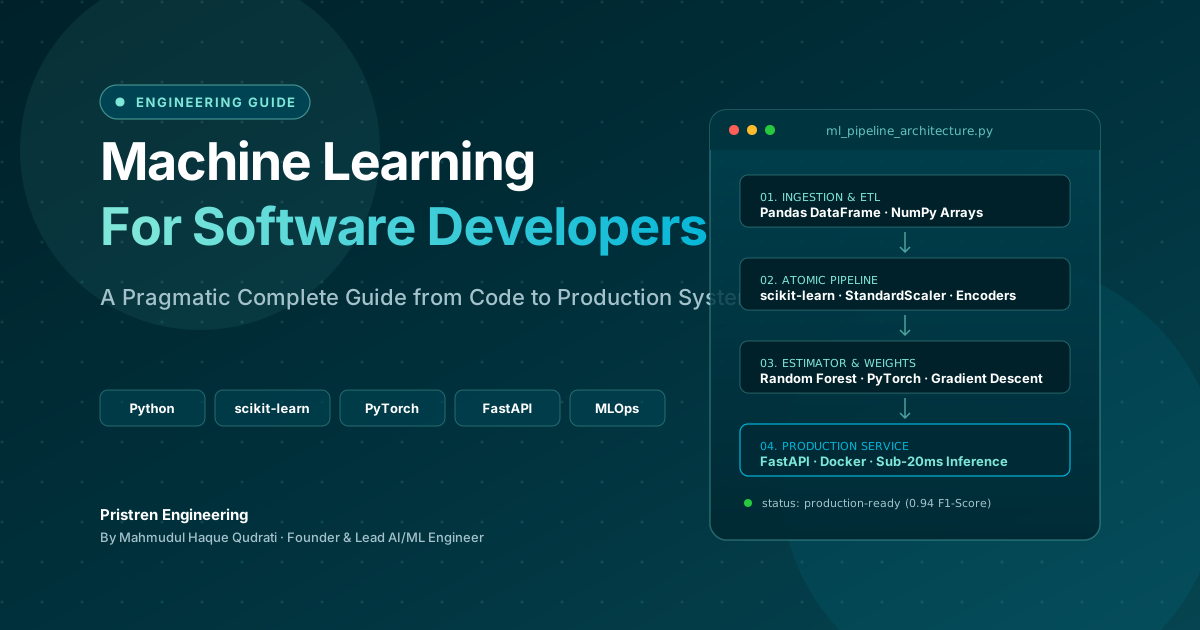 11 min read
Machine Learning: Complete Guide for Software Developers
Learn machine learning as a software developer with this complete guide covering Python, algorithms, mathematics, projects, deep learning, and a practical roadmap.
 7 min read
ONNX: Export Any ML Model and Run It Anywhere
ONNX (Open Neural Network Exchange) is the universal model format - export from PyTorch, scikit-learn, or HuggingFace and run 3x faster inference with ONNX Runtime on CPU or GPU.
 9 min read
Gradient Descent Explained: How Machine Learning Models Actually Learn
Gradient descent is the engine behind every modern ML model. Here is how it works, why learning rate matters, and when to use Adam over SGD.
// discussion
Comments