
SmolLM2: Training Tiny LLMs That Actually Work on Device
HuggingFace's SmolLM2 family (135M/360M/1.7B) brings capable instruction-following LLMs to browser and edge environments through WebGPU inference and Transformers.js, with quality trained on carefully curated educational data.

Mahmudul Haque Qudrati
CEO & ML Engineer
April 12, 2026
7 min read

One AI engineering post, weekly
LLM benchmarks, prompt techniques, and token-cost breakdowns — not another AI news roundup.
SmolLM2 ships three model sizes: 135M, 360M, and 1.7B parameters — all instruction-tuned variants available alongside the base models. The key question for tiny LLMs isn't just parameter count; it's training data quality.
SmolLM2 was trained on:
- FineWeb-Edu: 15T tokens of educational web content, filtered for learning value
- DCLM: Curated CommonCrawl with quality scoring
- The Stack: Permissively licensed code from GitHub
This data mixture explains why SmolLM2-135M outperforms models trained on raw CommonCrawl at 3-4x the parameter count. Quality filtering matters more than scale at the small model regime.
WebGPU Inference in the Browser
Transformers.js runs SmolLM2 directly in the browser via WebGPU:
import { pipeline } from "@xenova/transformers";

const generator = await pipeline(
  "text-generation",
  "HuggingFaceTB/SmolLM2-135M-Instruct",
  { device: "webgpu" }
);

const result = await generator(
  "<|im_start|>user
Explain recursion in one sentence.<|im_end|>
<|im_start|>assistant
",
  { max_new_tokens: 100, do_sample: false }
);

console.log(result[0].generated_text);
The 135M model downloads as ~270MB (int8 quantized ONNX). After first load and caching, inference runs entirely client-side with no API calls. WebGPU support is available in Chrome 113+ and Edge 113+.
Team workspace
Ship faster with chat, meetings, and projects in one place — Zlyqor.
The HuggingFaceTB/SmolLM2-135M-Instruct Model
The chat-tuned variant follows the ChatML instruction format and handles:
- Single-turn Q&A
- Text classification (prompt-based)
- Short summarization (under 200 words)
- Code completion for common patterns
It does not reliably handle: multi-step reasoning, complex instruction chains, or responses requiring factual knowledge beyond its training cutoff.
On-Device Use Cases
Autocomplete: At 135M parameters, generation is fast enough for real-time text completion with 50-100ms latency on mid-range mobile hardware.
Classification: Few-shot classification via prompting for 3-5 categories works reliably without fine-tuning.
Summarization: Extractive-style summaries of short documents (under 1000 tokens) with good factual preservation.
Comparison to Phi-3-mini
| Metric | SmolLM2-1.7B | Phi-3-mini (3.8B) |
|---|---|---|
| Parameters | 1.7B | 3.8B |
| Browser deployable | Yes (Transformers.js) | Marginal |
| MMLU (5-shot) | ~45% | ~68% |
| HumanEval (code) | ~25% | ~58% |
| On-device latency | Very fast | Moderate |
SmolLM2-1.7B is not competitive with Phi-3-mini on reasoning benchmarks. The tradeoff is deployment flexibility — SmolLM2 runs in contexts where Phi-3-mini cannot.
Quantization Options
All SmolLM2 variants are available in int8 and int4 quantization through bitsandbytes and GGUF. The 135M model at int4 is 68MB — small enough to bundle in mobile apps or serve from a CDN.
#smollm2#huggingface#on-device#tiny-llm#edge-ai
Mahmudul Haque Qudrati
CEO & ML Engineer
Visionary technologist, software engineer, and machine learning specialist. Founder and CEO of Pristren, directing engineering teams that ship production-grade AI/ML pipelines, mission-critical full-stack applications, and developer tooling. Creator of Zlyqor, the unified team workspace platform. Author of 540+ technical guides and benchmark research reports on large language models, agentic workflows, Model Context Protocol (MCP), and modern web stacks.

More from Mahmudul
Machine Learning: Complete Guide for Software Developers
11 min read
GPT-6 Astra AGI: How to Actually Use It and Get Its Best Performance
8 min read
DeepSeek vs MiniMax vs Kimi in Coding Benchmarks: Real Scores, Real Prices, Real Tradeoffs
8 min read
GPT-6 Astra Benchmarks, Pricing, and Safety: What Developers Need to Know
5 min read
Related Articles
 11 min read
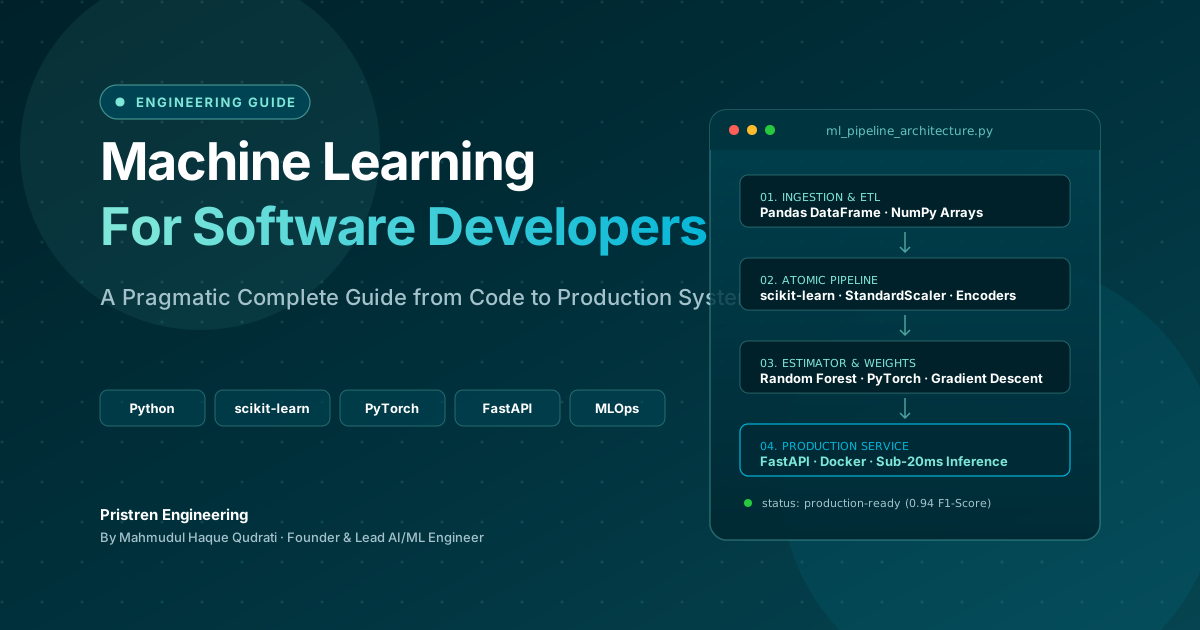
Machine Learning: Complete Guide for Software Developers
Learn machine learning as a software developer with this complete guide covering Python, algorithms, mathematics, projects, deep learning, and a practical roadmap.
 7 min read
ONNX: Export Any ML Model and Run It Anywhere
ONNX (Open Neural Network Exchange) is the universal model format - export from PyTorch, scikit-learn, or HuggingFace and run 3x faster inference with ONNX Runtime on CPU or GPU.
 9 min read
Gradient Descent Explained: How Machine Learning Models Actually Learn
Gradient descent is the engine behind every modern ML model. Here is how it works, why learning rate matters, and when to use Adam over SGD.
// discussion
Comments