Weights & Biases for LLM Fine-Tuning: Track Every Run and Compare Results
W&B provides experiment tracking for fine-tuning runs and LLM tracing via Weave, letting you compare models, trace agent calls, and manage models in a production registry.

Mahmudul Haque Qudrati
CEO & ML Engineer
April 22, 2026
8 min read
One AI engineering post, weekly
LLM benchmarks, prompt techniques, and token-cost breakdowns — not another AI news roundup.
Fine-tuning is iterative. You run with lr=2e-4, then try 5e-4. You experiment with 100 examples, then 500. Without tracking, you lose the context of what you tried and why something worked. Weights & Biases (W&B) captures every hyperparameter, metric, and artifact automatically.
Integrating with HuggingFace Trainer
The simplest integration requires one line:
python
from transformers import TrainingArguments

training_args = TrainingArguments(
    output_dir="./outputs",
    num_train_epochs=3,
    per_device_train_batch_size=4,
    learning_rate=2e-4,
    report_to="wandb",          # this one line
    run_name="llama3-qlora-v2",
)
W&B automatically logs training loss, validation loss, learning rate schedule, gradient norms, and system metrics (GPU utilization, memory). No other code changes needed.
Team workspace
Ship faster with chat, meetings, and projects in one place — Zlyqor.
Direct Logging
For custom training loops or logging additional metrics:
python
import wandb

wandb.init(
    project="llm-fine-tuning",
    config={
        "model": "meta-llama/Meta-Llama-3-8B",
        "lora_r": 16,
        "dataset_size": 500,
        "learning_rate": 2e-4,
    }
)

for step, batch in enumerate(train_loader):
    loss = train_step(batch)
    wandb.log({"train/loss": loss, "train/step": step})

wandb.finish()
W&B Weave for LLM Tracing
Weave is W&B's LLM observability layer. It automatically instruments OpenAI and Anthropic API calls when you add two lines:
python
import weave
from openai import OpenAI

weave.init("my-llm-app")   # that's it  -  OpenAI calls are now traced

client = OpenAI()
response = client.chat.completions.create(
    model="gpt-4o",
    messages=[{"role": "user", "content": "Hello"}]
)
Every call is logged with model, input, output, latency, token counts, and cost. For agent workflows, you see the full call tree showing how sub-calls compose.
Comparing Fine-Tuned vs Base Model
Weave's Evaluation feature lets you run both models on the same dataset and compare outputs side-by-side with automatic metrics:
python
import weave

@weave.op()
def evaluate_model(model_name: str, prompt: str) -> str:
    # call your model and return the output
    ...

evaluation = weave.Evaluation(
    dataset=test_cases,
    scorers=[accuracy_scorer, format_scorer],
)
asyncio.run(evaluation.evaluate(base_model_predict))
asyncio.run(evaluation.evaluate(finetuned_model_predict))
Model Registry
After fine-tuning, register your model artifact for production:
python
artifact = wandb.Artifact("llama3-customer-support", type="model")
artifact.add_dir("./outputs/final_model")
wandb.log_artifact(artifact)

# Link to registry for deployment tracking
artifact.link("my-org/model-registry/llama3-customer-support", aliases=["v2", "production"])
Resources
#weights-&-biases#mlops#fine-tuning#experiment-tracking#weave
Mahmudul Haque Qudrati
CEO & ML Engineer
Visionary technologist, software engineer, and machine learning specialist. Founder and CEO of Pristren, directing engineering teams that ship production-grade AI/ML pipelines, mission-critical full-stack applications, and developer tooling. Creator of Zlyqor, the unified team workspace platform. Author of 540+ technical guides and benchmark research reports on large language models, agentic workflows, Model Context Protocol (MCP), and modern web stacks.

More from Mahmudul
Related Articles
 11 min read
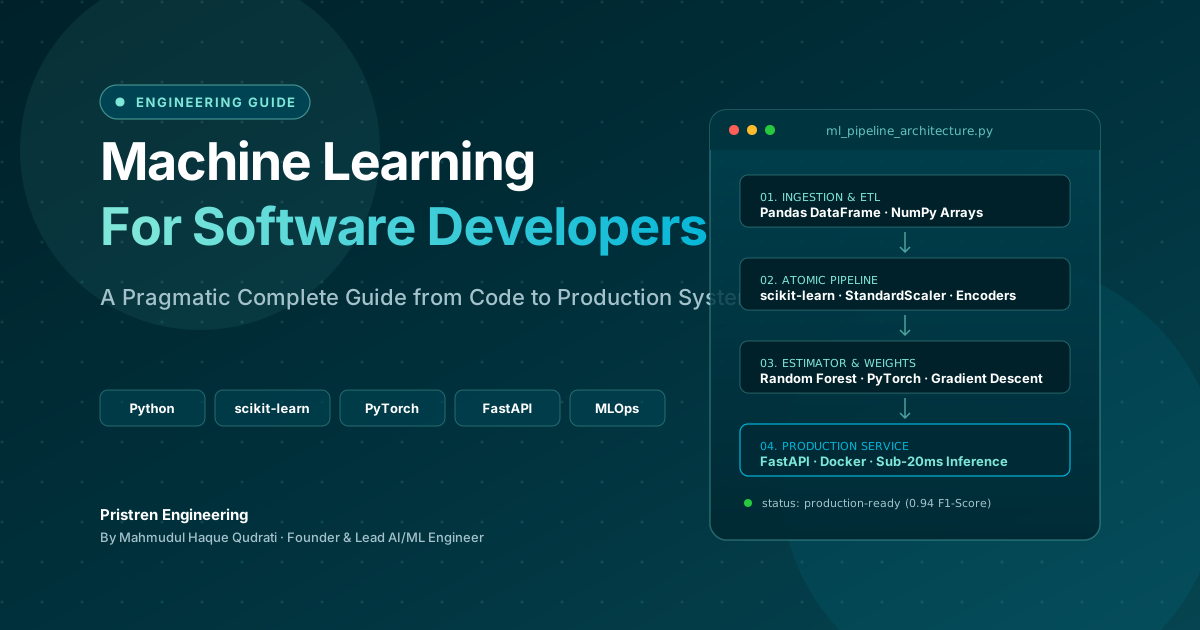
Machine Learning: Complete Guide for Software Developers
Learn machine learning as a software developer with this complete guide covering Python, algorithms, mathematics, projects, deep learning, and a practical roadmap.
 6 min read
How to Use Claude to Make Videos Like Vox and Others
Claude can help you make Vox-style videos by generating scripts, editing with code, and automating animation. Here's a practical guide with real workflows and costs.
 5 min read
OpenAI Ends Cursor Model Access on Nov 12, 2026: What Developers Need to Know
OpenAI will terminate Cursor's access to its models on November 12, 2026, following SpaceX's acquisition. This guide explains the timeline, why it happened, and practical steps to migrate your workflow.
// discussion
Comments