SDXL-Turbo: Real-Time Image Generation in 1-4 Steps
Stability AI's Adversarial Diffusion Distillation compresses SDXL into a 1-step model that generates 512px images in under 200ms - enabling real-time interactive generation.

Mahmudul Haque Qudrati
CEO & ML Engineer
April 8, 2026
7 min read
One AI engineering post, weekly
LLM benchmarks, prompt techniques, and token-cost breakdowns — not another AI news roundup.
Standard diffusion models denoise an image over 20 - 50 steps. Each step requires a full forward pass through a multi-billion parameter UNet, making real-time generation impractical. SDXL-Turbo collapses this to 1 - 4 steps using Adversarial Diffusion Distillation (ADD), without the blurry output that plagues earlier distillation attempts.
How Adversarial Diffusion Distillation Works
ADD combines two loss signals:
- Score distillation loss - the student (SDXL-Turbo) is trained to match the multi-step outputs of a frozen SDXL teacher
- Adversarial loss - a discriminator trained on real images pushes the student to produce sharp, photorealistic outputs even in one step
The adversarial component is the key innovation. Score distillation alone tends to produce over-smoothed images; the discriminator restores high-frequency detail.
python
from diffusers import AutoPipelineForText2Image
import torch

pipe = AutoPipelineForText2Image.from_pretrained(
    "stabilityai/sdxl-turbo",
    torch_dtype=torch.float16,
    variant="fp16",
)
pipe.to("cuda")

# 1-step generation
image = pipe(
    prompt="a golden retriever playing in autumn leaves, cinematic lighting",
    num_inference_steps=1,
    guidance_scale=0.0,  # CFG disabled at 1 step
).images[0]
image.save("output_1step.png")

# 4-step for higher quality
image_4step = pipe(
    prompt="a golden retriever playing in autumn leaves, cinematic lighting",
    num_inference_steps=4,
    guidance_scale=0.0,
).images[0]
image_4step.save("output_4step.png")
Note that CFG (classifier-free guidance) is disabled at 1 step - it hurts quality at this extreme distillation level.
Team workspace
Ship faster with chat, meetings, and projects in one place — Zlyqor.
SDXL-Lightning: ByteDance's Alternative
ByteDance released SDXL-Lightning using a different distillation approach (progressive adversarial distillation). At 4 steps, SDXL-Lightning tends to produce slightly sharper details than SDXL-Turbo, though SDXL-Turbo has better semantic coherence at 1 step. For production use, 4-step SDXL-Lightning is usually the better trade-off.
python
from diffusers import StableDiffusionXLPipeline, EulerDiscreteScheduler
from huggingface_hub import hf_hub_download
import torch

base = "stabilityai/stable-diffusion-xl-base-1.0"
repo = "ByteDance/SDXL-Lightning"
ckpt = "sdxl_lightning_4step_unet.safetensors"

pipe = StableDiffusionXLPipeline.from_pretrained(base, torch_dtype=torch.float16).to("cuda")
pipe.unet.load_state_dict(torch.load(hf_hub_download(repo, ckpt)))
pipe.scheduler = EulerDiscreteScheduler.from_config(pipe.scheduler.config, timestep_spacing="trailing")
Real-Time Interactive Generation
With 1-step generation running at 200ms on an A10G GPU, it becomes possible to regenerate images on every user input event. Gradio's streaming interface combined with SDXL-Turbo enables a slider-controlled real-time generation experience where the image updates as you type.
WebGPU acceleration via the Transformers.js port brings similar (though slower) capability to the browser without a server.
Comparison: SD 1.5 vs SDXL-Turbo
Standard SD 1.5 at 20 steps takes roughly 1.2 seconds on an A10G. SDXL-Turbo at 1 step takes 180ms on the same hardware - a 6.7x speedup - while producing images at significantly higher resolution and quality. The trade-off is the non-commercial license on SDXL-Turbo.
Links
#sdxl-turbo#stability-ai#real-time#add#diffusion
Mahmudul Haque Qudrati
CEO & ML Engineer
Visionary technologist, software engineer, and machine learning specialist. Founder and CEO of Pristren, directing engineering teams that ship production-grade AI/ML pipelines, mission-critical full-stack applications, and developer tooling. Creator of Zlyqor, the unified team workspace platform. Author of 540+ technical guides and benchmark research reports on large language models, agentic workflows, Model Context Protocol (MCP), and modern web stacks.


More from Mahmudul
Related Articles
 11 min read
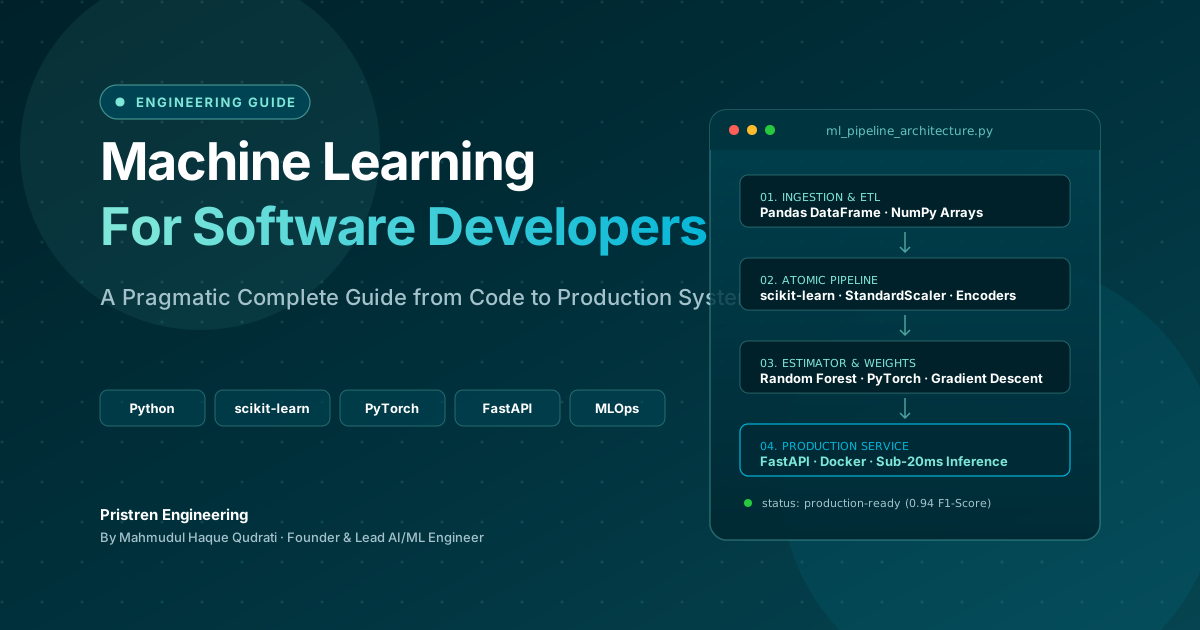
Machine Learning: Complete Guide for Software Developers
Learn machine learning as a software developer with this complete guide covering Python, algorithms, mathematics, projects, deep learning, and a practical roadmap.
 7 min read
ONNX: Export Any ML Model and Run It Anywhere
ONNX (Open Neural Network Exchange) is the universal model format - export from PyTorch, scikit-learn, or HuggingFace and run 3x faster inference with ONNX Runtime on CPU or GPU.
 9 min read
Redis Guide for Developers: Not Just a Cache
Redis is an in-memory data structure store used for caching, sessions, rate limiting, queues, pub/sub, and distributed locks. Here is how to use it well.
// discussion
Comments