XGBoost vs LightGBM vs CatBoost: The Gradient Boosting Showdown
All three gradient boosting libraries beat neural networks on tabular data - but they differ in training speed, categorical handling, and GPU support in ways that matter for your specific use case.

Mahmudul Haque Qudrati
CEO & ML Engineer
April 19, 2026
7 min read
One AI engineering post, weekly
LLM benchmarks, prompt techniques, and token-cost breakdowns — not another AI news roundup.
Despite all the excitement around deep learning, gradient boosting models win most Kaggle tabular competitions and outperform neural networks on structured business data. XGBoost, LightGBM, and CatBoost are the three dominant libraries - each with distinct strengths.
XGBoost: The Industry Standard
XGBoost invented the modern gradient boosting formula. It is the most widely deployed, has the largest community, and integrates with everything.
python
import xgboost as xgb
from sklearn.model_selection import train_test_split

X_train, X_val, y_train, y_val = train_test_split(X, y, test_size=0.2)

model = xgb.XGBClassifier(
    n_estimators=1000,
    learning_rate=0.05,
    max_depth=6,
    subsample=0.8,
    colsample_bytree=0.8,
    use_label_encoder=False,
    eval_metric="logloss",
    early_stopping_rounds=50,
    device="cuda",  # GPU training
)

model.fit(
    X_train, y_train,
    eval_set=[(X_val, y_val)],
    verbose=100,
)
XGBoost uses level-wise (breadth-first) tree growth, which is more regularized but slower than LightGBM.
Team workspace
Ship faster with chat, meetings, and projects in one place — Zlyqor.
LightGBM: Fastest Training
LightGBM is Microsoft's answer to XGBoost. It uses leaf-wise (depth-first) tree growth and Gradient-based One-Side Sampling (GOSS), making it 3-10x faster than XGBoost on large datasets.
python
import lightgbm as lgb

model = lgb.LGBMClassifier(
    n_estimators=1000,
    learning_rate=0.05,
    num_leaves=63,         # key hyperparameter  -  controls model complexity
    min_child_samples=20,  # regularization
    subsample=0.8,
    colsample_bytree=0.8,
    device="gpu",
)

model.fit(
    X_train, y_train,
    eval_set=[(X_val, y_val)],
    callbacks=[lgb.early_stopping(50), lgb.log_evaluation(100)],
)
LightGBM natively handles categorical features with categorical_feature parameter - no one-hot encoding needed.
CatBoost: Best for Categorical Features
CatBoost is Yandex's contribution. Its killer feature is ordered target encoding - it handles categorical features without preprocessing, without leakage, and without manual encoding.
python
from catboost import CatBoostClassifier, Pool

cat_features = ["country", "device_type", "plan_name"]

train_pool = Pool(X_train, y_train, cat_features=cat_features)
val_pool = Pool(X_val, y_val, cat_features=cat_features)

model = CatBoostClassifier(
    iterations=1000,
    learning_rate=0.05,
    depth=6,
    early_stopping_rounds=50,
    task_type="GPU",
    verbose=100,
)

model.fit(train_pool, eval_set=val_pool)
CatBoost also requires no hyperparameter tuning as a baseline - default parameters often give competitive results.
Hyperparameter Tuning with Optuna
python
import optuna
import lightgbm as lgb

def objective(trial):
    params = {
        "n_estimators": trial.suggest_int("n_estimators", 100, 2000),
        "num_leaves": trial.suggest_int("num_leaves", 20, 300),
        "learning_rate": trial.suggest_float("learning_rate", 1e-4, 0.3, log=True),
        "min_child_samples": trial.suggest_int("min_child_samples", 5, 100),
    }
    model = lgb.LGBMClassifier(**params)
    return cross_val_score(model, X_train, y_train, cv=3, scoring="roc_auc").mean()

study = optuna.create_study(direction="maximize")
study.optimize(objective, n_trials=100)
When to Choose Each
- XGBoost: existing codebase, widest ecosystem compatibility, sklearn API
- LightGBM: large datasets (>1M rows), fastest training, many categorical features
- CatBoost: high-cardinality categoricals, want minimal preprocessing, no-code baseline
On most competition datasets, running all three and ensembling beats any single library.
#xgboost#lightgbm#catboost#gradient-boosting#tabular-data
Mahmudul Haque Qudrati
CEO & ML Engineer
Visionary technologist, software engineer, and machine learning specialist. Founder and CEO of Pristren, directing engineering teams that ship production-grade AI/ML pipelines, mission-critical full-stack applications, and developer tooling. Creator of Zlyqor, the unified team workspace platform. Author of 540+ technical guides and benchmark research reports on large language models, agentic workflows, Model Context Protocol (MCP), and modern web stacks.

More from Mahmudul
Related Articles
 11 min read
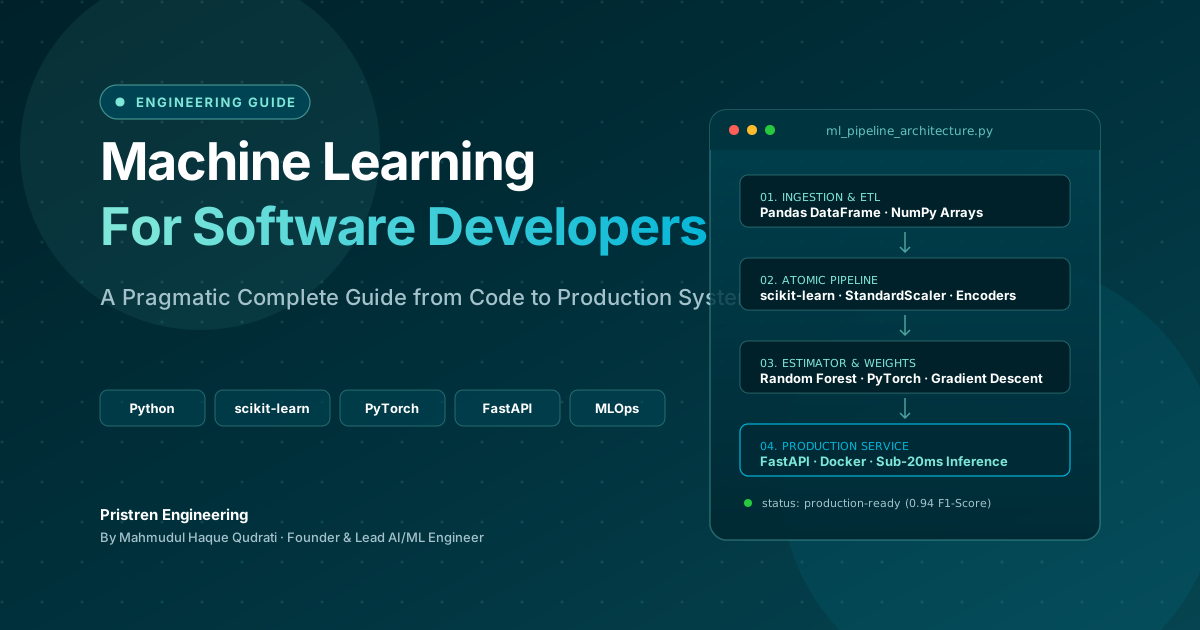
Machine Learning: Complete Guide for Software Developers
Learn machine learning as a software developer with this complete guide covering Python, algorithms, mathematics, projects, deep learning, and a practical roadmap.
 7 min read
ONNX: Export Any ML Model and Run It Anywhere
ONNX (Open Neural Network Exchange) is the universal model format - export from PyTorch, scikit-learn, or HuggingFace and run 3x faster inference with ONNX Runtime on CPU or GPU.
 9 min read
Gradient Descent Explained: How Machine Learning Models Actually Learn
Gradient descent is the engine behind every modern ML model. Here is how it works, why learning rate matters, and when to use Adam over SGD.
// discussion
Comments